
Wholesale Voice Carrier Explained: How It Works 2026
Working with a wholesale voice carrier? See our wholesale VoIP page for live rates and details.
Last updated: September 2026
A wholesale voice carrier is a telecommunications provider that routes large volumes of voice traffic between operators, VoIP providers, mobile networks, and businesses. Instead of selling calling services directly to consumers, wholesale carriers provide network capacity, international voice termination, SIP connectivity, and routing infrastructure that enables reliable global voice communication.
If you’ve ever wondered how an international phone call travels from one country to another in just a few seconds, the answer usually involves a wholesale voice carrier. These companies work behind the scenes, connecting telecom operators, VoIP providers, mobile networks, and enterprises through massive global voice networks.
Most people never hear about wholesale carriers because they don’t sell phone plans to consumers. Instead, they provide the infrastructure that keeps millions of business and international calls moving every day. Without them, global voice communication would be slower, more expensive, and far less reliable.
Whether you’re launching a VoIP business, managing telecom services, or simply trying to understand the industry, knowing how wholesale voice carriers operate is essential.
What Is a Wholesale Voice Carrier?
A wholesale voice carrier is a telecom company that buys, manages, and sells voice traffic capacity between different telecommunications networks.
Rather than serving individual customers, wholesale carriers connect businesses and telecom providers together. They make it possible for calls to travel across countries, mobile operators, landline networks, and cloud communication platforms.
These carriers maintain agreements with hundreds or even thousands of network operators around the world. Because of these partnerships, they can choose the most efficient route for every call while balancing quality, cost, and network availability.
In simple words, they’re the backbone of international voice communication.
How Does a Wholesale Voice Carrier Work?
The process sounds complicated, but the basic idea is actually pretty straightforward.
If you are comparing options, start with our International Voice page.
A customer starts a call
Someone places a call using a business phone system, VoIP platform, or mobile network.
The provider receives the traffic
The originating service provider sends that voice traffic to its wholesale carrier partner.
Intelligent routing begins
The wholesale carrier analyzes available routes using routing engines that consider quality metrics, pricing, latency, and network availability.
The destination network receives the call
The selected carrier delivers the call to the receiving operator in the destination country.
The conversation happens in real time
If everything is optimized correctly, the entire routing process takes only milliseconds.
Why Wholesale Voice Carriers Matter
International voice communication depends on reliability.
Businesses don’t just want cheap calls. They expect crystal-clear audio, minimal delays, stable connections, and consistent uptime.
Wholesale voice carriers make that possible by maintaining global interconnections with telecom operators and continuously monitoring network performance.
Without these carriers, businesses would have to negotiate agreements with hundreds of operators individually, which simply isn’t practical.
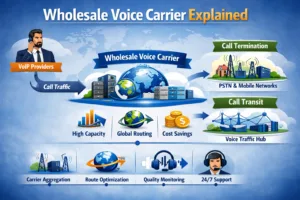
Services Offered by Wholesale Voice Carriers
Most providers offer much more than basic call routing.
Wholesale VoIP Termination
International calls are delivered through optimized voice routes with competitive pricing.
SIP Trunking
Businesses and service providers can connect their PBX systems directly to carrier-grade voice infrastructure.
DID Numbers
Many carriers provide local and international virtual phone numbers for businesses operating across multiple countries.
Voice Routing
Dynamic routing engines automatically select the best path for every call based on live network conditions.
Voice Capacity
High-volume providers can process thousands or even millions of call minutes every day without sacrificing performance.
Who Uses Wholesale Voice Carrier Services?
Wholesale voice isn’t limited to telecom companies.
Many industries rely on these services every single day.
VoIP Providers
VoIP companies use wholesale carriers to terminate international calls and expand their global coverage.
Mobile Operators
Mobile networks exchange international voice traffic with other operators through wholesale partnerships.
Enterprises
Large organizations with global offices often purchase wholesale voice connectivity to reduce communication costs.
Contact Centers
Call centers handling international customer support depend on reliable voice routes to maintain service quality.
Unified Communications Providers
Cloud communication platforms integrate wholesale voice services into their products for worldwide calling.
Benefits of Working With a Wholesale Voice Carrier
Choosing the right carrier can improve both service quality and operating costs.
Some of the biggest advantages include:
Better Call Quality
Carrier-grade infrastructure helps reduce dropped calls, echo, jitter, and latency.
Global Coverage
Many wholesale carriers connect to hundreds of countries through direct operator relationships.
Lower Costs
Buying voice capacity in bulk usually results in lower international calling rates.
Scalability
As your traffic grows, the network can handle additional capacity without major infrastructure changes.
Redundancy
Multiple routing options help keep calls flowing even if one network experiences an outage.
How to Choose the Right Wholesale Voice Carrier
Not every provider offers the same level of performance.
Here are several factors worth evaluating before signing an agreement.
Network Coverage
Look for providers with extensive international reach and strong operator relationships.
Call Quality Metrics
Review ASR, ACD, PDD, and other quality indicators to understand network performance.
Routing Transparency
Reliable carriers clearly explain how traffic is routed and monitored.
Technical Support
Telecom issues don’t follow business hours. Responsive support teams can make a huge difference.
Scalability
Choose a provider that can grow alongside your business without creating bottlenecks.
Security
Voice fraud prevention, traffic monitoring, and secure SIP connectivity should all be standard features.
Common Challenges in Wholesale Voice
Even advanced networks face occasional challenges.
Some of the most common include:
- Fraud and unauthorized traffic
- Poor-quality international routes
- Network congestion
- Number spoofing
- Regulatory compliance
- Capacity planning during traffic spikes
Experienced carriers invest heavily in monitoring systems that detect and resolve these issues quickly.
Future Trends in Wholesale Voice
The wholesale voice industry continues to evolve alongside cloud communications.
Several trends are shaping the market.
AI-Based Routing
Artificial intelligence helps optimize routing decisions based on live network performance.
Cloud Infrastructure
More carriers are replacing traditional hardware with cloud-native telecom platforms.
Analytics
Real-time reporting allows providers to monitor quality, pricing, and traffic instantly.
Improved Fraud Detection
Machine learning helps identify suspicious traffic patterns before they become expensive problems.
Automation
Provisioning, routing updates, and traffic management are becoming increasingly automated.
Final Thoughts
Wholesale voice carriers rarely receive public attention, yet they play a critical role in global telecommunications. Every day, they help businesses, telecom operators, and VoIP providers deliver millions of voice calls across continents with speed and reliability.
Choosing the right wholesale voice carrier isn’t only about finding the lowest price. It’s about selecting a partner with strong network coverage, dependable call quality, responsive technical support, and the ability to scale as your business grows.
As international communications continue moving toward cloud-based infrastructure, wholesale voice carriers will remain one of the most important components of the global telecom ecosystem.
Frequently Asked Questions
What is a wholesale voice carrier?
A wholesale voice carrier is a telecom provider that transports voice traffic between operators, VoIP providers, enterprises, and communication platforms rather than selling phone services directly to consumers.
What’s the difference between a wholesale carrier and a retail provider?
Retail providers sell phone services to end users, while wholesale carriers supply network connectivity and voice routing to other telecom businesses.
Do wholesale voice carriers only support international calls?
No. They can handle both domestic and international voice traffic depending on their network coverage and commercial agreements.
Why do VoIP providers use wholesale voice carriers?
Wholesale carriers provide global connectivity, competitive pricing, high-capacity routing, and reliable call delivery without requiring VoIP providers to build their own worldwide telecom network.
For broader context, see the Wikipedia entry on voice carrier.
What should businesses look for in a wholesale voice carrier?
Businesses should evaluate network coverage, call quality, routing performance, security, technical support, pricing transparency, and scalability before choosing a provider.
Last edit: October 6, 2026 - 17:22 by ENG. Hisham Mohamed
Eng. Hisham Mohamed is a telecommunications specialist with over 8 years of experience in VoIP, SIP termination, telecom infrastructure, voice services, and modern communication solutions. He is also a professional technical writer covering telecommunications, VoIP, cloud communication, and digital transformation.

Written by
ENG. Hisham Mohamed
Eng. Hisham Mohamed is a telecommunications specialist with over 8 years of experience in VoIP, SIP termination, telecom infrastructure, voice services, and modern communication solutions. He is also a professional technical writer covering telecommunications, VoIP, cloud communication, and digital transformation.