
What Is SIP Termination? 2026 Guide for VoIP & Telecom
What is SIP termination?
SIP termination is the process of routing outbound voice calls over the internet using the Session Initiation Protocol (SIP). It allows businesses, carriers, and VoIP providers to connect calls to traditional telephone networks or mobile networks at lower costs while maintaining high call quality.
Introduction
If you’ve ever made an international business call over a VoIP system, there’s a good chance SIP termination was working behind the scenes.
Last updated: September 2026
Most people hear terms like SIP trunking, VoIP termination, and SIP routing without really knowing the difference. That’s normal because these technologies work together and often overlap. Still, understanding SIP termination matters if you’re running a business phone system, managing a contact center, or providing telecom services.
In simple words, SIP termination is what takes your internet-based voice call and delivers it to the person you’re trying to reach, whether they’re using a mobile phone, a landline, or another VoIP service. It sounds simple, but there’s actually a lot happening in just a few seconds.
This guide explains everything you need to know, without making it more complicated than it needs to be.
What Is SIP Termination?
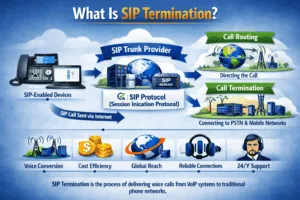
SIP termination is the process of delivering an outgoing SIP call from a VoIP network to its final destination.
The call begins as internet traffic using the Session Initiation Protocol. Once it reaches a SIP termination provider, the provider routes the call through the best available network until it reaches the recipient.
The destination could be:
- Mobile phones
- Landlines
- Business phone systems
- International telecom carriers
- Other VoIP networks
Think of the SIP termination provider as the transportation company that finds the fastest and most reliable route for every phone call.
Without SIP termination, internet voice calls wouldn’t be able to connect with the global telephone network.
How SIP Termination Works
Although the technology behind SIP termination is advanced, the basic process is pretty easy to understand.
Step 1: A Call Starts
Someone places a call using a VoIP phone, IP PBX, softphone, or cloud phone system.
Instead of using traditional phone lines, the call is converted into SIP packets and sent over the internet.
Step 2: The SIP Provider Receives the Call
The SIP termination provider receives the request and analyzes information like:
- Destination number
- Country
- Carrier availability
- Route quality
- Current network performance
Step 3: Intelligent Route Selection
Modern providers don’t simply send every call through one network.
Instead they compare multiple routes in real time and choose the one offering the best balance between quality, reliability, and cost.
Step 4: Delivery to the Destination
The provider hands the call over to the destination carrier.
The receiving carrier completes the connection to the recipient’s mobile phone, office phone, or landline.
All of this usually happens in less than a second.
SIP Termination vs SIP Trunking
Many people confuse these two services.
Here’s the difference.
| SIP Termination | SIP Trunking |
|---|---|
| Handles outgoing call delivery | Connects your PBX to the internet |
| Routes calls worldwide | Replaces traditional phone lines |
| Used by carriers and businesses | Mainly used by businesses |
| Focuses on outbound traffic | Supports both inbound and outbound communications |
A company can use SIP trunking to connect its phone system while relying on SIP termination to deliver outbound calls globally.
Why Businesses Use SIP Termination
Companies move to SIP termination because it offers advantages that traditional phone systems simply can’t match.
Lower Calling Costs
International calls become significantly cheaper because calls travel over IP networks instead of expensive legacy infrastructure.
Businesses making thousands of calls every month can reduce communication costs quite a bit.
Better Global Coverage
Most providers support hundreds of countries and thousands of telecom operators around the world.
That means businesses can reach customers almost anywhere.
High Call Quality
Premium SIP termination providers monitor their routes continuously.
If one carrier experiences problems, traffic is automatically moved to another route before users even notice.
Easy Scalability
Need ten simultaneous calls?
No problem.
Need ten thousand?
That’s possible too, assuming the provider has enough network capacity.
This flexibility makes SIP termination ideal for growing companies.
Who Uses SIP Termination?
SIP termination isn’t just for telecom operators anymore.
Today it’s used by many different industries.
Including:
- VoIP providers
- Wholesale carriers
- Call centers
- Enterprises
- Cloud PBX providers
- Unified communications platforms
- International businesses
- Customer support centers
Basically, if an organization makes a large number of outbound calls, SIP termination can usually improve efficiency while reducing costs.
Types of SIP Termination
Not every SIP termination service is the same.
Wholesale SIP Termination
Designed for telecom carriers, VoIP operators, and resellers handling massive call volumes.
Pricing is usually based on minutes.
Enterprise SIP Termination
Built for businesses that need reliable outbound calling without managing carrier relationships directly.
Premium SIP Termination
Uses higher quality routes that prioritize call clarity and reliability.
These routes typically deliver:
- Higher ASR
- Better ACD
- Lower packet loss
- Fewer failed calls
Standard SIP Termination
A lower-cost option suitable for companies where price matters more than achieving the absolute highest quality.
Key Features of a Good SIP Termination Provider
Not every provider delivers the same performance.
When evaluating providers, pay attention to these features.
Route Quality
Reliable providers constantly monitor route performance.
Poor routes should automatically be removed before they affect customers.
Competitive Rates
Cheap isn’t always better.
The goal is finding the best balance between quality and pricing.
Global Coverage
The more destinations available, the easier it becomes to expand internationally.
Network Redundancy
Multiple carrier connections help prevent outages.
If one carrier fails, traffic switches automatically.
Fraud Protection
Voice fraud remains a serious issue.
Good providers offer real-time monitoring, traffic analysis, and security controls to minimize risk.
24/7 Technical Support
Telecom networks don’t stop overnight.
Support shouldn’t either.
SIP Termination Quality Metrics You Should Know
Professional telecom companies don’t judge providers based only on price.
They also monitor network performance.
ASR
Answer-Seizure Ratio measures how many attempted calls are successfully answered.
Higher percentages generally indicate healthier routes.
ACD
Average Call Duration shows how long connected calls typically last.
Extremely low ACD values may indicate poor routing or customer dissatisfaction.
PDD
Post Dial Delay measures the time between dialing and hearing the destination ring.
Lower PDD creates a much better customer experience.
Jitter
Jitter measures variation in packet arrival times.
Too much jitter can make conversations sound broken or robotic.
Packet Loss
Lost voice packets reduce call quality and can even disconnect conversations.
Professional providers work to keep packet loss extremely low.
Benefits of Wholesale SIP Termination
Wholesale SIP termination provides several additional benefits for telecom companies.
These include:
- Large-scale routing capacity
- Direct carrier interconnections
- Better pricing for high volumes
- Flexible routing options
- Redundant international connectivity
- High availability infrastructure
For providers serving thousands of customers, wholesale SIP termination becomes an essential part of the network.
Common Challenges
Like any communication technology, SIP termination has its challenges.
Some common issues include:
- Congested carrier routes
- International regulatory restrictions
- Fraud attempts
- Network outages
- Poor route management
- Codec compatibility problems
Working with an experienced provider reduces these risks significantly.
How to Choose the Right SIP Termination Provider
Before signing with any provider, ask yourself a few questions.
- Do they publish quality metrics?
- Is their network geographically diverse?
- Do they offer premium and standard routes?
- Can they support future growth?
- Is technical support available around the clock?
- Do they provide fraud protection?
- Are routing policies transparent?
- Can they customize routing for different destinations?
A provider that performs well in these areas will usually deliver better long-term value than simply choosing the lowest price.
Future of SIP Termination
The telecom industry continues to evolve.
Artificial intelligence is already helping providers optimize routing decisions in real time.
Cloud-native telecom platforms are making networks more flexible than ever before.
Automation is reducing downtime.
Real-time analytics are improving route quality.
Meanwhile, 5G and cloud communications continue expanding the demand for high-performance SIP termination services across global markets.
Frequently Asked Questions
Is SIP termination the same as VoIP termination?
Not exactly.
SIP termination specifically uses the SIP protocol to deliver voice calls, while VoIP termination is a broader term covering multiple voice technologies.
Is SIP termination secure?
Yes.
Most professional providers support encryption, authentication, fraud monitoring, and secure signaling to protect voice traffic.
Who needs SIP termination?
Businesses making international calls, call centers, telecom carriers, cloud PBX providers, and VoIP operators all benefit from SIP termination.
Does SIP termination improve call quality?
A high-quality provider certainly can.
Route optimization, direct carrier connections, and continuous monitoring all contribute to clearer voice calls.
Can SIP termination reduce communication costs?
Absolutely.
Using IP-based routing often lowers domestic and international calling expenses compared with traditional telephone networks.
Final Thoughts
SIP termination is one of the core technologies behind modern business communications. Every outbound VoIP call depends on reliable routing to reach its destination, and that’s exactly what SIP termination delivers.
Whether you’re a growing company looking to reduce phone costs, a cloud communications provider expanding globally, or a wholesale carrier managing millions of call minutes, choosing the right SIP termination service can have a direct impact on call quality, customer experience, and operating costs.
As voice communications continue shifting toward cloud infrastructure and IP networks, SIP termination will remain a critical building block for reliable global connectivity.
Want to understand how wholesale VoIP termination works end to end? See our complete Wholesale VoIP Termination guide.
Last edit: October 6, 2026 - 17:21 by ENG. Hisham Mohamed
Eng. Hisham Mohamed is a telecommunications specialist with over 8 years of experience in VoIP, SIP termination, telecom infrastructure, voice services, and modern communication solutions. He is also a professional technical writer covering telecommunications, VoIP, cloud communication, and digital transformation.

Written by
ENG. Hisham Mohamed
Eng. Hisham Mohamed is a telecommunications specialist with over 8 years of experience in VoIP, SIP termination, telecom infrastructure, voice services, and modern communication solutions. He is also a professional technical writer covering telecommunications, VoIP, cloud communication, and digital transformation.