
What Is VoIP Termination? Types & Key Uses
Choosing a termination partner? See our wholesale VoIP page for live rates and details.
Last updated: September 2026
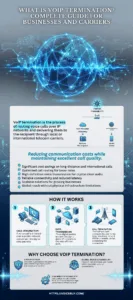
If you have ever wondered what happens to a VoIP call after it leaves a business phone system, the answer is often VoIP termination. VoIP termination is the process of delivering an internet-based voice call to its final destination, such as a mobile phone, landline, or another voice network.
In simple terms, termination is the part of a voice connection that gets the call to the person being called. A business, telecom operator, MVNO, or VoIP provider can use a termination service to connect outbound SIP or VoIP traffic to local and international telephone networks.
This guide explains what VoIP termination means, the main types, how it differs from origination and transit, and where carriers and businesses use it.
What Is VoIP Termination?
VoIP termination is the delivery of a voice call from an IP-based communications network to its destination network.
For example, imagine a company in the United States using a cloud PBX to call a mobile number in Germany.
The call may start inside the company’s IP network, travel through a VoIP provider, and then be handed to a carrier that can deliver it to the German mobile network.
That final delivery is the termination part of the call.
A simple way to remember it is:
VoIP termination = getting an outbound VoIP call to its destination.
The destination can be:
- A mobile phone
- A fixed-line telephone
- A PSTN network
- Another VoIP network
- A business PBX or SIP endpoint
VoIP termination is commonly used by telecom operators, wholesale carriers, MVNOs, cloud communications companies, contact centers, and businesses with significant outbound calling traffic.
How Does VoIP Termination Work?
The technical process can be complex inside a carrier network, but the basic idea is straightforward.
A typical outbound call follows this path:
Caller → IP/PBX network → VoIP provider → carrier route → destination network → recipient
For example:
US business → SIP connection → VoIP carrier → German carrier → German mobile number
The VoIP provider identifies the destination number and determines how the call should be delivered.
Routing decisions can depend on factors such as:
- Destination country and operator
- Available carrier routes
- Route quality
- Cost
- Capacity
- Historical call performance
- Regulatory requirements
SIP is commonly used to control VoIP sessions. The IETF’s RFC 3261 defines SIP as an application-layer signaling protocol for creating, modifying, and terminating communication sessions.
The important point is that SIP handles signaling and session control, while the termination service is responsible for helping deliver the outbound call toward its destination.
What Are the Main Types of VoIP Termination?
VoIP termination can be described in several ways depending on the network, customer, and destination.
SIP Termination
SIP termination uses SIP-based connectivity to send voice traffic from a customer’s communications infrastructure toward a carrier or voice network.
A company may connect its PBX, SBC, softswitch, or communications platform to a provider using SIP.
For example:
Business PBX → SIP trunk → VoIP provider → PSTN
SIP is particularly common in enterprise voice, cloud PBX, contact center, and carrier environments.
Wholesale VoIP Termination
Wholesale VoIP termination is designed for organizations that handle larger volumes of voice traffic.
Typical users include:
- Telecom operators
- Wholesale VoIP carriers
- MVNOs
- VoIP resellers
- Contact center operators
- UCaaS providers
The main difference is scale. A wholesale customer may need multiple destinations, carrier-grade routing, higher capacity, and commercial agreements designed around voice traffic.

International VoIP Termination
International VoIP termination is used when calls need to be delivered across national borders.
For example:
UK VoIP platform → international termination → UAE mobile network
The provider needs suitable carrier connectivity in the destination market. The available routes, regulations, numbering requirements, and commercial conditions can differ significantly from one country to another.
Direct and Aggregated Termination
Some providers use direct carrier interconnections for particular destinations, while others may aggregate capacity from multiple carriers.
For a buyer, the important question is not simply whether a destination is available. It is also whether the route provides the required quality, stability, CLI behavior, capacity, and commercial terms.
VoIP Termination vs Origination
One of the easiest ways to understand termination is to compare it with origination.
| Service | Basic meaning | Typical direction |
|---|---|---|
| VoIP Termination | Delivers an outbound call to its destination | IP network → telephone network |
| VoIP Origination | Brings an inbound call into an IP network | Telephone network → IP network |
| Transit | Carries traffic between networks or carriers | Network → network |
Termination Example
A customer in a US contact center calls a mobile number in France.
Contact center → VoIP provider → French carrier → mobile user
This is termination.
Origination Example
A customer calls a business number.
Mobile user → carrier network → VoIP provider → business PBX
This is origination.
Transit Example
A carrier does not directly connect the call to the final destination and instead passes traffic through another carrier network.
Carrier A → Carrier B → Carrier C → destination
Transit is therefore about carrying traffic between networks, while termination focuses on completing the call to its destination.
Keeping these three concepts separate is important when comparing telecom services and network agreements.
Why Do Businesses and Carriers Use VoIP Termination?
VoIP termination is useful whenever an organization needs to send voice traffic outside its own IP network.
Telecom Operators
Telecom operators may use termination partners to extend their international coverage without establishing direct interconnections with every destination carrier.
MVNOs
MVNOs may need voice connectivity for subscribers while relying on external telecom infrastructure for parts of the voice network.
Contact Centers
International contact centers can use termination services to deliver large numbers of outbound calls to customers in different countries.
Cloud PBX Providers
Cloud PBX platforms can use SIP termination to connect customer extensions with mobile and fixed-line networks.
VoIP Resellers
Resellers can use wholesale termination capacity instead of building their own carrier relationships in every destination market.
International Businesses
Companies operating across multiple countries may use VoIP termination to connect their business communications with international telephone networks.
What Affects VoIP Termination Quality?
Not every route performs the same way.
When evaluating termination, carriers commonly look at operational metrics such as ASR, ACD, and PDD.
ASR
Answer-Seizure Ratio (ASR) indicates the percentage of call attempts that result in an answered call.
A consistently poor ASR can indicate problems with routing, destination reachability, traffic quality, or other network conditions.
ACD
Average Call Duration (ACD) measures the average length of connected calls.
It can help carriers identify unusual traffic patterns and evaluate route performance, although ACD should not be treated as a standalone measure of voice quality.
PDD
Post-Dial Delay (PDD) refers to the time between initiating a call and receiving the initial ringing or call progress.
High PDD can create a noticeable delay for callers.
Route Selection
The selected carrier route can have a direct impact on call performance.
A routing platform may consider:
- Destination
- Carrier availability
- Cost
- Capacity
- Historical performance
- Failover options
For high-volume traffic, route selection becomes more important because a small difference in performance can affect a large number of calls.
Does VoIP Termination Mean the Same as SIP Termination?
Not exactly.
VoIP termination is the broader concept of delivering an IP-based voice call to its destination.
SIP termination refers specifically to termination using SIP-based signaling and connectivity.
SIP is a signaling protocol used to establish, modify, and terminate sessions.
So SIP termination can be considered one common implementation of VoIP termination rather than a completely separate voice service.
A Simple VoIP Termination Example
Consider a US-based contact center that calls customers in Spain.
The contact center has its own VoIP platform and sends outbound traffic through a SIP connection.
The basic scenario looks like this:
Contact Center
↓
SIP / IP Network
↓
VoIP Termination Provider
↓
Selected Spanish Carrier Route
↓
Spanish Mobile or Fixed Network
↓
Customer
The contact center does not need to build a direct relationship with every destination carrier itself.
Instead, the termination provider supplies the connectivity and routing needed to complete the call.
This is one reason termination services are important for companies operating internationally.
VoIP Termination and Route Selection
Termination is not only about reaching a destination. For carriers, the route selected for each destination can affect both economics and call performance.
A routing engine may compare available routes based on:
- Destination
- Carrier availability
- Quality history
- ASR
- ACD
- PDD
- Cost
- Capacity
- Failover availability
This is where Least Cost Routing (LCR) can become relevant.
LCR attempts to select an available route based heavily on cost while applying the rules configured by the operator.
However, the cheapest route is not automatically the best route for every traffic type. A carrier may choose a more expensive route when quality, CLI requirements, reliability, or customer expectations are more important.
What Is the Difference Between VoIP Termination and Wholesale VoIP?
These terms are related but they are not identical.
VoIP termination describes a specific function: delivering voice traffic to its destination.
Wholesale VoIP describes a broader B2B commercial model in which voice capacity and related services are supplied to carriers, resellers, operators, and other service providers.
A wholesale provider can therefore offer VoIP termination as one of its core services.
If you are researching the wider wholesale model, see our guide to wholesale VoIP.
What Should You Check Before Choosing a Termination Service?
If you are buying termination for a business or telecom operation, do not compare providers only by the advertised rate.
Check:
Destination Coverage
Make sure the provider can support the countries and operators you actually need.
Route Quality
Ask how route performance is monitored and whether alternative routes are available.
SIP Compatibility
Confirm that the provider supports the SIP configuration and connectivity model used by your PBX, SBC, softswitch, or platform.
Performance Reporting
For larger traffic volumes, access to call statistics can help you monitor ASR, ACD, PDD, failures, and routing performance.
Failover
Ask what happens if the preferred route becomes unavailable.
Commercial Terms
Review billing increments, minimum commitments, route-specific conditions, and any restrictions that apply to your traffic.
Frequently Asked Questions
What is VoIP termination?
VoIP termination is the process of delivering an outbound voice call from an IP-based network to its final destination, such as a mobile phone, landline, or another voice network.
What is an example of VoIP termination?
A US business sends a VoIP call to a mobile number in Germany through a carrier. The provider routes the call to a German telecom network that connects the call to the mobile user. That delivery is VoIP termination.
What is the difference between VoIP termination and origination?
Termination generally refers to outbound traffic being delivered to a destination network. Origination generally refers to inbound traffic coming from a telephone network into an IP-based communications system.
Is SIP termination the same as VoIP termination?
No. VoIP termination is the broader concept. SIP termination specifically uses SIP signaling and connectivity as part of the voice service.
Who uses wholesale VoIP termination?
Telecom operators, MVNOs, wholesale carriers, VoIP providers, contact centers, cloud communications companies, and resellers can all use wholesale termination services.
Does VoIP termination work internationally?
Yes. International VoIP termination is commonly used to deliver calls between countries, although route availability, numbering, regulations, quality, and commercial conditions vary by destination.
What metrics are important for VoIP termination?
ASR, ACD, and PDD are commonly used operational indicators. Route availability, capacity, latency, and failover options can also matter depending on the traffic.
Final Takeaway
VoIP termination is essentially the delivery stage of an outbound IP voice call. It connects traffic from a VoIP, SIP, PBX, or carrier network to the destination network where the called party can be reached.
For a business, understanding termination helps clarify how outbound international calls are delivered.
For a carrier or MVNO, the topic becomes more important because route quality, destination coverage, capacity, and routing decisions can directly affect the customer experience and the economics of voice traffic.
If you are looking for an actual termination solution rather than only an explanation of the technology, explore VoiceBuy’s VoIP termination services for carrier and business voice connectivity.
Ready to Explore VoIP Termination?
If you need international voice termination, SIP connectivity, or wholesale routes, VoiceBuy can help you evaluate the right routing option for your traffic. For broader context, see the Wikipedia entry on VoIP.
Explore VoIP Termination or request routes and rates from VoiceBuy.
Buying wholesale minutes? Read our wholesale VoIP termination guide first, then compare live rates on the wholesale routing page.
Last edit: October 6, 2026 - 17:22 by ENG. Hisham Mohamed
Eng. Hisham Mohamed is a telecommunications specialist with over 8 years of experience in VoIP, SIP termination, telecom infrastructure, voice services, and modern communication solutions. He is also a professional technical writer covering telecommunications, VoIP, cloud communication, and digital transformation.

Written by
ENG. Hisham Mohamed
Eng. Hisham Mohamed is a telecommunications specialist with over 8 years of experience in VoIP, SIP termination, telecom infrastructure, voice services, and modern communication solutions. He is also a professional technical writer covering telecommunications, VoIP, cloud communication, and digital transformation.