
What Is Wholesale VoIP? The Complete 2026 Guide for Carriers, Resellers & Telecom Businesses
Quick Answer
Last updated: September 2026
Wholesale VoIP is a business-to-business (B2B) telecommunications service that enables carriers, service providers, contact centers, and resellers to purchase voice traffic in bulk at carrier rates. Instead of building expensive global telecom infrastructure, businesses connect to established wholesale carriers that provide SIP connectivity, international voice termination, DID numbers, and carrier-grade routing across hundreds of destinations.
Today, wholesale VoIP powers everything from international calling platforms and cloud PBX providers to CPaaS applications and enterprise communications.

What Is Wholesale VoIP?
Wholesale VoIP (Voice over Internet Protocol) is the large-scale buying and selling of voice services over IP networks. Unlike retail VoIP, which is designed for individual businesses and end users, wholesale VoIP focuses on organizations that process thousands—or even millions—of call minutes every month.
Rather than investing millions of dollars in international carrier agreements, switching equipment, and interconnection infrastructure, telecom companies purchase wholesale voice services from specialized providers. Those providers already maintain direct relationships with carriers around the world, allowing customers to access global voice networks almost instantly.
Think of wholesale VoIP as the telecommunications equivalent of a wholesale distribution network.
A supermarket doesn’t manufacture every product it sells. Instead, it purchases inventory in bulk from wholesalers and supplies it to customers. Wholesale VoIP follows the same business model. Providers supply voice capacity in bulk, while carriers, resellers, and communication platforms package those services for their own customers.
This model dramatically reduces deployment costs, shortens time-to-market, and gives smaller providers access to the same global voice infrastructure used by major telecom operators.
Who Uses Wholesale VoIP?
Wholesale VoIP supports a wide range of telecommunications businesses, not just traditional carriers.
Typical customers include:
- International telecom carriers
- VoIP service providers
- SIP trunking providers
- Hosted PBX companies
- UCaaS providers
- CPaaS platforms
- MVNO operators
- Contact centers
- BPO companies
- Wholesale voice resellers
- Internet service providers
- Software companies building voice applications
- Large enterprises managing global communications
Whether a business is routing outbound traffic, terminating international calls, or providing cloud communications to customers, wholesale VoIP forms the backbone of its voice infrastructure.
The Wholesale VoIP Ecosystem
One of the biggest misconceptions is that a wholesale VoIP provider operates independently. In reality, every international phone call passes through a connected ecosystem of carriers, routing platforms, and network operators.
A simplified view looks like this:
End User
      │
Business PBX / Softphone
      │
VoIP Provider
      │
Wholesale VoIP Provider
      │
Tier-1 or Tier-2 Carrier
      │
National Telecom Network
      │
Destination Phone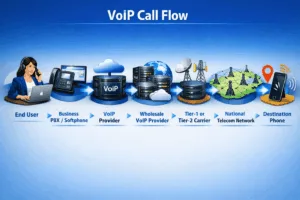
Every participant plays a different role.
Tier-1 carriers own major international backbone networks and maintain direct interconnections with operators worldwide.
Wholesale carriers aggregate these connections, optimize routing, monitor quality, and provide commercial access to businesses.
VoIP providers purchase wholesale capacity and deliver voice services under their own brand.
Finally, businesses and consumers make and receive calls without ever seeing the complex infrastructure working behind the scenes.
Understanding this ecosystem is essential because call quality, latency, and pricing all depend on how efficiently these networks connect together.
How Wholesale VoIP Works
Although modern voice networks are incredibly sophisticated, the process behind a wholesale VoIP call can be broken into a series of straightforward steps.
Step 1 — A Call Is Initiated
A customer places a call using a SIP phone, IP PBX, mobile application, or softphone.
Instead of traveling through traditional copper telephone lines, the call is converted into digital packets and transmitted over an IP network.
Step 2 — Authentication and Routing
The request reaches the provider’s switching platform.
Here the system verifies:
- SIP credentials
- Account permissions
- Available balance or billing profile
- Destination number
- Codec compatibility
- Security policies
If everything passes validation, the routing engine searches for the most suitable carrier.
Step 3 — Least Cost Routing (LCR)
The routing platform compares multiple available carriers simultaneously.
Rather than always choosing the cheapest option, modern LCR engines evaluate both cost and quality using metrics such as:
- ASR (Answer-Seizure Ratio)
- ACD (Average Call Duration)
- PDD (Post Dial Delay)
- Historical route performance
- Network congestion
- Route availability
The system automatically selects the route that provides the best balance between quality and price.
Step 4 — Call Termination
Once the best route is selected, the wholesale carrier forwards the call toward the destination network.
If the recipient uses a traditional phone number, the call eventually reaches the Public Switched Telephone Network (PSTN).
If the recipient is another VoIP user, the call may remain entirely within IP networks without touching the PSTN at all.
Step 5 — Continuous Quality Monitoring
Unlike consumer VoIP services, wholesale platforms monitor every route continuously.
Carrier-grade monitoring systems automatically detect:
- Failed routes
- Rising latency
- Packet loss
- Fraud attempts
- Congestion
- Decreasing ASR
- Increasing PDD
If a route begins to perform poorly, traffic can be redirected to an alternative carrier in seconds without disrupting service.
Wholesale VoIP Architecture
Behind every successful wholesale provider is a highly resilient telecom infrastructure designed for scalability, redundancy, and intelligent routing.
A simplified architecture looks like this:
Customer
     │
 SIP Trunk
     │
Session Border Controller (SBC)
     │
Softswitch
     │
Routing Engine (LCR)
     │
Fraud Detection
     │
Billing Platform
     │
Carrier Network
     │
PSTN / Mobile Operator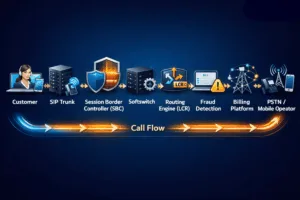
Each layer performs a specific function:
- Session Border Controller (SBC): Secures SIP traffic, manages sessions, and protects the network from unauthorized access.
- Softswitch: Controls call signaling, routing decisions, and interoperability between networks.
- Routing Engine: Selects the optimal carrier using cost, quality, and real-time performance data.
- Fraud Detection Platform: Identifies suspicious traffic patterns such as IRSF attacks, CLI spoofing, or traffic pumping.
- Billing Platform: Calculates usage, applies rate decks, generates invoices, and monitors customer balances.
- Carrier Interconnections: Deliver calls to regional operators, mobile networks, or international telecom carriers.
This layered architecture allows wholesale providers to process millions of concurrent call attempts while maintaining high availability and consistent call quality.
Why SIP Is the Foundation of Wholesale VoIP
The vast majority of wholesale voice networks rely on the Session Initiation Protocol (SIP) as the standard signaling protocol for establishing and managing voice sessions.
SIP makes it possible to:
- Establish voice calls between carriers.
- Route calls across multiple networks.
- Authenticate customers securely.
- Scale capacity without installing new physical circuits.
- Connect cloud PBX platforms, SBCs, and softswitches seamlessly.
Because SIP is vendor-neutral and widely supported, it has become the global standard for wholesale voice interconnection, replacing many legacy telecom technologies.
Core Wholesale VoIP Services Explained
Wholesale VoIP is not a single product. It is a collection of carrier-grade services that allow businesses to build, operate, and scale communication platforms without owning a global telecom network.
Understanding these services helps you choose the right provider and avoid paying for capabilities you don’t actually need.
VoIP Termination
Voice termination is the core service offered by every wholesale VoIP provider.
When a customer places an outbound call, the provider is responsible for delivering that call to its final destination—whether that’s a mobile network, landline, or another VoIP platform.
For example:
A company in Germany calls a customer in Brazil.
Instead of negotiating directly with Brazilian telecom operators, the company sends the call to its wholesale provider, which selects the most efficient carrier route and completes the call.
Good termination providers focus on three things:
- High call completion rates
- Low latency
- Stable pricing
Premium providers continuously monitor route quality and automatically reroute traffic if performance drops.
VoIP Origination
Origination is the opposite of termination.
Instead of sending calls out, origination allows businesses to receive inbound calls from the Public Switched Telephone Network (PSTN).
Companies typically purchase:
- Local DID numbers
- National numbers
- Toll-free numbers
- International virtual numbers
This allows businesses to establish a local presence in multiple countries without opening physical offices.
A company headquartered in London can own local phone numbers in New York, Sydney, Paris, and Dubai while answering every call from a single cloud platform.
SIP Trunking
SIP trunking connects an organization’s PBX system directly to IP-based carrier networks.
Instead of using expensive ISDN or PRI circuits, businesses route voice traffic through secure internet connections.
Benefits include:
- Lower operating costs
- Flexible scalability
- Easier disaster recovery
- Global coverage
- Rapid deployment
For enterprises replacing legacy phone systems, SIP trunking is usually the first step toward modern cloud communications.
DID Numbers
Direct Inward Dialing (DID) numbers are virtual telephone numbers assigned by wholesale providers.
These numbers allow customers to receive inbound calls without requiring dedicated physical telephone lines.
Businesses use DIDs for:
- Local customer support
- International expansion
- Sales offices
- Remote employees
- Contact centers
Modern providers can activate new DIDs within minutes rather than days.
Toll-Free Services
Wholesale providers also supply toll-free number ranges.
These numbers increase customer trust because callers are not charged for reaching the business.
Common examples include:
- 800
- 888
- 877
- 866
Large enterprises often maintain hundreds of toll-free numbers across different countries for customer support and marketing campaigns.
International A–Z Voice Termination
One of the most valuable wholesale services is A–Z termination.
This means the provider can terminate calls to virtually every destination worldwide.
However, not all A–Z coverage offers the same quality.
Premium carriers typically provide:
- Direct routes
- CLI support
- Better ASR
- Lower PDD
- Higher reliability
Low-cost providers often rely on multiple intermediaries, increasing latency and reducing call quality.
Wholesale VoIP Infrastructure
Many people think wholesale VoIP simply means buying cheap call minutes.
In reality, carrier-grade providers operate complex global infrastructures capable of processing millions of concurrent calls.
A modern wholesale platform normally includes:
- Multiple global data centers
- Geo-redundant Points of Presence (PoPs)
- Carrier interconnections
- Session Border Controllers
- Softswitch clusters
- Distributed billing systems
- Monitoring platforms
- Security appliances
- Fraud detection engines
- Network analytics
Every component contributes to service availability and call quality.
The Technical Components Behind Wholesale VoIP
Understanding the technology behind wholesale voice services makes it easier to evaluate providers.
Session Border Controller (SBC)
The SBC is the security gateway of a VoIP network.
It protects SIP sessions while ensuring reliable communication between different carriers.
Its responsibilities include:
- SIP security
- NAT traversal
- Encryption
- Traffic control
- Call admission control
- Topology hiding
- DoS protection
Without SBCs, carrier networks would be significantly more vulnerable to attacks and service disruptions.
Softswitch
The softswitch is the brain of a wholesale voice platform.
It decides how every call should be processed.
Responsibilities include:
- Call routing
- SIP signaling
- Authentication
- Number translation
- Codec negotiation
- Billing integration
A high-performance softswitch can process thousands of simultaneous call requests every second.
Least Cost Routing (LCR) Engine
The routing engine evaluates multiple carrier routes before every call.
It compares:
- Price
- ASR
- ACD
- PDD
- Route availability
- Historical performance
Rather than selecting the cheapest provider, intelligent routing balances both quality and profitability.
Media Gateway
Media gateways connect IP networks with traditional telephone infrastructure.
Whenever a call moves between VoIP and the PSTN, media gateways perform protocol conversion.
This allows modern cloud communication systems to interact with legacy telecom networks.
RTP Media Streams
While SIP controls signaling, RTP (Real-time Transport Protocol) transports the actual voice packets.
Poor RTP performance usually results in:
- Audio delays
- Echo
- Packet loss
- Choppy conversations
Carrier-grade providers constantly monitor RTP quality to maintain clear voice communication.
Billing Platform
Every wholesale provider requires an advanced billing system capable of processing millions of call records.
Billing platforms manage:
- Rate decks
- Customer balances
- Invoicing
- Currency conversion
- Usage reports
- Credit limits
- Margin calculations
Accurate billing is just as important as reliable routing.
The KPIs Every Wholesale Carrier Should Monitor
Successful wholesale businesses rely on data rather than assumptions.
These are the most important performance indicators.
| KPI | Why It Matters | Healthy Benchmark |
|---|---|---|
| ASR | Call completion rate | Above 60% for premium routes |
| ACD | Average conversation duration | Above 3 minutes |
| PDD | Time before ringing | Under 3 seconds |
| MOS | Voice quality score | Above 4.0 |
| CPS | Call attempts per second | Depends on infrastructure capacity |
| NER | Network effectiveness ratio | Above 90% |
| Packet Loss | Audio quality | Less than 1% |
| Jitter | Voice stability | Under 30 ms |
Monitoring these metrics continuously allows providers to detect routing issues before customers notice them.
Common Wholesale VoIP Challenges
Even the best carrier networks experience operational challenges.
Understanding these issues helps businesses choose providers with strong engineering capabilities rather than simply the lowest prices.
False Answer Supervision (FAS)
Some fraudulent routes report calls as answered even when the recipient never picks up.
This inflates billing and damages customer trust.
CLI Spoofing
Unauthorized manipulation of caller ID remains a major issue in international voice networks.
Reliable providers implement strict CLI validation and regulatory compliance procedures.
High Post Dial Delay (PDD)
Long delays before ringing usually indicate poor routing or overloaded carrier connections.
Customers often abandon calls when PDD exceeds a few seconds.
Low ASR
A low Answer-Seizure Ratio generally points to:
- Congested routes
- Incorrect routing
- Carrier outages
- Fraud
- Destination restrictions
Packet Loss
Voice packets that never reach their destination create broken conversations, robotic audio, and poor customer experiences.
Route Instability
Frequent route changes can cause unpredictable quality.
Professional wholesale providers continuously evaluate route performance and automatically fail over to healthier paths.
How Wholesale VoIP Pricing Works
Pricing is one of the biggest reasons businesses move to wholesale VoIP. However, many new providers focus only on the advertised per-minute rate without considering the factors that actually determine their total operating costs.
Carrier pricing is influenced by destination, route quality, traffic volume, billing increments, and commercial agreements. Two providers may advertise the same destination at nearly identical prices, yet deliver completely different call quality.
Understanding how pricing works helps you compare providers fairly and protect your margins.
Per-Minute Billing
The majority of wholesale voice traffic is billed per minute.
Each destination has its own rate, which may change daily or weekly depending on market conditions, carrier agreements, and local regulations.
Typical examples include:
| Destination | Typical Premium Route |
|---|---|
| USA Landline | $0.002–0.005/min |
| USA Mobile | $0.003–0.006/min |
| United Kingdom | $0.004–0.009/min |
| Germany | $0.003–0.008/min |
| India Mobile | $0.006–0.015/min |
| Middle East Mobile | $0.018–0.045/min |
| Africa Mobile | $0.025–0.120/min |
These values vary depending on route quality, traffic commitments, and market fluctuations.
Billing Increments
One of the most overlooked contract details is billing increments.
For example:
60/60 Billing
A 15-second call is charged as 60 seconds.
30/6 Billing
The first 30 seconds are billed, then every additional 6 seconds.
6/6 Billing
Only the exact usage is billed in six-second intervals.
Even when two providers advertise the same rate, different billing increments can significantly affect your monthly costs.
Rate Decks
Every wholesale provider publishes a rate deck.
A rate deck lists:
- Destination prefixes
- Country codes
- Per-minute pricing
- Effective date
- Currency
- Route class
- Billing increment
Large carriers often update their rate decks every week, while others make changes several times per month.
Businesses should always automate rate deck imports whenever possible to avoid pricing discrepancies.
Route Quality Tiers
Price alone does not determine value.
Most providers offer multiple quality tiers.
| Tier | Characteristics | Best For |
|---|---|---|
| Standard | Lowest cost, more indirect routing | Cost-sensitive traffic |
| Mix | Balanced cost and quality | General business traffic |
| Premium | Direct routes, higher ASR | Enterprises |
| Premium Plus | Highest quality with strict SLAs | Mission-critical communications |
Premium routes cost more because they rely on direct carrier relationships rather than multiple intermediaries.
Real Business Use Cases
Wholesale VoIP serves many industries beyond traditional telecom operators.
Understanding these use cases helps businesses identify the right deployment model.
International Telecom Carriers
Carriers purchase wholesale voice services to expand global coverage without negotiating direct agreements in every country.
Instead of maintaining hundreds of interconnection contracts, they rely on trusted wholesale partners.
Contact Centers
Large contact centers generate millions of outbound and inbound call minutes every month.
Wholesale VoIP reduces operating costs while maintaining consistent voice quality across international campaigns.
UCaaS Providers
Unified Communications providers integrate wholesale SIP termination into cloud phone systems.
This enables customers to place and receive calls worldwide from a single communications platform.
CPaaS Platforms
Communication Platform as a Service providers embed voice into applications.
Examples include:
- Appointment reminders
- Two-factor authentication
- Customer notifications
- Voice APIs
- Click-to-call services
Wholesale voice provides the carrier infrastructure behind these applications.
Managed Service Providers (MSPs)
Many MSPs build recurring revenue by reselling SIP trunking and hosted PBX solutions using wholesale carrier infrastructure.
Software Companies
CRM vendors, healthcare platforms, logistics companies, and fintech businesses increasingly integrate programmable voice into their applications instead of relying on traditional phone systems.
The Five Types of Wholesale VoIP Providers
Not every provider operates the same type of business.
Choosing the wrong provider can affect pricing, scalability, and customer experience.
1. Tier-1 Carrier Networks
Tier-1 carriers own large portions of the physical telecom infrastructure.
Advantages include:
- Direct interconnections
- Maximum quality
- Lower latency
- Better redundancy
Best suited for large carriers with significant traffic volumes.
2. Wholesale Voice Aggregators
Aggregators combine routes from multiple international carriers into a single platform.
Advantages:
- Global coverage
- Competitive pricing
- Simplified procurement
- Flexible routing
Most growing telecom businesses begin with an aggregator.
3. SIP Trunking Specialists
These providers focus on business voice connectivity.
Ideal for:
- Enterprises
- Hosted PBX providers
- Corporate communications
- Cloud telephony
4. White-Label Communication Providers
White-label providers deliver complete communication platforms that businesses can brand as their own.
Services often include:
- Voice
- SMS
- Video
- Customer portals
- Billing systems
This model allows companies to launch telecom services without developing infrastructure from scratch.
5. API-First Voice Platforms
Developer-focused providers expose voice capabilities through APIs rather than traditional telecom portals.
This approach is popular among software companies building communication directly into their applications.
How to Choose the Right Wholesale VoIP Provider
Selecting a provider should involve far more than comparing price lists.
Here are the most important evaluation criteria.
Network Quality
Ask providers:
- Do you own direct carrier interconnections?
- How many Points of Presence do you operate?
- Which destinations are served directly?
Performance Metrics
Request historical reports showing:
- ASR
- ACD
- PDD
- MOS
- Uptime
- Packet loss
Reliable providers are willing to share performance data.
Geographic Coverage
Verify that your highest-volume destinations are supported through premium routes rather than indirect transit carriers.
Scalability
Your provider should comfortably support future traffic growth without requiring infrastructure changes.
Technical Support
Voice traffic never sleeps.
Look for:
- 24/7 Network Operations Center
- Dedicated account manager
- Rapid escalation procedures
- Engineering support
Transparent Contracts
Review:
- Monthly minimum commitments
- Rate change notifications
- Billing increments
- DID charges
- Porting fees
- SLA guarantees
A lower advertised rate can become expensive if hidden charges are overlooked.
Security and Fraud Prevention
Telecom fraud remains one of the industry’s largest operational risks.
Professional wholesale providers invest heavily in security systems designed to detect suspicious activity before financial losses occur.
Key protections include:
Real-Time Fraud Monitoring
Automated systems identify unusual traffic patterns within seconds.
International Revenue Share Fraud (IRSF)
Attackers generate high volumes of calls toward premium-rate destinations.
Providers reduce exposure using destination limits and automated blocking.
CLI Validation
Caller identification should be verified to reduce spoofing and improve trust.
Traffic Anomaly Detection
Modern analytics identify unexpected spikes that may indicate compromised SIP accounts.
Session Border Controllers
Enterprise SBCs protect SIP infrastructure against:
- DoS attacks
- Registration hijacking
- SIP scanning
- Unauthorized access
Encryption
Many providers support secure signaling and media encryption using:
- TLS
- SRTP
These technologies help protect sensitive voice communications across public networks.
Regulatory Compliance
Wholesale voice providers operating internationally must comply with telecommunications regulations in multiple jurisdictions.
Key areas include:
- Know Your Customer (KYC)
- Anti-Fraud Policies
- Numbering Regulations
- Emergency Calling Requirements
- Caller ID Regulations
- Data Protection Standards
- STIR/SHAKEN (where applicable)
- GDPR compliance for European customers
Working with a compliant provider reduces legal risk while improving call acceptance rates.
Wholesale VoIP vs SIP Trunking
Many businesses use the terms Wholesale VoIP and SIP trunking interchangeably, but they serve different purposes.
SIP trunking is a connectivity service that replaces traditional phone lines with IP-based connections. Wholesale VoIP is a broader carrier service that includes SIP trunking alongside voice termination, origination, DID provisioning, routing, fraud protection, billing, and international carrier interconnections.
Think of SIP trunking as one component inside the larger wholesale VoIP ecosystem.
| Feature | Wholesale VoIP | SIP Trunking |
|---|---|---|
| Primary Purpose | Carrier voice infrastructure | PBX connectivity |
| Target Customers | Carriers, resellers, CPaaS, enterprises | Businesses with PBXs |
| International Termination | ✔ | Limited |
| DID Numbers | ✔ | Usually available |
| LCR Routing | ✔ | Rare |
| Carrier Interconnections | ✔ | No |
| Billing Model | Per minute | Monthly channels or usage |
| Scalability | Millions of minutes | Business communications |
If your goal is to operate a telecom business or deliver international voice services, wholesale VoIP is the better fit. If you simply need to connect an office phone system to the PSTN, SIP trunking may be all you need.
Wholesale VoIP vs Retail VoIP
Another common source of confusion is the difference between wholesale and retail VoIP.
Retail VoIP providers sell ready-to-use phone services directly to businesses and consumers. Everything from provisioning to customer support is managed by the provider.
Wholesale VoIP operates one layer below.
Instead of selling phone systems, wholesale providers supply the infrastructure that retail providers use to deliver those services.
| Wholesale VoIP | Retail VoIP |
|---|---|
| Designed for businesses selling voice services | Designed for businesses using voice services |
| Per-minute carrier pricing | Monthly subscriptions |
| High traffic volumes | Normal office usage |
| Advanced routing control | Minimal routing control |
| Custom infrastructure | Ready-to-use service |
In simple terms:
Retail providers sell phone systems.
Wholesale providers power the companies that sell phone systems.
Wholesale VoIP vs CPaaS
Communications Platform as a Service (CPaaS) platforms allow developers to embed communications into software using APIs.
Examples include:
- Click-to-call
- Voice authentication
- Appointment reminders
- Automated notifications
- AI voice assistants
Most CPaaS companies do not build international telecom infrastructure from scratch.
Instead, they purchase wholesale voice services from carrier partners.
That means wholesale VoIP often sits behind modern cloud communication platforms without customers ever realizing it.
The Future of Wholesale VoIP
The wholesale voice market continues to evolve as operators modernize their networks and businesses demand more flexible communication platforms.
Several trends are shaping the future of carrier communications.
Cloud-Native Telecom Networks
Legacy hardware is gradually being replaced by cloud-native architectures that improve scalability, simplify maintenance, and reduce infrastructure costs.
Virtualized softswitches, cloud SBCs, and distributed routing platforms are becoming the new standard.
AI-Powered Routing
Artificial intelligence is beginning to improve routing decisions by analyzing millions of historical call records.
Instead of relying solely on static Least Cost Routing rules, AI can predict route quality before a call is placed.
This helps providers improve:
- ASR
- ACD
- Customer experience
- Network efficiency
- Operating margins
5G Voice Services
As 5G adoption continues to grow, carriers are expanding Voice over LTE (VoLTE) and Voice over New Radio (VoNR) services.
Wholesale providers capable of integrating with modern mobile networks will be well positioned for future demand.
Cloud IMS
Many operators are migrating from traditional switching environments to cloud-based IP Multimedia Subsystems (IMS).
Cloud IMS supports voice, messaging, video, and rich communication services from a unified architecture while simplifying network management.
Stronger Security Standards
Fraud prevention, identity verification, and caller authentication continue to receive greater attention worldwide.
Technologies such as STIR/SHAKEN, real-time analytics, and AI-driven fraud detection will become standard features rather than premium add-ons.
Wholesale VoIP Glossary
Understanding telecom terminology makes it much easier to evaluate providers and troubleshoot network performance.
| Term | Definition |
|---|---|
| ACD | Average Call Duration, measuring how long successful calls last. |
| ASR | Answer-Seizure Ratio, indicating the percentage of successfully connected calls. |
| ANI | Automatic Number Identification used for billing and routing. |
| CLI | Calling Line Identification presented to the call recipient. |
| CPS | Calls Per Second that a platform can process. |
| DID | Direct Inward Dialing number for inbound voice services. |
| IMS | IP Multimedia Subsystem supporting next-generation communications. |
| LCR | Least Cost Routing engine that selects the most suitable carrier route. |
| MOS | Mean Opinion Score used to evaluate voice quality. |
| PBX | Private Branch Exchange managing internal business communications. |
| PDD | Post Dial Delay, measuring the time before a phone begins ringing. |
| PoP | Point of Presence connecting regional carrier infrastructure. |
| PSTN | Public Switched Telephone Network. |
| RTP | Real-time Transport Protocol carrying voice packets. |
| SBC | Session Border Controller securing SIP sessions. |
| SIP | Session Initiation Protocol used for call signaling. |
| Softswitch | Software platform responsible for routing and controlling voice calls. |
| VoIP Origination | Receiving calls from the PSTN into an IP network. |
| VoIP Termination | Delivering outbound calls from IP networks to their destination. |
Frequently Asked Questions
What is wholesale VoIP?
Wholesale VoIP is a carrier-grade voice service that enables businesses to purchase voice traffic, SIP connectivity, and telecom infrastructure at wholesale rates for resale or large-scale communications.
Who should use wholesale VoIP?
Wholesale VoIP is ideal for telecom carriers, VoIP providers, SIP trunking companies, CPaaS platforms, contact centers, managed service providers, and enterprises with significant voice traffic.
Is wholesale VoIP cheaper than retail VoIP?
Yes. Wholesale providers offer carrier-level pricing designed for high-volume usage, while retail VoIP includes additional services such as customer support, user management, and hosted communications.
How do wholesale VoIP providers make money?
They purchase or manage carrier capacity, optimize routing, negotiate interconnection agreements, and generate revenue through traffic margins, value-added services, and infrastructure offerings.
What is the difference between a wholesale carrier and a wholesale provider?
A wholesale carrier generally owns or operates network infrastructure and direct interconnections. A wholesale provider may combine services from multiple carriers into a single platform, offering broader coverage and simplified management.
What KPIs matter most in wholesale voice?
The most important performance indicators include ASR, ACD, PDD, MOS, packet loss, jitter, and network uptime.
Can small businesses buy wholesale VoIP?
Some providers require minimum monthly traffic commitments, while others work with growing businesses and allow customers to scale gradually.
How do I start a wholesale VoIP business?
The typical process involves:
- Defining your business model.
- Selecting a wholesale provider.
- Deploying a softswitch or hosted platform.
- Importing rate decks.
- Configuring routing.
- Testing quality.
- Launching commercial services.
Compare VoiceBuy route tiers
Choose the quality tier that fits your traffic mix: Standard VoIP routes for lowest-cost termination, Premium VoIP routes for balanced ASR and quality, Premium+ VoIP routes for maximum ASR with full CLI transparency, or Mix routes to blend all three tiers in one SIP trunk.
Final Thoughts
Compare VoiceBuy route tiers
Choose the quality tier that fits your traffic mix: Standard VoIP routes for lowest-cost termination, Premium VoIP routes for balanced ASR and quality, Premium+ VoIP routes for maximum ASR with full CLI transparency, or Mix routes to blend all three tiers in one SIP trunk.
Wholesale VoIP has become the foundation of modern global voice communications. From international carriers and cloud PBX providers to CPaaS platforms and enterprise contact centers, organizations rely on wholesale voice infrastructure to deliver reliable, scalable, and cost-effective communication services.
Choosing the right provider is about more than finding the lowest per-minute rate. Network quality, direct carrier relationships, routing intelligence, fraud protection, geographic coverage, technical support, and long-term scalability all play a critical role in the success of your business.
As technologies such as Cloud IMS, AI-powered routing, and 5G continue to reshape the telecom industry, businesses that invest in a reliable wholesale VoIP partner will be better positioned to improve call quality, expand globally, and adapt to future communication demands.
Whether you’re launching a new telecom company, expanding an existing VoIP platform, or optimizing enterprise voice infrastructure, understanding how wholesale VoIP works is the first step toward building a more resilient and competitive communications business.
Last edit: October 6, 2026 - 17:22 by ENG. Hisham Mohamed
Eng. Hisham Mohamed is a telecommunications specialist with over 8 years of experience in VoIP, SIP termination, telecom infrastructure, voice services, and modern communication solutions. He is also a professional technical writer covering telecommunications, VoIP, cloud communication, and digital transformation.

Written by
ENG. Hisham Mohamed
Eng. Hisham Mohamed is a telecommunications specialist with over 8 years of experience in VoIP, SIP termination, telecom infrastructure, voice services, and modern communication solutions. He is also a professional technical writer covering telecommunications, VoIP, cloud communication, and digital transformation.