
Last updated: September 2026
Wholesale VoIP Margins at a Glance (2026)
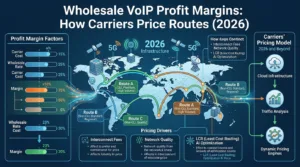
Wholesale VoIP margin is the spread between what you pay the upstream carrier per minute and what you charge downstream. Healthy carriers protect a consistent per-minute spread across destinations, steer traffic by tier, and use LCR to keep routing costs low while quality holds. The wholesale layer is a volume game: route pricing determines per-minute spread, and volume determines total profitability.
Where Margin Comes From
The Rate Spread
You buy wholesale, sell wholesale-plus. The spread per minute is your margin. Widen by negotiating volume discounts and route mixing: standard for low-margin traffic, premium for quality-demanding clients. See the tiers — standard / premium / premium+ — to build your price book.
LCR Automation
Least cost routing picks the cheapest route that meets ASR targets per destination. Routing without LCR leaves margin on the table. Understand LCR in VoIP to automate route selection safely.
ASR Quality
High ASR turns seizures into billable minutes. Discounted low-ASR routes can actually cost more per successful minute. Track ASR/ACD in real time — the ASR/ACD guide explains the metrics that decide your effective margin.
How Carriers Build the Rate Deck
Start from the wholesale cost per destination, apply your target spread per tier, add CLI and quality adjustments, then review against competitor decks. Read how to read a rate deck — most margin leak happens inside the deck structure.
When Rates Move (and Margins Shrink)
Destination demand and FX shifts move wholesale costs. A carrier that locks prices to clients without re-basing the deck when wholesale cost rises eats the difference. Monthly rate reviews protect your spread.
Margin Leak Checklist
(1) No LCR — paying average cost instead of best route. (2) Low ASR traffic paying premium prices. (3) Stale rate decks after wholesale changes. (4) Mixing tiers in one price without premium pricing. Each unchecked box is a percentage point of margin. Compare provider quality on termination quality criteria to avoid expensive surprises.
Pricing Strategy for Newer Carriers
Newer carriers compete on price, then widen spread as volume qualifies for better wholesale tiers. Use mix routes to serve diverse client quality demands from one trunk. For startups, the startup route buying guide lays out low-risk entry pricing.
Frequently Asked Questions
What is a normal wholesale VoIP profit margin?
Margin is expressed as a per-minute spread, not a percentage of revenue. It varies by destination and tier — thinner on competitive routes, wider on premium and premium+. Consistent monthly routing review matters more than a target number.
How do carriers make money in wholesale VoIP?
By buying wholesale minutes at scale and reselling with a per-minute markup while controlling costs through LCR, ASR management and route mixing. Volume is what turns a small per-minute spread into meaningful profit.
Why does ASR affect profit margins?
ASR is the share of calls that connect. Low-ASR routes waste seizures and often charge on more minutes that fail; high-ASR routes convert traffic into billable minutes. Effective margin depends on ASR as much as on the headline rate.
Can a small provider build wholesale VoIP margins?
Yes. Startups buy standard or mix routes, keep ASR healthy and move up tiers as volume earns better wholesale pricing. The spread grows as your purchasing power grows.
How often should I review my rate deck?
Monthly is a reasonable rhythm. Wholesale costs move with demand and currency; a stale deck silently transfers your margin to the upstream carrier. Review against the current route pricing .
Conclusion
Build your route pricing on real wholesale rates.
Last edit: October 6, 2026 - 17:10 by ENG. Hisham Mohamed
Eng. Hisham Mohamed is a telecommunications specialist with over 8 years of experience in VoIP, SIP termination, telecom infrastructure, voice services, and modern communication solutions. He is also a professional technical writer covering telecommunications, VoIP, cloud communication, and digital transformation.

Written by
ENG. Hisham Mohamed
Eng. Hisham Mohamed is a telecommunications specialist with over 8 years of experience in VoIP, SIP termination, telecom infrastructure, voice services, and modern communication solutions. He is also a professional technical writer covering telecommunications, VoIP, cloud communication, and digital transformation.