LCR (Least Cost Routing) in VoIP: Everything Carriers Need to Know

LCR (Least Cost Routing) in VoIP: Everything Carriers Need to Know

What is Least Cost Routing (LCR) in VoIP?

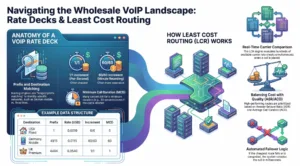
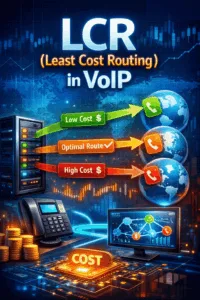
Least Cost Routing (LCR) is a routing method used by VoIP carriers to automatically choose the most cost-effective route for every outbound call. Modern LCR systems don’t only compare prices, they also evaluate call quality, ASR, ACD, latency, and route reliability to balance profitability with customer experience.
Every wholesale VoIP carrier wants the same thing. Lower costs, better margins, and customers who never complain about call quality.

Sounds simple, but anyone who’s worked in telecom knows it isn’t.

One wrong routing decision can increase your termination costs overnight. Even worse, choosing the absolute cheapest route often leads to dropped calls, poor audio, low ASR, frustrated customers, and eventually lost business.

That’s exactly why Least Cost Routing, better known as LCR, has become one of the most important technologies in modern VoIP networks.

If you’re running a wholesale VoIP business, operating a softswitch, or simply trying to understand how global carriers optimize millions of calls every day, this guide will walk you through everything that matters.

What Is Least Cost Routing (LCR)?

Least Cost Routing is an automated routing process that determines which carrier should handle an outbound phone call based on predefined rules.

At first glance, the goal seems obvious: choose the cheapest route.

But modern telecom networks have evolved far beyond that.

Today’s LCR engines evaluate dozens of factors before making a routing decision, including:

  • Termination price
  • Route quality
  • Average Call Duration (ACD)
  • Answer-Seizure Ratio (ASR)
  • Post Dial Delay (PDD)
  • Latency
  • Network stability
  • Carrier reputation
  • Historical performance
  • Customer routing preferences

The final decision isn’t always the cheapest option. It’s the route that provides the best balance between cost and quality.

That’s why experienced carriers rarely think of LCR as Lowest Price Routing. They think of it as Smart Cost Optimization.

Least Cost Routing
Least Cost Routing

Why LCR Matters in Wholesale VoIP

Wholesale margins are getting smaller every year.

Carriers compete on fractions of a cent.

Saving even $0.0005 per minute across millions of monthly minutes can translate into thousands of dollars in additional profit.

Without LCR, operators would have to manually compare thousands of destinations every time suppliers publish new rate decks.

That simply isn’t possible.

Instead, the routing engine performs those calculations automatically and updates routing decisions in seconds.

The result is:

  • Lower operating costs
  • Better profit margins
  • Faster response to rate changes
  • Reduced manual work
  • More competitive pricing

How Least Cost Routing Works

Here’s a simplified version of the process.

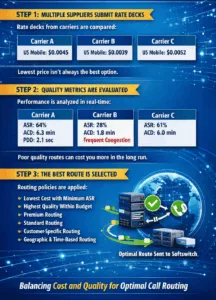
Step 1: Multiple Suppliers Submit Rate Decks

Each carrier provides pricing for thousands of international prefixes.

For example:

Carrier A

US Mobile: $0.0045

Carrier B

US Mobile: $0.0039

Carrier C

US Mobile: $0.0052

At first, Carrier B appears to be the obvious choice.

But price isn’t everything.

Step 2: Quality Metrics Are Evaluated

The routing engine also checks live performance.

For example:

Carrier A

  • ASR: 64%
  • ACD: 6.3 min
  • PDD: 2.1 sec

Carrier B

  • ASR: 28%
  • ACD: 1.8 min
  • Frequent congestion

Carrier C

  • ASR: 61%
  • ACD: 6.0 min

Now the cheapest route suddenly looks much less attractive.

A low-quality route creates repeated call attempts, customer complaints, refunds, and support tickets.

Sometimes paying slightly more actually reduces your overall costs.

Step 3: The Best Route Is Selected

The routing engine applies routing policies.

Examples include:

  • Lowest price with minimum ASR
  • Highest quality within budget
  • Premium routing
  • Standard routing
  • Customer-specific routing
  • Geographic routing
  • Time-based routing

The selected route is then delivered to the softswitch for call completion.

How Least Cost Routing Works

Key Components of an LCR Engine

A modern LCR platform usually includes several important components.

Rate Management

Imports supplier rate decks automatically.

Handles frequent price updates.

Supports thousands of international prefixes.

Quality Monitoring

Continuously measures:

  • ASR
  • ACD
  • PDD
  • Packet loss
  • Jitter
  • MOS scores
  • Route failures

Without quality monitoring, LCR becomes little more than price comparison.

Routing Policies

Every carrier has different priorities.

Some prioritize profit.

Others prioritize customer experience.

Policies allow operators to customize routing based on business objectives.

Real-Time Switching

If one supplier experiences congestion or an outage, the system can immediately switch traffic to another carrier.

Customers often never notice the change.

Static LCR vs Dynamic LCR

Static LCR

Routes are calculated after rate updates.

They remain unchanged until the next routing refresh.

Advantages:

  • Easy to manage
  • Predictable
  • Lower processing requirements

Disadvantages:

  • Doesn’t react instantly to quality issues.

Dynamic LCR

Continuously evaluates live network conditions.

Routes may change several times during the day.

Advantages:

  • Better quality
  • Faster failover
  • Higher ASR
  • Better customer satisfaction

Disadvantages:

  • More complex
  • Requires continuous monitoring
  • Higher infrastructure requirements

Most Tier-1 and Tier-2 carriers rely heavily on dynamic routing today.

LCR (Least Cost Routing) in VoIP

LCR Doesn’t Mean Choosing the Cheapest Route

This is probably the biggest misconception in telecom.

Imagine two suppliers.

Supplier A charges $0.0060 per minute.

Supplier B charges $0.0053 per minute.

Supplier B looks cheaper.

But if 25% of calls fail, customers dial again.

Now you’ve doubled signaling traffic, increased support costs, reduced customer trust, and wasted network resources.

Suddenly the “cheapest” supplier becomes the most expensive.

That’s why experienced carriers focus on total call cost, not just termination price.

Metrics Every Carrier Should Monitor

Successful routing depends on accurate data.

Some of the most important KPIs include:

Answer Seizure Ratio (ASR)

Measures how many attempted calls are successfully answered.

Higher ASR generally indicates healthier routes.

Average Call Duration (ACD)

Longer conversations often indicate better call quality.

Very short calls may signal poor routing.

Post Dial Delay (PDD)

Measures the delay between dialing and ringing.

High PDD frustrates users.

MOS Score

The Mean Opinion Score estimates perceived voice quality.

Higher MOS usually means clearer conversations.

Route Stability

Frequent outages or congestion should lower routing priority.

Consistency matters just as much as pricing.

Benefits of LCR for VoIP Carriers

Properly configured LCR delivers measurable business advantages.

  • Lower termination expenses
  • Better profitability
  • Higher call completion rates
  • Improved customer retention
  • Faster response to carrier outages
  • Better supplier management
  • Automatic route optimization
  • Reduced manual routing tasks
  • Improved network efficiency
  • More competitive wholesale pricing

Common Challenges with Least Cost Routing

LCR isn’t perfect.

Carriers often face challenges such as:

Frequent Rate Updates

Suppliers may update rate decks daily or even multiple times per day.

Keeping routing tables current is essential.

Poor Quality Cheap Routes

Not every low-cost provider delivers acceptable performance.

Blindly chasing the lowest price often hurts profitability.

Fraud Risks

Artificial traffic inflation and fraudulent routes can distort routing decisions.

Continuous monitoring helps reduce exposure.

Prefix Accuracy

Incorrect prefixes can cause routing failures or unexpected billing.

Maintaining accurate destination tables is critical.

Best Practices for Optimizing LCR

Successful carriers usually follow a few consistent principles.

Never Optimize for Price Alone

Quality always affects profitability.

A slightly higher rate may generate better long-term revenue.

Continuously Monitor Suppliers

Carrier performance changes throughout the day.

Regular testing helps identify deteriorating routes early.

Maintain Multiple Suppliers

Relying on a single provider increases operational risk.

Carrier diversity improves resilience.

Automate Everything Possible

Manual routing cannot keep pace with today’s wholesale market.

Automation reduces errors and improves response time.

Review KPIs Weekly

Monitoring ASR, ACD, PDD, and quality trends allows routing policies to evolve with network conditions.

Who Uses Least Cost Routing?

LCR is widely used across the telecom industry.

Common users include:

Any organization managing significant voice traffic can benefit from intelligent routing.

Final Thoughts

Least Cost Routing is no longer just a billing optimization tool. It’s one of the core technologies that determines whether a VoIP carrier can remain competitive in a market where margins are tight and customer expectations keep rising.

The best LCR strategy isn’t about finding the absolute lowest rate. It’s about making smarter routing decisions using live pricing, real network performance, and continuous quality monitoring.

Carriers that combine cost optimization with reliable routing consistently deliver better voice quality, stronger customer retention, and healthier profit margins. As global VoIP traffic continues to grow, investing in a modern LCR strategy isn’t just a technical upgrade, it’s a competitive advantage that pays off every single day.

References

Last edit: August 2, 2026 - 11:07 by ENG. Hisham Mohamed

Eng. Hisham Mohamed is a telecommunications specialist with over 8 years of experience in the telecom industry, focusing on VoIP technologies, communication solutions, and emerging trends in the telecommunications sector. Throughout his career, he has gained extensive knowledge of telecom infrastructure, voice services, and modern communication platforms. In addition to his technical expertise, Eng. Hisham is a professional technical writer who creates insightful and industry-focused articles covering telecommunications, VoIP, cloud communication, and digital transformation. His writing combines practical industry experience with deep technical understanding, helping businesses and professionals stay informed about the latest developments in communication technologies. With a passion for technology and knowledge sharing, Eng. Hisham continues to contribute valuable content that simplifies complex telecom concepts and provides meaningful insights for readers around the world.

Ready to Get Started?

Contact our team today and get a fast response.

Contact Us