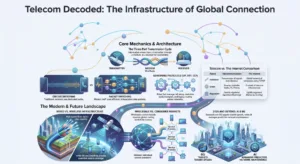
What Is Telecom? Complete Guide to Telecommunications

Table of Contents

What Is Telecom? A Complete Guide to Telecommunications Networks, Technologies & Services (2026)


Telecommunications commonly shortened to telecom is the foundation of modern digital communication. Every phone call, video meeting, online payment, text message, cloud application, and streaming service depends on telecommunications networks operating behind the scenes.

Although billions of people rely on telecom services every day, many still misunderstand what telecommunications actually include. Telecom is far more than mobile phone networks; it encompasses the global infrastructure that enables voice, data, video, and internet communications across cities, countries, and continents.

Today’s telecommunications industry is also undergoing one of the most significant transformations in its history. Traditional circuit-switched telephone systems have evolved into cloud native, IP-based platforms powered by technologies such as 5G, VoIP, fiber optics, cloud computing, artificial intelligence (AI), edge computing, and satellite communications. These innovations are enabling faster connectivity, lower latency, greater scalability, and entirely new digital services for consumers and businesses alike.

Whether you’re a business owner evaluating communication solutions, an IT professional exploring telecom infrastructure, or simply curious about how modern networks operate, understanding telecommunications provides valuable insight into the technology that keeps the world connected.

In this comprehensive guide, you’ll learn:

  • What telecom means and why it matters
  • How telecommunications networks work
  • The different types of telecom systems
  • Core network components and technologies
  • The relationship between telecom, the internet, and cloud communications
  • How telecom companies generate revenue
  • Emerging trends including AI, 6G, Open RAN, and cloud-native networks
  • Frequently asked questions about telecommunications

By the end of this guide, you’ll have a clear understanding of how the telecommunications ecosystem powers nearly every aspect of modern life.

What Is Telecom?

Telecommunications (telecom) is the technology and infrastructure used to transmit information over distance using electronic and digital communication systems. The information being transmitted may include:

  • Voice calls
  • Text messages
  • Internet data
  • Video streams
  • Emails
  • Images
  • Files
  • IoT device data
  • Emergency communications
  • Machine-to-machine (M2M) traffic

Simply put, telecom enables people, businesses, governments, and devices to communicate regardless of their physical location.

Without telecommunications, services that billions of people rely on every day including online banking, cloud software, remote work, GPS navigation, video conferencing, social media, e-commerce, and streaming platforms would not exist.

Modern telecom combines multiple technologies into one interconnected ecosystem, including:

  • Fiber-optic networks
  • Cellular networks (4G and 5G)
  • Satellite communications
  • Wireless broadband
  • Internet Protocol (IP) networking
  • Voice over IP (VoIP)
  • Cloud communications
  • Data centers
  • International submarine cables

Rather than being a single technology, telecom is an entire industry responsible for designing, operating, and maintaining the networks that connect the world.

What Does Telecom Mean in Simple Words?

Imagine speaking with a friend on the other side of the world. Your voice is converted into digital signals, transmitted through nearby cellular towers or broadband connections, routed across fiber-optic cables and internet backbones, processed by telecom core networks, and delivered to your friend’s device all within milliseconds.

This process happens so quickly that it feels instantaneous, despite your voice traveling thousands of miles through multiple interconnected networks.

In simple terms:

Telecom is the system that moves information from one place to another quickly, securely, and reliably.

Whether the information is a phone call, a WhatsApp message, a Zoom meeting, or a Netflix stream, telecommunications networks make the communication possible.

Why Is Telecom Important?

Telecommunications has become one of the most critical infrastructures in the global economy. Nearly every industry depends on reliable communication networks to operate efficiently.

Connecting People Worldwide

Telecom enables instant communication between individuals, families, businesses, and governments regardless of geographic location.

International voice calls, messaging apps, and video conferencing platforms all rely on telecommunications infrastructure.

Supporting Digital Businesses

Modern organizations depend on telecom for:

  • Cloud applications
  • Unified communications
  • Customer support centers
  • Remote collaboration
  • Video conferencing
  • Secure enterprise networking
  • Data synchronization

Without telecom, digital transformation would be impossible.

Powering the Internet

Although people often confuse telecom with the internet, telecommunications infrastructure actually makes internet connectivity possible.

Internet service providers, cloud providers, and content delivery networks all rely on telecom operators to transport data between users and digital services.

Enabling Economic Growth

Telecommunications contributes significantly to national economies by:

  • Supporting innovation
  • Creating employment
  • Enabling digital commerce
  • Improving productivity
  • Expanding financial inclusion
  • Connecting rural communities

Countries with advanced telecom infrastructure generally experience stronger digital economies and greater technological competitiveness.

Supporting Critical Services

Telecom networks are essential for:

  • Emergency response systems
  • Healthcare communications
  • Banking transactions
  • Transportation systems
  • Government services
  • Defense communications
  • Disaster recovery

Reliable telecommunications can literally save lives during emergencies.

A Brief History of Telecommunications

Understanding where telecom began helps explain how today’s sophisticated communication systems evolved.

The Telegraph Era (1830s–1870s)

The first major breakthrough in long-distance communication came with the electric telegraph, allowing messages to travel across vast distances in minutes instead of days or weeks.

For the first time in history, information could move faster than physical transportation.

The Telephone Revolution (1876)

The invention of the telephone transformed global communication by enabling real-time voice conversations between people in different locations.

Telephone networks rapidly expanded across cities and countries, laying the foundation for today’s telecom industry.

The Rise of Wireless Communications

Throughout the 20th century, radio technology introduced wireless communications, eventually leading to:

  • Mobile phones
  • Satellite communications
  • Television broadcasting
  • Wireless internet

This marked the beginning of mobile telecommunications.

The Internet Age

As internet technologies matured during the 1990s and early 2000s, telecom networks shifted from carrying mostly voice traffic to transporting massive amounts of digital data.

This transition introduced:

  • Broadband internet
  • Fiber-optic networks
  • IP networking
  • Cloud computing
  • Digital media

Telecommunications evolved from a voice-centric industry into a data-driven ecosystem.

The Era of Cloud Telecom

Today’s telecom environment is increasingly software-defined and cloud-native.

Modern operators now deploy technologies such as:

  • 5G
  • VoLTE
  • VoWiFi
  • Cloud PBX
  • SIP Trunking
  • Unified Communications
  • AI-powered network automation
  • Edge computing
  • Open RAN

Rather than simply connecting phone calls, telecom providers now deliver intelligent digital communication platforms capable of supporting millions of users and connected devices simultaneously.

How Does Telecom Work?

Although telecommunications may appear complex, the basic process follows a logical sequence. Every phone call, text message, or internet request travels through multiple interconnected network components before reaching its destination.

Understanding this journey helps explain why modern telecom is one of the most sophisticated engineering systems ever built.

H3: Step 1: The User Initiates Communication

Every telecom session begins with a device, such as:

  • Smartphone
  • Laptop
  • Desk phone
  • Tablet
  • IoT sensor
  • Smartwatch
  • IP phone

When you place a call, send a message, or open a website, your device converts your request into digital data packets or voice signals.

Step 2: The Access Network Receives the Signal

The request reaches the nearest access point, which may be:

  • A cellular tower
  • A Wi-Fi access point
  • A fiber-optic connection
  • A broadband modem
  • A satellite terminal

The access network serves as the entry point into the telecommunications infrastructure.

Step 3: The Core Network Processes the Request

Once inside the telecom network, powerful core systems authenticate users, determine the destination, allocate network resources, enforce security policies, and select the most efficient routing path.

This is where technologies such as IMS, packet cores, routing engines, and subscriber databases work together to manage communication sessions in real time.

Step 4: Data Travels Across National and Global Networks

If the destination is located elsewhere, the traffic moves through high-capacity transport networks, internet exchange points, and international fiber-optic backbones before reaching the recipient’s network.

For international communications, data may travel through submarine cables spanning thousands of kilometers beneath the ocean.

 Step 5: The Destination Receives the Communication

Finally, the destination network delivers the voice, message, or data to the recipient’s device.

This entire process typically takes only milliseconds, enabling seamless conversations, instant messaging, and real-time video streaming across the globe.

How a Phone Call Travels Across the World

Although making a phone call feels instantaneous, the process involves multiple network elements working together in milliseconds. Whether you’re calling someone across town or on another continent, your voice follows a sophisticated digital journey.

Below is a simplified call flow for a modern telecom network.

Your Smartphone
        │
        ▼
Nearest Cell Tower / Wi-Fi Access Point
        │
        ▼
Radio Access Network (RAN)
        │
        ▼
Mobile Core Network / IMS
        │
        ▼
National Backbone Network
        │
        ▼
International Carrier (if required)
        │
        ▼
Destination Carrier
        │
        ▼
Recipient's Network
        │
        ▼
Recipient's Phone
How a Phone Call Travels Across the World

Every step involves authentication, routing, traffic optimization, quality monitoring, and security checks to ensure reliable communication.

For Voice over LTE (VoLTE) and Wi-Fi Calling (VoWiFi), the call is established entirely over IP networks instead of the traditional Public Switched Telephone Network (PSTN), delivering better voice quality, faster call setup, and richer communication features.

How Internet Data Travels Through Telecom Networks

Browsing a website follows a process similar to placing a phone call, but instead of transmitting voice, the network transports packets of digital information.

For example, when you open a website:

Laptop or Smartphone
        │
        ▼
Wi-Fi Router / Mobile Network
        │
        ▼
Internet Service Provider
        │
        ▼
Telecom Backbone
        │
        ▼
Internet Exchange Point (IXP)
        │
        ▼
Cloud Data Center
        │
        ▼
Web Server
        │
        ▼
Website Loads

Every image, video, webpage, or application follows this route, often crossing multiple countries before reaching your device.

Modern telecom infrastructure is designed to optimize this journey by minimizing latency, reducing congestion, and ensuring reliable data delivery.

The Main Components of a Telecom Network

Telecommunications networks are built using several interconnected layers. Each layer performs a specialized function that contributes to the overall communication process.

Understanding these layers provides a clearer picture of how telecom systems operate at scale.

Access Network

The Access Network is the first point of contact between users and the telecom provider.

Its primary role is connecting customer devices to the wider telecommunications infrastructure.

Examples include:

  • Cellular base stations
  • Fiber-to-the-home (FTTH)
  • DSL connections
  • Cable broadband
  • Wi-Fi hotspots
  • Satellite terminals

Without the access network, users would have no way to connect to telecom services.

Radio Access Network (RAN)

In mobile telecommunications, the Radio Access Network (RAN) enables wireless communication between mobile devices and the operator’s core network.

The RAN consists of:

  • Cell towers
  • Radio antennas
  • Baseband units
  • Small cells
  • Massive MIMO equipment

As mobile technologies evolved from 2G to 5G, RAN architecture became increasingly software-driven and intelligent.

Modern deployments also embrace Open RAN (O-RAN), allowing operators to use interoperable hardware and software from different vendors, reducing costs and increasing flexibility.

Transport Network

Once traffic enters the telecom network, it must travel between different locations.

The Transport Network performs this function using high-capacity connections such as:

  • Fiber-optic cables
  • Microwave links
  • Ethernet
  • MPLS
  • IP transport
  • Optical transmission systems

Think of the transport network as the highway system connecting cities together.

Core Network

The Core Network is the intelligence center of a telecom operator.

Instead of simply forwarding traffic, it performs critical functions including:

  • User authentication
  • Subscriber management
  • Session control
  • Routing
  • Billing
  • Security enforcement
  • Mobility management
  • Quality of Service (QoS)
  • Policy control

For mobile operators, the core network determines how users connect, roam between locations, and access voice and data services.

Today’s operators increasingly deploy cloud-native packet cores to improve scalability and operational efficiency.

IP Multimedia Subsystem (IMS)

One of the most important technologies in modern telecommunications is the IP Multimedia Subsystem (IMS).

IMS enables IP-based communication services such as:

  • VoLTE
  • VoWiFi
  • Rich Communication Services (RCS)
  • Video calling
  • SIP-based voice services
  • Multimedia sessions

Instead of relying on legacy circuit-switched infrastructure, IMS uses Internet Protocol to establish and manage communication sessions.

Benefits include:

  • Faster call setup
  • HD voice quality
  • Better scalability
  • Easier integration with cloud services
  • Support for multimedia applications

IMS has become the standard architecture for next-generation telecom networks.

Backbone Network

The backbone network connects regional and national telecom infrastructures using extremely high-capacity fiber-optic links.

Characteristics include:

  • Terabit-level bandwidth
  • Ultra-low latency
  • Geographic redundancy
  • Carrier-grade reliability
  • Long-distance connectivity

Large backbone networks often span entire countries and connect to international submarine cable systems.

Edge Network

The Edge Network brings computing resources closer to users.

Instead of sending all traffic to centralized cloud data centers, edge computing processes information near its source.

Benefits include:

  • Lower latency
  • Faster application response
  • Reduced backbone traffic
  • Better gaming performance
  • Improved IoT responsiveness
  • Enhanced AR and VR experiences

Edge computing is becoming increasingly important for autonomous vehicles, smart factories, and industrial automation.

Types of Telecommunications Networks

Telecommunications encompasses multiple network types, each designed for specific communication needs.

Fixed-Line Telecommunications

Fixed-line networks use physical cables to connect homes and businesses.

Examples include:

  • Fiber optics
  • DSL
  • Cable broadband
  • Traditional telephone lines

These networks typically provide stable, high-speed connectivity with low latency.

Mobile Telecommunications

Mobile networks enable wireless communication using radio technologies.

Generations include:

  • 2G
  • 3G
  • 4G LTE
  • 5G

Mobile telecom now supports far more than voice calls, delivering broadband internet, IoT connectivity, video streaming, and enterprise networking.

Fiber-Optic Networks

Fiber optics transmit information as pulses of light through ultra-thin strands of glass.

Advantages include:

  • Extremely high bandwidth
  • Minimal signal loss
  • Long transmission distances
  • Low latency
  • Excellent reliability

Fiber has become the preferred medium for modern telecom infrastructure.

Satellite Telecommunications

Satellite communications extend connectivity to locations where terrestrial infrastructure is unavailable.

Common applications include:

  • Rural broadband
  • Maritime communications
  • Aviation
  • Military operations
  • Disaster recovery
  • Remote industrial sites

The emergence of Low Earth Orbit (LEO) satellite constellations is significantly improving performance and reducing latency.

Microwave Networks

Microwave communication uses high-frequency radio waves for point-to-point data transmission.

Operators often deploy microwave links when installing fiber is impractical or cost-prohibitive.

They are commonly used for:

  • Cellular backhaul
  • Emergency communications
  • Rural connectivity
  • Temporary deployments

Submarine Cable Networks

More than 95% of international internet traffic travels through submarine fiber-optic cables laid across the ocean floor.

These cables connect continents and carry enormous volumes of global voice and data traffic every second.

Without submarine cable infrastructure, global telecommunications would not function at today’s scale.

Telecom Technologies That Power Modern Communications

The telecom industry relies on numerous technologies working together to deliver seamless communication experiences.

Some of the most important include:

Technology Primary Purpose
Fiber Optics High-speed data transmission
5G Mobile broadband and ultra-low latency
LTE Fourth-generation mobile connectivity
VoLTE Voice over LTE networks
VoWiFi Calling over Wi-Fi
VoIP IP-based voice communication
SIP Session establishment for voice services
IMS Multimedia communication platform
MPLS Enterprise traffic engineering
SD-WAN Intelligent WAN connectivity
Edge Computing Localized application processing
Cloud Infrastructure Scalable telecom platforms
AI Automation Network optimization and analytics

Modern telecom is no longer defined by hardware alone. Increasingly, networks are software-driven, cloud-native, AI-assisted, and automated.

Telecom Services Explained

Modern telecommunications extends far beyond traditional phone calls. Today’s telecom providers deliver a comprehensive portfolio of communication services that support consumers, enterprises, governments, and emerging technologies.

Each service is built on the same underlying infrastructure but serves different business and operational needs.

Voice Services

Voice communication remains one of the core pillars of telecommunications.

Unlike legacy telephone systems that relied on circuit switching, modern voice services primarily operate over IP-based networks.

Common voice services include:

  • Mobile voice calls
  • Fixed-line telephony
  • VoLTE (Voice over LTE)
  • VoWiFi (Voice over Wi-Fi)
  • HD Voice
  • International calling
  • Enterprise voice systems

Most telecom operators now prioritize all-IP voice networks because they offer higher call quality, faster call setup, and lower operational costs.

Messaging Services

Messaging has evolved significantly from traditional SMS.

Today’s telecom ecosystem supports multiple messaging technologies, including:

  • SMS
  • MMS
  • Rich Communication Services (RCS)
  • Application-to-Person (A2P) messaging
  • Business messaging
  • OTP verification messages
  • Emergency alerts

Businesses increasingly use telecom messaging for customer engagement, authentication, appointment reminders, and marketing campaigns.

Broadband Internet

Broadband services provide high-speed internet connectivity for homes and businesses.

Depending on location and infrastructure, broadband may be delivered through:

  • Fiber-to-the-Home (FTTH)
  • Fiber-to-the-Building (FTTB)
  • Cable networks
  • DSL
  • Fixed Wireless Access (FWA)
  • Satellite internet

Broadband has become the foundation for cloud computing, remote work, online education, and digital entertainment.

Mobile Data Services

Modern smartphones generate far more data traffic than voice traffic.

Mobile operators provide:

  • 4G LTE connectivity
  • 5G broadband
  • Mobile hotspots
  • Roaming data services
  • IoT connectivity
  • Machine-to-machine (M2M) communication

As 5G adoption grows, mobile networks increasingly support ultra-high-definition video, cloud gaming, autonomous vehicles, and industrial automation.

Enterprise Communication Services

Businesses require communication solutions that extend beyond consumer offerings.

Telecom providers deliver enterprise services such as:

  • SIP Trunking
  • Cloud PBX
  • Hosted PBX
  • Unified Communications (UCaaS)
  • Contact Center as a Service (CCaaS)
  • SD-WAN
  • Dedicated internet access
  • MPLS private networks
  • VPN connectivity

These services enable organizations to connect offices, employees, customers, and cloud platforms securely and efficiently.

Wholesale Telecom Services

Behind every retail telecom provider is a complex wholesale ecosystem.

Wholesale telecom companies sell network capacity and communication services to other operators rather than directly to end users.

Examples include:

  • Wholesale Voice Termination
  • International Voice Transit
  • SIP Interconnect
  • DID Number Services
  • SMS Wholesale
  • Carrier Interconnection
  • IP Transit
  • Mobile Roaming Agreements

This business model allows operators to expand global coverage without building infrastructure in every country.

Cloud Communications

One of the fastest-growing sectors within telecom is cloud communications.

Instead of relying on physical PBX systems and legacy hardware, organizations now use cloud-based communication platforms.

Cloud telecom services include:

  • Cloud PBX
  • Hosted VoIP
  • SIP-based calling
  • Virtual phone numbers
  • Video conferencing
  • Team collaboration platforms
  • AI-powered contact centers

Cloud communications reduce infrastructure costs while improving scalability and flexibility.

Internet of Things (IoT)

Telecommunications also connects billions of machines not just people.

IoT networks support:

  • Smart cities
  • Connected vehicles
  • Industrial automation
  • Smart agriculture
  • Healthcare monitoring
  • Logistics tracking
  • Utility metering

These connected devices continuously exchange data using cellular, satellite, or low-power wireless networks.

Telecom vs Internet

One of the most common misconceptions is that telecom and the internet are the same thing.

They are closely related but they are not identical.

Telecom Internet
Physical communication infrastructure Global network of interconnected computers
Includes voice, SMS, broadband, fiber, mobile, satellite Primarily delivers digital content and applications
Built and operated by telecom companies Uses telecom infrastructure
Supports voice and data services Primarily focuses on data communication

Simple Example

Imagine the internet as traffic and telecom as the highway system.

Without highways, traffic cannot move.

Likewise, without telecom infrastructure, internet services cannot reach users.

Telecom vs Networking

Although the terms are often used interchangeably, telecommunications and networking represent different disciplines.

Telecom Networking
Connects users across cities and countries Connects devices within local or enterprise environments
Operated by carriers Managed by IT departments
Includes nationwide infrastructure Includes LANs, WANs, switches, and routers
Supports millions of users Typically serves organizations or campuses

Networking focuses on internal connectivity.

Telecom focuses on large-scale public communications.

Telecom vs VoIP

VoIP is not a replacement for telecom it is one technology within the telecom industry.

Telecom VoIP
Entire communications ecosystem Voice communication over IP
Includes voice, internet, messaging, satellite, fiber Focuses only on voice services
Uses multiple transport technologies Operates over IP networks
Includes mobile operators Used by enterprises and service providers

Every VoIP service belongs to telecom, but telecom includes far more than VoIP alone.

Telecom vs ISP

Internet Service Providers (ISPs) are often confused with telecom operators.

While some organizations perform both roles, they are not necessarily the same.

Telecom Company ISP
Provides communication infrastructure Provides internet access
Offers voice, messaging, mobile, fiber, enterprise services Primarily offers internet connectivity
Operates nationwide communication networks May lease telecom infrastructure

Many ISPs purchase capacity from larger telecom carriers before delivering services to customers.

Telecom vs Cloud Communications

Cloud communications represent the evolution of traditional telecom.

Traditional Telecom Cloud Telecom
Hardware-centric Software-defined
On-premises equipment Cloud infrastructure
Limited scalability Instantly scalable
Manual provisioning Automated deployment
High capital expenditure Subscription-based pricing

Cloud-native telecom platforms enable businesses to launch communication services much faster than legacy systems.

Key Telecom Protocols Explained

Telecommunications depends on standardized communication protocols that ensure devices and networks can communicate reliably.

Below are some of the most important protocols used across modern telecom infrastructure.

SIP (Session Initiation Protocol)

SIP is responsible for establishing, modifying, and terminating multimedia communication sessions.

Common uses include:

  • VoIP calls
  • Video conferencing
  • SIP Trunking
  • Unified Communications
  • Cloud PBX

SIP acts like the “call manager” of IP communications.

RTP (Real-time Transport Protocol)

After SIP establishes a session, RTP carries the actual voice or video.

Its responsibilities include:

Ready to Get Started?

Contact our team today and get a fast response.

Contact Us
  • Audio transport
  • Video transport
  • Timing synchronization
  • Low-latency media delivery

Without RTP, real-time conversations would not be possible.

SS7 (Signaling System No. 7)

Although many networks have migrated to IP, SS7 remains an important protocol in legacy telephone infrastructure.

SS7 supports:

  • Call setup
  • SMS routing
  • Number portability
  • Roaming
  • Mobile authentication

Many operators still integrate SS7 with modern IMS environments.

Diameter

Diameter is widely used in LTE and 5G core networks.

It manages:

  • Authentication
  • Authorization
  • Accounting
  • Subscriber profiles
  • Policy control

Diameter replaced several older signaling mechanisms used in previous mobile generations.

TCP/IP

TCP/IP forms the foundation of internet communication.

Nearly every telecom application depends on the TCP/IP protocol suite for transporting data across networks.

UDP

Unlike TCP, UDP prioritizes speed over guaranteed delivery.

It is commonly used for:

  • Voice calls
  • Live video
  • Online gaming
  • Real-time applications

Its low latency makes it ideal for multimedia traffic.

MPLS (Multiprotocol Label Switching)

MPLS enables telecom operators to deliver highly reliable enterprise connectivity.

Benefits include:

  • Traffic engineering
  • Quality of Service (QoS)
  • Low latency
  • High reliability
  • Secure private networking

Many multinational businesses still rely on MPLS for mission-critical applications.

BGP (Border Gateway Protocol)

BGP determines how internet traffic travels between different networks worldwide.

It acts as the routing protocol of the global internet, enabling telecom operators and internet providers to exchange routing information efficiently.

Telecom Infrastructure: The Foundation of Global Connectivity

Every call, message, video stream, and cloud application depends on a vast physical infrastructure built over decades. While users only see their smartphones or laptops, telecom operators maintain millions of interconnected components that keep global communications running 24/7.

From cell towers in remote villages to submarine cables crossing oceans, telecom infrastructure is one of the largest engineering achievements in human history.

Let’s explore the key building blocks.

Cell Towers

Cell towers provide the wireless coverage that allows mobile devices to connect to nearby networks.

Each tower contains specialized equipment such as:

  • Radio antennas
  • Baseband units (BBUs)
  • Remote radio heads (RRHs)
  • Massive MIMO antennas (for 5G)
  • Power systems
  • Backup batteries
  • Fiber or microwave backhaul connections

When you make a phone call or browse the internet, your device first communicates with the nearest cell tower before your traffic enters the telecom network.

Modern cities may contain thousands of interconnected towers to ensure seamless coverage and capacity.

Fiber-Optic Networks

Fiber optics form the backbone of modern telecommunications.

Instead of transmitting electrical signals through copper cables, fiber uses pulses of light that travel through strands of ultra-pure glass.

Advantages include:

  • Terabit-scale bandwidth
  • Extremely low latency
  • Minimal signal loss
  • Long-distance transmission
  • High reliability
  • Lower maintenance costs

Today, telecom operators deploy fiber for:

  • Mobile backhaul
  • Enterprise connectivity
  • Residential broadband
  • International backbone networks
  • Data center interconnection

Without fiber, modern cloud computing and high-speed internet would not exist.

Data Centers

Modern telecom networks rely heavily on geographically distributed data centers.

These facilities host:

  • Cloud applications
  • IMS platforms
  • Subscriber databases
  • DNS services
  • Routing systems
  • Virtual network functions (VNFs)
  • AI platforms
  • Network management systems

Rather than depending solely on proprietary hardware, today’s telecom operators increasingly virtualize network functions inside cloud environments.

This transition enables faster service deployment, greater scalability, and lower operational costs.

Internet Exchange Points (IXPs)

An Internet Exchange Point (IXP) is a physical location where different internet service providers, telecom carriers, and cloud companies exchange traffic directly.

Instead of routing data through distant networks, IXPs allow local traffic to remain local.

Benefits include:

  • Lower latency
  • Faster internet performance
  • Reduced transit costs
  • Improved redundancy
  • Better user experience

Major metropolitan areas often host multiple IXPs to support growing internet demand.

Submarine Cable Systems

Although satellites receive significant public attention, the vast majority of global internet traffic travels through submarine fiber-optic cables.

These undersea cables connect continents and carry:

  • International voice calls
  • Cloud traffic
  • Financial transactions
  • Streaming media
  • Enterprise data
  • Government communications

A single submarine cable can transport hundreds of terabits of data every second.

This global network forms the invisible backbone of the digital economy.

Satellite Infrastructure

Satellite telecommunications extend connectivity beyond the reach of terrestrial networks.

Modern satellite systems support:

  • Rural broadband
  • Maritime communications
  • Aviation connectivity
  • Emergency response
  • Military operations
  • Remote industrial facilities

The emergence of Low Earth Orbit (LEO) satellite constellations has significantly reduced latency compared to traditional geostationary satellites, making satellite internet a practical option for many regions.

The Global Telecom Ecosystem

The telecommunications industry is much larger than mobile operators alone.

It consists of interconnected organizations that work together to deliver communication services worldwide.

Understanding this ecosystem helps explain how international connectivity is achieved.

Equipment Vendors

Equipment vendors design and manufacture the hardware and software used throughout telecom networks.

Their products include:

  • Radio equipment
  • Core network platforms
  • Optical transport systems
  • Routers
  • Switches
  • Network management software
  • Cloud-native telecom platforms

These technologies provide the foundation on which telecom operators build their services.

Telecom Carriers

Telecom carriers own and operate communication infrastructure.

Their responsibilities include:

  • Building fiber networks
  • Managing mobile networks
  • Operating core networks
  • Providing enterprise connectivity
  • Supporting international communication
  • Maintaining service availability

Carriers invest billions of dollars annually to expand and modernize their networks.

Wholesale Telecom Providers

Wholesale providers sell communication services to other telecom companies rather than directly to consumers.

Their offerings include:

  • International voice termination
  • SIP interconnection
  • Number hosting
  • Carrier routing
  • Global messaging
  • Roaming services
  • IP transit

Many retail operators rely on wholesale partners to extend their global reach.

Internet Service Providers (ISPs)

ISPs deliver internet connectivity to homes, businesses, and public institutions.

Some ISPs own their infrastructure, while others lease capacity from larger telecom carriers.

Their services typically include:

  • Broadband internet
  • Business connectivity
  • Managed Wi-Fi
  • Static IP services
  • Enterprise internet access

Cloud Providers

Cloud providers have become an increasingly important part of the telecom ecosystem.

They offer scalable infrastructure for hosting:

  • Virtual network functions
  • Business applications
  • AI workloads
  • Storage platforms
  • Disaster recovery systems
  • Collaboration tools

As telecom networks become cloud-native, collaboration between operators and cloud providers continues to grow.

Understanding Tier 1, Tier 2, and Tier 3 Carriers

Not all telecom carriers play the same role within the global communications network.

The industry is commonly divided into three tiers based on network ownership and interconnection capabilities.

Tier 1 Carriers

Tier 1 carriers own massive international backbone networks and exchange traffic with one another through settlement-free peering.

Characteristics include:

  • Global infrastructure
  • Extensive submarine cable ownership
  • International backbone networks
  • Direct interconnection with other Tier 1 providers
  • Worldwide reach

They form the highest level of the global internet and telecom ecosystem.

Tier 2 Carriers

Tier 2 carriers operate significant regional or national networks but also purchase connectivity from Tier 1 providers.

They often:

  • Serve specific countries or regions
  • Operate metropolitan fiber networks
  • Provide enterprise services
  • Offer wholesale connectivity
  • Peer with regional operators

Tier 3 Carriers

Tier 3 providers focus on local connectivity.

Examples include:

  • Local internet providers
  • Regional telecom companies
  • Community broadband operators
  • Municipal networks

They usually purchase upstream connectivity from Tier 1 or Tier 2 carriers.

MNO vs MVNO

The mobile telecommunications industry includes two primary business models.

Mobile Network Operator (MNO)

An MNO owns and operates its own mobile infrastructure.

This includes:

  • Licensed spectrum
  • Radio access network
  • Mobile core
  • Billing systems
  • Subscriber databases
  • Cell towers

Because MNOs control the underlying network, they make significant investments in infrastructure and spectrum licenses.

Mobile Virtual Network Operator (MVNO)

An MVNO provides mobile services without owning radio infrastructure.

Instead, it leases network capacity from an MNO and focuses on:

  • Branding
  • Customer service
  • Pricing
  • Specialized market segments
  • Digital experiences

This model enables companies to launch mobile services with significantly lower capital investment.

How Telecom Companies Make Money

While consumers often associate telecom companies with monthly phone bills, their revenue streams are far more diverse.

Successful operators generate income from multiple business segments.

Consumer Mobile Services

Revenue sources include:

  • Monthly subscriptions
  • Voice plans
  • Mobile data packages
  • International calling
  • Roaming charges
  • Device financing

Broadband Services

Telecom operators earn recurring revenue through:

  • Residential fiber
  • Business internet
  • Fixed wireless access
  • Dedicated enterprise connectivity

Broadband has become one of the fastest-growing revenue categories.

Enterprise Solutions

Large organizations purchase advanced communication services such as:

  • SIP Trunking
  • Cloud PBX
  • SD-WAN
  • Managed security
  • Private networking
  • Data center connectivity
  • Unified Communications

Enterprise customers typically generate higher long-term revenue than individual consumers.

Wholesale Services

Wholesale operations represent a major revenue stream for international carriers.

Services include:

  • Voice termination
  • IP transit
  • Number services
  • SMS aggregation
  • Roaming
  • Carrier interconnection

These services enable operators to monetize unused network capacity while expanding global partnerships.

Cloud and Digital Services

Modern telecom providers increasingly generate revenue from:

  • Cloud communications
  • AI-powered customer services
  • IoT connectivity
  • Managed cybersecurity
  • Edge computing
  • API platforms
  • Digital identity services

This diversification reduces dependence on traditional voice revenue and supports long-term growth.

A Real-World Example

Imagine a business in New York making an international VoIP call to a customer in London.

The communication may involve:

  1. A Cloud PBX provider initiating the call.
  2. A SIP trunk provider connecting the session.
  3. A wholesale carrier routing international traffic.
  4. A Tier 1 backbone transporting data across continents.
  5. A destination carrier delivering the call.
  6. The recipient’s mobile operator completing the connection.

Each participant earns revenue for the role they play in delivering the service, demonstrating how interconnected the telecom value chain has become.

Emerging Technologies Transforming the Telecom Industry

The telecommunications industry is evolving faster than ever before. Traditional hardware-centric networks are being replaced by intelligent, software-driven platforms capable of supporting billions of connected devices, ultra-low latency applications, and AI-powered automation.

The following technologies are shaping the future of global communications.

Artificial Intelligence (AI) in Telecom

Artificial Intelligence has become one of the most transformative technologies in telecommunications.

Instead of relying solely on manual network management, operators now use AI to analyze enormous volumes of network data in real time.

AI applications include:

  • Predictive network maintenance
  • Intelligent traffic routing
  • Automatic fault detection
  • Fraud detection and prevention
  • Customer service chatbots
  • Network capacity forecasting
  • Energy optimization
  • Service quality monitoring

For example, if a network segment begins showing signs of congestion, AI can proactively reroute traffic before customers experience degraded service.

As networks become more complex, AI will play an increasingly important role in improving reliability, reducing operational costs, and enhancing user experiences.

Private 5G Networks

Unlike public mobile networks that serve millions of subscribers, Private 5G networks are designed for individual organizations.

Large enterprises deploy private 5G to achieve:

  • Ultra-secure communications
  • Dedicated bandwidth
  • Low latency
  • Reliable wireless connectivity
  • Complete network control

Industries adopting private 5G include:

  • Manufacturing
  • Logistics
  • Mining
  • Oil and gas
  • Airports
  • Healthcare
  • Smart ports
  • Warehousing

Private 5G enables organizations to connect thousands of devices while maintaining enterprise-grade security and performance.

Network Slicing

One of the most innovative capabilities introduced with 5G is Network Slicing.

Rather than operating a single network for all users, operators can create multiple virtual networks on the same physical infrastructure.

Each slice can be optimized for a specific purpose.

Examples include:

Network Slice Optimized For
Enhanced Mobile Broadband (eMBB) Video streaming and high-speed internet
Ultra-Reliable Low-Latency Communications (URLLC) Autonomous vehicles and remote surgery
Massive Machine-Type Communications (mMTC) IoT sensors and smart cities

This flexibility allows telecom providers to deliver customized services for different industries without building separate physical networks.

Open RAN (O-RAN)

Traditionally, mobile operators purchased complete radio network solutions from a single equipment vendor.

Open RAN changes this model by introducing open standards that allow hardware and software from multiple vendors to work together.

Benefits include:

  • Reduced deployment costs
  • Greater vendor flexibility
  • Faster innovation
  • Increased competition
  • Easier software upgrades
  • Improved scalability

Many operators across Europe and North America are actively investing in Open RAN as part of their long-term network modernization strategies.

Cloud-Native Telecom

Modern telecom infrastructure is rapidly moving away from proprietary hardware appliances toward cloud-native architectures.

Cloud-native telecom platforms offer:

  • Automated scaling
  • Faster software deployment
  • Higher availability
  • Reduced operational costs
  • Improved disaster recovery
  • Simplified maintenance

Technologies supporting this transformation include:

  • Containers
  • Kubernetes
  • Microservices
  • Virtual Network Functions (VNFs)
  • Cloud-Native Network Functions (CNFs)

This shift enables operators to launch new services in days rather than months.

Edge Computing

Edge computing brings processing power closer to end users.

Instead of sending all data to centralized cloud data centers, applications can process information locally.

Benefits include:

  • Lower latency
  • Faster response times
  • Reduced bandwidth usage
  • Better user experiences
  • Enhanced reliability

Edge computing is particularly valuable for:

  • Autonomous vehicles
  • Industrial automation
  • Smart factories
  • Augmented reality (AR)
  • Virtual reality (VR)
  • Cloud gaming

As 5G adoption grows, edge computing will become a core component of next-generation telecom infrastructure.

The Future of Telecommunications

Telecommunications has evolved from simple voice communication into the foundation of the digital economy.

Over the next decade, the industry will continue transforming through automation, virtualization, and intelligent connectivity.

Several trends are expected to define the future.

The Rise of 6G

Although 5G deployment is still expanding globally, researchers and telecom vendors are already developing sixth-generation (6G) wireless technology.

Potential capabilities include:

  • Multi-gigabit speeds
  • AI-native network management
  • Extremely low latency
  • Integrated sensing and communication
  • Enhanced satellite integration
  • Holographic communications
  • Immersive extended reality (XR)

Commercial 6G deployments are expected in the next decade, building on the foundation established by 5G.

AI-Native Networks

Future telecom networks will increasingly make autonomous decisions without human intervention.

AI-native networks will:

  • Detect faults automatically
  • Optimize traffic continuously
  • Predict equipment failures
  • Improve energy efficiency
  • Enhance cybersecurity
  • Personalize network performance

The result will be more resilient, efficient, and adaptive communication systems.

Satellite and Terrestrial Network Integration

Future telecom services will seamlessly combine:

  • Fiber networks
  • Mobile networks
  • Wi-Fi
  • Low Earth Orbit (LEO) satellites
  • High Altitude Platform Stations (HAPS)

Users will experience uninterrupted connectivity regardless of location.

This convergence is expected to expand broadband access to underserved and remote regions.

Sustainable Telecom Networks

Environmental sustainability is becoming a strategic priority for telecom operators.

Future initiatives include:

  • Energy-efficient network equipment
  • Renewable-powered base stations
  • AI-based power optimization
  • Efficient cooling systems
  • Reduced electronic waste
  • Carbon-neutral data centers

Green telecom practices help operators reduce costs while supporting global sustainability goals.

Common Challenges Facing the Telecom Industry

Despite rapid innovation, telecom operators continue to face significant challenges.

Rising Infrastructure Costs

Deploying fiber networks, mobile towers, and 5G infrastructure requires substantial long-term investment.

Balancing network expansion with profitability remains a key challenge.

Cybersecurity Threats

Telecommunications networks are attractive targets for cybercriminals.

Operators must protect against:

  • Distributed Denial-of-Service (DDoS) attacks
  • Data breaches
  • Signaling attacks
  • SIM swapping
  • Identity fraud
  • Ransomware

Advanced security frameworks and continuous monitoring are essential for maintaining network integrity.

Spectrum Availability

Wireless communication depends on licensed radio spectrum.

As demand for mobile data grows, operators must compete for limited spectrum resources while maximizing efficiency.

Increasing Customer Expectations

Consumers and businesses expect:

  • Faster internet speeds
  • Lower latency
  • Higher reliability
  • Better customer support
  • Affordable pricing
  • Seamless digital experiences

Meeting these expectations requires continuous investment in technology and innovation.

Frequently Asked Questions (FAQs)

What is telecom in simple words?

Telecom refers to the technologies and infrastructure that enable people and devices to communicate over long distances using voice, data, video, and internet services.

What is the difference between telecom and telecommunications?

There is no difference. Telecom is simply the shortened form of telecommunications.

Is telecom the same as the internet?

No. Telecom provides the physical infrastructure and communication networks, while the internet is a global system that operates on top of that infrastructure.

What are telecom services?

Telecom services include voice calls, mobile data, broadband internet, messaging, cloud communications, SIP trunking, IoT connectivity, and enterprise networking.

What is a telecom network?

A telecom network is a system of interconnected equipment, transmission media, and software that enables communication between users and devices.

What technologies are used in telecommunications?

Modern telecom relies on technologies such as fiber optics, 4G, 5G, VoIP, IMS, SIP, cloud computing, AI, edge computing, and satellite communications.

What is the role of telecom in business?

Telecom enables organizations to communicate with customers, employees, suppliers, and partners through voice, video, messaging, and internet connectivity while supporting cloud applications and digital transformation.

What is cloud telecom?

Cloud telecom delivers communication services through cloud-based infrastructure instead of traditional on-premises hardware, providing greater flexibility, scalability, and cost efficiency.

What is a telecom carrier?

A telecom carrier is a company that owns or operates communication infrastructure and provides voice, data, or internet services to consumers, businesses, or other carriers.

Why is telecom important?

Telecommunications powers the global digital economy by enabling communication, internet access, cloud computing, financial transactions, emergency services, and countless other essential applications.

Conclusion

Telecommunications is far more than phone calls or mobile networks it is the invisible infrastructure powering nearly every aspect of modern life. From streaming videos and cloud applications to emergency services and global commerce, telecom connects people, businesses, and devices across the world.

As technologies like AI, 5G, Open RAN, cloud-native networking, edge computing, and future 6G architectures continue to reshape the industry, telecommunications will become even more intelligent, automated, and essential to digital transformation.

Whether you’re a business leader evaluating communication solutions, an IT professional building enterprise infrastructure, or an entrepreneur entering the telecom market, understanding how telecom works provides a strong foundation for making informed technology decisions.

The future of telecommunications is no longer just about connecting people it’s about connecting everything.

References

The following authoritative sources were used to support the concepts, technologies, and industry information covered in this guide.

  1. International Telecommunication Union (ITU) – The United Nations agency for information and communication technologies.
    https://www.itu.int/
  2. 3rd Generation Partnership Project (3GPP) – Official specifications for LTE, 5G, IMS, VoLTE, and mobile core networks.
    https://www.3gpp.org/
  3. GSMA – Global organization representing the mobile telecommunications industry.
    https://www.gsma.com/
  4. European Telecommunications Standards Institute (ETSI) – European standards body for telecommunications technologies, including SIP, IMS, NFV, and Open RAN.
    https://www.etsi.org/
  5. Internet Engineering Task Force (IETF) – Official standards organization responsible for internet protocols such as SIP, RTP, TCP/IP, UDP, and BGP.
    https://www.ietf.org/
  6. Institute of Electrical and Electronics Engineers (IEEE) – Research, standards, and technical resources for telecommunications and networking.
    https://www.ieee.org/
  7. Federal Communications Commission (FCC) – U.S. regulatory authority for communications and telecommunications services.
    https://www.fcc.gov/
  8. National Institute of Standards and Technology (NIST) – U.S. government standards and cybersecurity guidance for communications infrastructure.
    https://www.nist.gov/
  9. Internet Society (ISOC) – Global organization promoting the development and accessibility of the Internet.
    https://www.internetsociety.org/
  10. Broadband Forum – Industry organization developing broadband network standards and best practices.
    https://www.broadband-forum.org/
  11. Cisco – Technical resources on enterprise networking, telecommunications, and cloud communications.
    https://www.cisco.com/
  12. Nokia – Insights and technical resources on 5G, Cloud Core, Open RAN, and telecommunications innovation.
    https://www.nokia.com/
  13. Ericsson – Research and technical publications on mobile networks, 5G, 6G, AI, and telecom evolution.
    https://www.ericsson.com/
  14. Cloud Native Computing Foundation (CNCF) – Resources on cloud-native technologies, Kubernetes, containers, and modern telecom architectures.
    https://www.cncf.io/
  15. ICANN (Internet Corporation for Assigned Names and Numbers) – Official organization responsible for domain names and the global DNS infrastructure.
    https://www.icann.org/
Last edit: July 6, 2026 - 12:58 By hisham

Ready to Get Started?

Contact our team today and get a fast response.

Contact Us

Leave a Comment