
International Voice Routing Explained: How Global Voice Calls Work
Routing international voice traffic? See our wholesale VoIP page for live rates and details.
Last updated: September 2026
International voice routing is the process of transferring voice calls between countries through interconnected telecom networks, VoIP carriers, and routing platforms. It uses technologies like SIP, softswitches, and Least Cost Routing (LCR) to deliver calls with better quality, lower costs, and global coverage.
International voice communication has become a critical part of the modern telecom industry. Every day, millions of businesses, telecom operators, call centers, and service providers exchange voice traffic across different countries. If you are comparing options, start with our Wholesale Voice Carrier page.
But behind every international phone call there is a complex system of carriers, networks, routing platforms, and agreements working together to make sure the call reaches the correct destination.
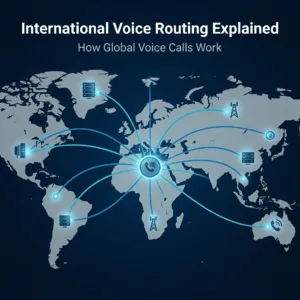
This process is known as International Voice Routing.
For businesses using VoIP services or telecom providers managing large voice volumes, understanding how international voice routing works is important because it directly affects call quality, pricing, reliability, and customer experience.
In this guide, we will explain what international voice routing means, how it works, the technologies behind it, and why choosing the right routing partner can make a big difference.
What Is International Voice Routing?
International voice routing is the process of directing voice calls from one country to another through different telecom networks and voice carriers.
When a user makes an international call, the call does not simply travel directly from one phone network to another. Instead, it passes through several interconnected systems that analyze the destination, select the best available route, and deliver the call to the final network.
For example, when someone in the United States calls a mobile number in Germany, the call may travel through:
- The original telecom provider
- A wholesale voice carrier
- International voice gateways
- Multiple interconnected carriers
- The destination mobile or fixed network
The main goal of international routing is to deliver the call with:
- High voice quality
- Low latency
- Competitive pricing
- Reliable connection rates
For wholesale VoIP providers and telecom operators, efficient routing is one of the most important parts of their business.
How International Voice Routing Works
The process behind international voice routing involves multiple technical layers. Although it looks simple from the user side, the backend includes advanced telecom infrastructure.
Call Origination
The first step happens when a customer starts a voice call.
The originating network collects important information such as:
- Caller number
- Destination number
- Country code
- Network type
- Available routes
In VoIP environments, this information is usually handled using SIP signaling.
SIP allows different communication systems to exchange information and establish voice sessions over IP networks.
Route Selection Process
After receiving the call request, the routing platform decides where to send the call.
Modern telecom providers use advanced routing systems that compare different available routes based on several factors:
- Cost per minute
- Voice quality
- Availability
- Historical performance
- ASR (Answer-Seizure Ratio)
- ACD (Average Call Duration)
The routing engine then selects the most suitable carrier or destination.
This process happens within milliseconds.
Call Termination
The final stage is called voice termination.
International voice termination means delivering the call to the destination country’s local network.
For example, a carrier in Europe may purchase wholesale routes to terminate calls into mobile networks in Asia, Africa, or North America.
The quality of termination depends heavily on the chosen carrier and route.
Poor-quality routes can result in:
- Echo problems
- Delayed audio
- Dropped calls
- Low answer rates
While premium routes usually provide better stability and clearer conversations.
Types of International Voice Routes
Not all international voice routes are the same. Telecom companies usually classify routes based on quality, pricing, and reliability.
Premium Voice Routes
Premium routes are designed for businesses that require excellent call quality.
They usually provide:
- Direct carrier connections
- Better voice clarity
- Higher stability
- Lower failure rates
Premium routes are commonly used by enterprises, financial companies, customer support centers, and telecom operators.
The downside is that premium routes usually have higher costs compared to standard routes.
Standard Voice Routes
Standard routes provide a balance between price and quality.
They are often used for:
- General business communication
- High-volume calling
- Cost-sensitive operations
Although they can be cheaper, quality may vary depending on the carrier chain involved.
Grey Routes
Grey routing refers to unofficial or unauthorized voice traffic paths.
These routes attempt to reduce termination costs by bypassing official agreements with telecom operators.
While grey routes can appear attractive because of lower prices, they often create problems such as:
- Poor call quality
- Security concerns
- Regulatory issues
- Caller ID manipulation
Professional telecom operators usually avoid unreliable routing practices.
Technologies Behind International Voice Routing
Modern international voice routing depends on several technologies that help carriers manage and optimize voice traffic.
SIP Protocol
Session Initiation Protocol (SIP) is one of the most important technologies in VoIP communication.
It controls the setup, management, and termination of voice sessions between different networks.
SIP allows carriers to exchange voice traffic globally without relying only on traditional telephone infrastructure.
Softswitch Technology
A softswitch acts as the intelligence layer of a modern voice network.
It manages:
- Call signaling
- Routing decisions
- Number translation
- Billing integration
- Carrier connections
Many wholesale VoIP providers use hosted softswitch platforms to manage thousands or millions of minutes every month.
Least Cost Routing (LCR)
Least Cost Routing is a technology that automatically selects the cheapest available route for a destination while considering quality requirements.
A basic LCR system looks only at price, but advanced routing platforms consider:
- Carrier quality history
- Real-time performance
- Network congestion
- Destination type
This helps providers reduce costs without damaging customer experience.
Why International Voice Routing Quality Matters
Choosing the wrong voice route can negatively impact communication.
For businesses, bad routing can lead to frustrated customers and lost opportunities.
Important quality factors include:
Answer-Seizure Ratio (ASR)
ASR measures the percentage of successful answered calls compared to total call attempts.
A higher ASR usually indicates better route performance.
Average Call Duration (ACD)
ACD measures the average length of completed calls.
Very short call durations can sometimes indicate problems such as unsuccessful connections or poor-quality routes.
Latency and Delay
Voice communication requires low delay.
High latency creates uncomfortable conversations where users talk over each other.
Reliable international voice carriers focus on maintaining low latency connections between networks.
Benefits of Using Professional International Voice Routing Providers
Companies that handle international voice traffic usually work with specialized wholesale voice carriers because managing global routes independently can be complicated.
A professional provider can offer:
Global Coverage
Wholesale voice providers maintain relationships with multiple carriers worldwide, allowing access to thousands of destinations.
Better Pricing
Because they operate at large volumes, international carriers can negotiate better rates and provide competitive pricing.
Improved Call Quality
Established providers monitor route performance and remove poor-performing connections.
This results in more stable voice communication.
Scalability
A reliable routing partner allows businesses to increase traffic without investing heavily in telecom infrastructure.
This is especially useful for:
- MVNO operators
- Calling platforms
- Contact centers
- Telecom resellers
International Voice Routing Challenges
Although technology has improved significantly, international routing still faces several challenges.
Regulatory Differences
Every country has different telecom regulations.
Carriers must follow local requirements related to:
- Numbering plans
- Caller ID rules
- Compliance policies
- Traffic monitoring
Fraud Prevention
Voice fraud is a major concern in international telecom.
Common threats include:
- Toll fraud
- Artificial traffic
- Caller ID spoofing
Modern routing platforms use monitoring systems to detect unusual activity.
Maintaining Quality Across Multiple Networks
A call may travel through several carriers before reaching its destination.
Each additional network can affect quality.
That is why experienced carriers focus on direct routes and trusted partnerships.
How Businesses Choose the Right International Voice Routing Partner
Selecting a voice routing provider should not be based only on price.
Important factors include:
Network Reach
A good provider should have strong coverage across the countries your business targets.
Route Quality
Ask about:
- Premium routes availability
- Direct connections
- Monitoring systems
- Quality statistics
Technical Support
International voice traffic requires fast technical support because routing problems can affect large volumes of calls.
Transparent Pricing
Reliable providers offer clear pricing models without hidden fees.
The Future of International Voice Routing
The international voice market continues to evolve as telecom companies move toward cloud-based infrastructure.
Future routing systems will rely more on:
- Artificial intelligence optimization
- Real-time route selection
- Advanced fraud detection
- Cloud-native telecom platforms
AI-powered routing can analyze millions of call records and automatically identify the best route based on quality and cost.
This will make international communication faster, cheaper, and more reliable.
Final Thoughts
International Voice Routing is the foundation behind global voice communication. Although customers only see a simple phone call, a complex network of carriers, routing platforms, and technologies work together behind the scenes.
For businesses and telecom operators, choosing the right routing strategy is essential to maintaining high-quality communication while controlling costs.
Whether you are a VoIP provider, MVNO, enterprise, or international carrier, investing in reliable voice routing infrastructure can improve customer satisfaction and create a stronger position in the global telecom market.
A quality international voice routing partner is not just about cheaper minutes, it is about delivering clear, stable, and trusted communication worldwide.
Last edit: October 6, 2026 - 17:21 by ENG. Hisham Mohamed
Eng. Hisham Mohamed is a telecommunications specialist with over 8 years of experience in VoIP, SIP termination, telecom infrastructure, voice services, and modern communication solutions. He is also a professional technical writer covering telecommunications, VoIP, cloud communication, and digital transformation.

Written by
ENG. Hisham Mohamed
Eng. Hisham Mohamed is a telecommunications specialist with over 8 years of experience in VoIP, SIP termination, telecom infrastructure, voice services, and modern communication solutions. He is also a professional technical writer covering telecommunications, VoIP, cloud communication, and digital transformation.