
wholesale VoIP vs retail VoIP: Key Differences 2026
Comparing wholesale and retail VoIP? See our wholesale VoIP page for live rates and details.
Last updated: September 2026
Wholesale VoIP is a telecom service that allows carriers, VoIP providers, and large businesses to buy voice traffic in bulk at wholesale rates. Retail VoIP is designed for end users and businesses that need phone services with simple pricing, support, and ready-to-use features. The right choice depends on your traffic volume, technical expertise, and business goals.
If you’ve been researching VoIP services, you’ve probably seen the terms Wholesale VoIP and Retail VoIP everywhere. At first they sound almost the same, but in reality they’re built for completely different customers.
Some companies only need reliable phone service for their employees. Others move millions of voice minutes every month across multiple countries. Those two businesses should never buy the same type of VoIP service. If you are comparing options, start with our Wholesale VoIP page.
This guide explains the real differences between Wholesale VoIP and Retail VoIP, how pricing works, who should use each option, and which one offers the best value depending on your business.
What Is Wholesale VoIP?
Wholesale VoIP is a service where voice traffic is purchased in large volumes from telecom carriers or wholesale providers.
Instead of buying individual phone lines, businesses purchase routes that allow them to terminate international and domestic calls at wholesale prices.
Wholesale VoIP is commonly used by:
- Telecom operators
- VoIP providers
- MVNOs
- Call centers
- International carriers
- Voice aggregators
- SIP providers
The goal is simple: move large amounts of traffic while keeping costs as low as possible without sacrificing call quality.
What Is Retail VoIP?
Retail VoIP is the service most businesses are familiar with.
Instead of dealing with voice routing, carriers, and termination agreements, customers simply subscribe to a provider that delivers phone numbers, extensions, voicemail, mobile apps, conferencing, and business phone features.
Everything is packaged into one easy service.
Retail VoIP is ideal for:
- Small businesses
- Remote teams
- Startups
- Offices
- Freelancers
- Healthcare clinics
- Law firms
The provider handles the technical side while customers focus on making calls.
Wholesale VoIP vs Retail VoIP: The Main Differences
Target Customers
Wholesale VoIP serves telecom companies and organizations with high call volumes.
Retail VoIP serves businesses and individuals who simply need a reliable phone system.
Pricing Structure
Wholesale pricing is based on call destinations, traffic volume, route quality, and negotiated rates.
Retail pricing usually comes as monthly subscriptions per user or per phone number.
The more traffic you generate, the more attractive wholesale pricing becomes.
Infrastructure
Wholesale customers often manage:
- Softswitches
- SIP routing
- SBCs
- Billing platforms
- Carrier relationships
Retail customers rarely touch any of these systems.
Everything is managed by the provider.
Technical Knowledge
Wholesale VoIP requires telecom experience.
You’ll likely need engineers who understand:
- SIP signaling
- Codec selection
- Routing policies
- Fraud prevention
- Quality monitoring
- Least Cost Routing (LCR)
Retail VoIP needs very little technical knowledge.
Most providers can have a business running within a few hours.
Scalability
Wholesale VoIP is built for massive scale.
It’s common for providers to process millions of call minutes every month.
Retail VoIP scales well for businesses, but it’s not designed for carrier-level traffic.
Call Routing
This is probably the biggest difference.
Wholesale providers optimize routes based on:
- Cost
- Quality
- ASR
- ACD
- Latency
- Carrier availability
Retail users never see any of this.
Calls are automatically routed behind the scenes.
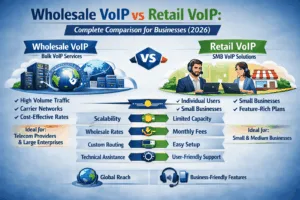
Wholesale VoIP vs Retail VoIP Comparison Table
| Feature | Wholesale VoIP | Retail VoIP |
|---|---|---|
| Target Users | Carriers and providers | Businesses and individuals |
| Pricing | Per minute | Monthly subscription |
| Call Volume | Very high | Low to medium |
| Infrastructure | Customer managed | Provider managed |
| Technical Skills | Advanced | Basic |
| Global Routing | Yes | Limited |
| Custom Routing | Yes | Usually No |
| Carrier Agreements | Required | Not required |
| Scalability | Carrier grade | Business grade |
Advantages of Wholesale VoIP
Wholesale VoIP offers significant advantages when used in the right environment.
Some of the biggest benefits include:
- Lower cost per minute
- Flexible routing
- Multiple carrier options
- Better profit margins
- Global coverage
- High scalability
- Better traffic control
- Custom quality management
For telecom companies, these advantages often translate directly into higher revenue.
Advantages of Retail VoIP
Retail VoIP focuses on simplicity.
Businesses don’t need to hire telecom engineers or negotiate with international carriers.
Common benefits include:
- Quick deployment
- Fixed monthly costs
- Business phone features
- Mobile applications
- Video conferencing
- Easy administration
- Customer support
- Minimal maintenance
It’s a great option for companies that just need dependable communication.
When Should You Choose Wholesale VoIP?
Wholesale VoIP is usually the better option if you:
- Run a telecom business
- Operate an MVNO
- Provide VoIP services
- Own a call center
- Terminate international traffic
- Need custom routing
- Process large call volumes
If your business depends on voice traffic, wholesale services generally offer much greater flexibility.
When Is Retail VoIP the Better Choice?
Retail VoIP is often the smarter choice when:
- You need office phones
- You have fewer than a few hundred users
- You want predictable billing
- You don’t have telecom engineers
- You need collaboration features
- You prefer a managed solution
Most companies fall into this category.
Can a Business Use Both?
Absolutely.
Many growing telecom companies actually combine both services.
For example:
A company may use Retail VoIP internally for employee communications while using Wholesale VoIP Termination to deliver international voice services to customers.
This hybrid approach gives businesses the best of both worlds.
Common Mistakes When Choosing Between Wholesale and Retail VoIP
Many businesses spend more than necessary because they choose the wrong service.
Some common mistakes include:
- Buying Wholesale VoIP without technical expertise
- Paying retail prices despite generating millions of call minutes
- Ignoring route quality
- Choosing the cheapest provider without monitoring ASR and ACD
- Not planning for future growth
Taking time to evaluate your traffic and business model usually prevents these costly decisions.
Frequently Asked Questions
Is Wholesale VoIP cheaper than Retail VoIP?
For high-volume traffic, yes. Wholesale pricing is generally much lower per minute than retail pricing.
Can small businesses use Wholesale VoIP?
Technically yes, but it’s rarely the most practical option unless they have telecom expertise or very large calling volumes.
Does Wholesale VoIP include phone numbers?
Not always. Many wholesale providers focus on voice termination and routing rather than end-user phone services.
Which option offers better call quality?
Both can deliver excellent quality. In Wholesale VoIP, quality depends heavily on route selection and carrier management. Retail providers handle these optimizations for you.
Is Wholesale VoIP difficult to manage?
Compared with Retail VoIP, yes. It requires technical knowledge, monitoring, and ongoing route optimization.
Final Thoughts
Wholesale VoIP and Retail VoIP solve different problems, and neither is universally better than the other.
If you’re building a telecom platform, operating a call center, or managing large-scale voice traffic, Wholesale VoIP offers greater control, lower costs, and unmatched scalability.
If your goal is simply reliable business communications, Retail VoIP provides an easier experience with predictable pricing and minimal management.
The best decision comes down to understanding your traffic volume, technical capabilities, and long-term business strategy. Choosing the right model today can save substantial costs and create a much stronger communications infrastructure as your organization grows.
Last edit: October 6, 2026 - 17:22 by ENG. Hisham Mohamed
Eng. Hisham Mohamed is a telecommunications specialist with over 8 years of experience in VoIP, SIP termination, telecom infrastructure, voice services, and modern communication solutions. He is also a professional technical writer covering telecommunications, VoIP, cloud communication, and digital transformation.

Written by
ENG. Hisham Mohamed
Eng. Hisham Mohamed is a telecommunications specialist with over 8 years of experience in VoIP, SIP termination, telecom infrastructure, voice services, and modern communication solutions. He is also a professional technical writer covering telecommunications, VoIP, cloud communication, and digital transformation.