
Table of Contents
ToggleHow Wholesale VoIP Termination Works (Complete Guide)
If you’ve ever wondered what actually happens after someone presses the call button, you’re not alone. Most people think a VoIP call simply travels over the internet and reaches the other person instantly. In reality, there’s an entire chain of networks, carriers, routing engines, and signaling protocols working together behind the scenes.
Wholesale VoIP Termination is the technology that makes international voice communication possible at scale. Mobile operators, VoIP providers, contact centers, enterprises, and telecom carriers rely on it every day to connect millions of calls across countries.
Understanding how the process works helps businesses choose better providers, reduce costs, improve call quality, and avoid routing problems that affect customer experience.
What Is Wholesale VoIP Termination?
Wholesale VoIP Termination is the process of delivering voice calls from one telecommunications network to another through wholesale carriers.
Instead of connecting directly to every mobile and fixed operator worldwide, a provider purchases access to global voice networks from wholesale carriers that already have agreements with thousands of telecom operators.
Those wholesale providers become the bridge between different networks.
Think of it like international shipping.
Rather than owning airports, trucks, ships, and warehouses in every country, one logistics company partners with others around the world to complete the delivery.
Voice traffic works almost the same way.
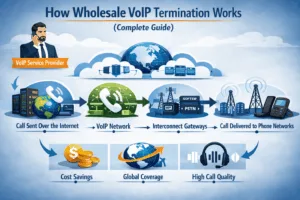
The Complete Wholesale VoIP Call Flow
A single international call passes through several stages before reaching the destination.
Step 1: The User Places a Call
Everything begins when someone starts a call from:
- IP Phone
- Softphone
- Mobile application
- Hosted PBX
- Unified Communications platform
- Contact center software
The call is converted into digital voice packets.
Step 2: SIP Signaling Starts
The device sends a SIP INVITE request to the VoIP provider.
SIP (Session Initiation Protocol) is responsible for creating, managing, and ending voice sessions.
At this point no voice has been transmitted yet.
Only signaling information is exchanged, including:
- Caller ID
- Destination number
- Supported codecs
- Authentication
- Session parameters
Step 3: The Softswitch Receives the Call
The provider’s softswitch acts as the decision maker.
It analyzes the destination number and checks routing policies.
Typical routing decisions include:
- Which carrier should receive the call
- Current carrier availability
- Call cost
- Route quality
- Traffic limits
- Customer profile
- Fraud detection rules
Modern routing engines make these decisions in milliseconds.
Step 4: Least Cost Routing (LCR)
One of the most important technologies in Wholesale VoIP Termination is Least Cost Routing.
The routing engine compares multiple available carriers.
For example:
| Carrier | Price | ASR | ACD |
|---|---|---|---|
| Carrier A | Lowest | Medium | Medium |
| Carrier B | Higher | Excellent | High |
| Carrier C | Medium | Good | Very Good |
The routing engine selects the route based on pricing policies and quality requirements.
Some providers always choose the cheapest route.
Others prioritize voice quality over price.
Most enterprise providers combine both.
Step 5: The Wholesale Carrier Receives the Call
After selecting the route, the call is sent to a wholesale carrier.
That carrier may:
- Deliver the call directly
- Send it to another regional carrier
- Forward it to a national telecom operator
Large wholesale providers maintain thousands of direct interconnections worldwide.
The more direct the route, the fewer network hops the call experiences.
Step 6: Destination Operator Completes the Call
The final telecom operator delivers the call to:
- Mobile subscriber
- Landline
- Enterprise PBX
- SIP endpoint
Once answered, RTP streams begin transmitting real-time voice packets between both parties.
Understanding SIP Voice Termination
While SIP handles signaling, RTP carries the actual audio.
Together they form the foundation of modern VoIP communications.
The process looks like this:
Caller
↓
SIP INVITE
↓
Softswitch
↓
Wholesale Carrier
↓
Destination Carrier
↓
Recipient Answers
↓
RTP Voice Stream Starts
This separation between signaling and media makes VoIP flexible, scalable, and efficient.
How Wholesale Providers Choose the Best Route
Professional providers don’t rely on static routing tables anymore.
Instead, they continuously analyze network performance.
Important routing metrics include:
Answer Seizure Ratio (ASR)
Measures how many calls are successfully answered compared to attempts.
Higher ASR usually indicates healthier routes.
Average Call Duration (ACD)
Shows how long completed calls last.
Very short durations often indicate poor call quality or routing issues.
Post Dial Delay (PDD)
Measures the time between dialing and hearing the phone ring.
Lower PDD improves user experience.
Latency
Voice packets should travel quickly.
Lower latency reduces delays and prevents awkward conversations.
Packet Loss
Lost packets create robotic voices, missing words, or dropped conversations.
Reliable carriers maintain very low packet loss rates.
Jitter
Jitter measures variations in packet arrival times.
Excessive jitter leads to distorted audio.
Direct Routes vs Indirect Routes
Not every wholesale provider owns direct connections to every destination.
Direct Routes
Advantages:
- Better call quality
- Lower latency
- Stable CLI delivery
- Higher ASR
- Fewer intermediaries
Indirect Routes
Advantages:
- Lower pricing
- Wider availability
- Flexible routing
Possible disadvantages include inconsistent quality during busy periods.
Why Multiple Carriers Matter
Professional Wholesale VoIP providers rarely depend on one carrier.
Instead they connect with dozens or even hundreds of international partners.
Benefits include:
- Automatic failover
- Better redundancy
- Competitive pricing
- Higher uptime
- Route optimization
- Disaster recovery
If one carrier experiences problems, traffic automatically shifts to another route.
Most users never notice the change.
Security During VoIP Termination
Security has become increasingly important as voice fraud continues to grow.
Modern providers protect their networks using:
- SIP authentication
- TLS encryption
- SRTP encryption
- IP whitelisting
- Fraud detection systems
- Real-time monitoring
- Rate limiting
- Geographic restrictions
These measures reduce unauthorized access and financial losses.
Common Challenges in Wholesale VoIP Termination
Even well-designed networks face occasional issues.
Some of the most common include:
Poor Voice Quality
Usually caused by congestion, packet loss, or unstable routes.
Fake Answer Supervision
Some low-quality carriers report calls as answered even when no one picked up.
This creates billing disputes.
High PDD
Slow call setup frustrates users and increases call abandonment.
CLI Problems
Caller IDs may disappear or display incorrectly when routes are poorly configured.
Capacity Limits
Traffic spikes can overwhelm providers that lack sufficient capacity.
How Businesses Benefit from Wholesale VoIP Termination
Organizations of all sizes depend on wholesale voice routing.
Common users include:
- International carriers
- Mobile operators
- MVNO providers
- Hosted PBX companies
- Contact centers
- UCaaS providers
- SIP trunk providers
- Enterprise communication platforms
The biggest advantages are:
- Lower international calling costs
- Better scalability
- Global coverage
- Improved call quality
- Flexible routing
- Higher network reliability
Choosing the Right Wholesale VoIP Provider
Before selecting a provider, evaluate more than pricing.
Important questions include:
- Do they offer direct routes?
- What ASR and ACD do they achieve?
- Is routing dynamic?
- How many carrier partnerships do they maintain?
- Is 24/7 network monitoring available?
- Do they support fraud prevention?
- Can they scale during traffic peaks?
- Are SLAs clearly defined?
The cheapest provider isn’t always the most cost-effective over time.
Consistent quality often delivers better customer satisfaction and lower operational costs.
Frequently Asked Questions
Is Wholesale VoIP Termination only for telecom companies?
No. Enterprises, call centers, cloud PBX providers, and UCaaS platforms also use wholesale voice services.
How does SIP differ from RTP?
SIP establishes and manages the call session, while RTP transports the voice itself.
Why are direct routes considered better?
Direct routes reduce network hops, improve voice quality, lower latency, and usually deliver higher ASR.
What affects international call quality the most?
Latency, packet loss, jitter, routing quality, carrier infrastructure, and network congestion all play significant roles.
Can providers automatically switch routes?
Yes. Most modern softswitch platforms support dynamic routing and automatic failover when route quality declines.
Final Thoughts
Wholesale VoIP Termination is far more than simply sending calls across the internet. It’s a sophisticated ecosystem of softswitches, SIP signaling, routing algorithms, carrier partnerships, and performance monitoring that work together in real time.
When implemented correctly, it enables businesses to deliver high-quality international voice services with reliable connectivity, competitive pricing, and excellent customer experiences. Whether you’re a telecom operator, an enterprise, or a growing VoIP provider, understanding how Wholesale VoIP Termination works makes it easier to evaluate providers, optimize network performance, and build a communications platform that scales with your business.