
Last updated: September 2026
VoIP Termination Call Flow Explained: A Carrier Guide
When a VoIP call is placed, the voice does not simply travel from the caller to the person receiving it. The call passes through several technical stages, including origination, destination analysis, route selection, carrier interconnection, call delivery, and quality monitoring. We cover this in detail in our Is VoIP Termination guide.
For carriers, MVNOs, VoIP providers, and telecom operators, understanding this VoIP termination call flow is important because every routing decision can affect call completion, cost, latency, and voice quality.
This guide follows the actual call path step by step, from the first SIP request to final delivery and post-call route analysis.
VoIP Termination Call Flow at a Glance
A typical carrier call flow can be simplified as:
Caller → Origination Network → Destination Analysis → Routing Engine → Carrier Selection → Terminating Carrier → Destination Network → Quality Monitoring
A more detailed version looks like this:
SIP Endpoint → Originating Carrier → Number Analysis → Route Database → Routing Engine → Wholesale Carrier → Terminating Carrier → PSTN/Mobile Network → Called Party
The exact architecture can vary between providers, but the core routing logic remains similar.
What Happens Before VoIP Termination?
It is important to separate origination from termination.
VoIP Origination
Origination is the part of the call where traffic enters a VoIP provider or carrier network.
For example, a customer may place a call through:
- A SIP trunk
- IP phone
- Softphone
- Hosted PBX
- Contact center platform
- Mobile application
The originating provider receives the call and prepares it for routing.
VoIP Termination
Termination happens when the call is routed toward and delivered to its final destination network.
The destination can be:
- A mobile subscriber
- A fixed-line subscriber
- A business PBX
- Another VoIP network
- A telecom operator
So, in simple terms:
Origination = bringing the call into the network.
Termination = delivering the call to the destination network.
What About VoIP Transit?
Transit is different again.
A transit carrier may carry traffic between two networks without being the final destination network.
For example:
Originating Carrier → Transit Carrier → Terminating Carrier → Mobile Network
The transit carrier transports the traffic, while the terminating carrier is responsible for completing the call toward the destination.
Keeping these three roles separate is important when designing wholesale voice routing.
Step 1: The Caller Starts the Call
The call begins when the caller dials a destination number.
The call may originate from an enterprise PBX, SIP trunk, softphone, contact center, or another VoIP platform.
The originating system creates SIP signaling to establish the session.
A typical SIP call starts with an INVITE request containing information required to establish the session.
The destination number is especially important because the routing system uses it to determine where the call needs to go.
SIP is defined by the IETF in RFC 3261, which describes the protocol used for initiating, modifying, and terminating multimedia sessions.
Step 2: The Originating Carrier Receives the Call
The originating carrier receives the SIP request and performs its initial validation.
Depending on the network architecture, the carrier may check:
- Customer authentication
- Source IP
- SIP credentials
- Calling number
- Destination number
- Account permissions
- Traffic limits
- Fraud rules
- Allowed destinations
At this stage, the carrier is not yet selecting the final termination route.
It first needs to understand what traffic it has received and whether that traffic is allowed to continue.
Step 3: The Routing System Identifies the Destination
The routing engine analyzes the destination number.
For international traffic, number analysis commonly uses country codes and numbering information to determine the destination.
The ITU-T E.164 numbering plan defines the international public telecommunications numbering structure and includes digit analysis used for routing calls. ITU-T E.164
The routing platform may determine:
- Destination country
- Destination area
- Mobile or fixed destination
- Network or operator
- Number range
- Route availability
- Applicable rate
- Carrier options
This step is critical because incorrect destination analysis can result in the wrong route being selected.
Step 4: The Routing Engine Builds the Available Route List
Once the destination has been identified, the routing engine looks for carriers capable of completing the call.
A wholesale VoIP provider may have several possible routes for the same destination.
For example:
| Route | Cost | Quality Profile | Typical Use |
|---|---|---|---|
| Direct route | Higher | High | Business and carrier traffic |
| Premium route | Higher | High | Quality-sensitive traffic |
| Standard route | Lower | Variable | Cost-sensitive traffic |
| Mixed route | Balanced | Balanced | General traffic |
The important point is that route selection is not simply about finding the lowest price.
A carrier needs to consider whether the route is currently available and whether its historical performance is acceptable.
Step 5: Carrier Selection and Routing Decision
The routing engine now selects the carrier that should receive the call.
This is where routing policies become important.
A routing platform may consider:
- Destination
- Route cost
- ASR
- ACD
- PDD
- Route availability
- Historical performance
- Capacity
- Network conditions
- Customer routing policy
Why the Cheapest Route Is Not Always the Best Route
Suppose Carrier A offers a lower rate than Carrier B.
Carrier A may appear to be the better option until its recent performance shows a higher failure rate or poor call completion.
Carrier B may cost slightly more but provide more consistent delivery.
For a carrier handling large traffic volumes, the better route can therefore be the one that produces the best overall result rather than the lowest nominal rate.
This is one reason modern routing platforms combine cost and quality data instead of relying only on static price tables.
Step 6: The SIP Session Is Forwarded to the Selected Carrier
After the routing decision is made, the originating network forwards the SIP session toward the selected carrier.
The selected carrier may be:
- A direct carrier
- A wholesale provider
- A regional carrier
- A transit provider
- A terminating carrier
The SIP signaling continues through the interconnected networks until the call reaches the network responsible for completing it.
At this stage, the signaling layer is responsible for establishing the session.
The actual voice media is handled separately.
Step 7: SIP Negotiation Establishes the Session
SIP signaling coordinates the call setup between the participating systems.
The session may negotiate information such as:
- Codec
- Media address
- Media port
- Session parameters
- Call state
Once the destination accepts the call, the media path can begin.
This distinction matters because SIP controls the session while RTP carries the real-time media.
RFC 3550 defines RTP as a protocol for transporting real-time data such as audio and video. It also describes RTCP functions used for monitoring aspects of media delivery. RFC 3550 – RTP
Step 8: Voice Media Travels Through RTP
Once the call is established, the actual audio is transported using RTP.
The media path can be affected by:
- Latency
- Packet loss
- Jitter
- Available bandwidth
- Codec selection
- Network congestion
This is why a call can successfully connect but still have poor voice quality.
The SIP signaling may work correctly while the media path experiences problems.
For carriers, monitoring both signaling and media performance is therefore important.
Step 9: The Terminating Carrier Delivers the Call
The call eventually reaches the carrier responsible for terminating the traffic.
The terminating network may connect the call to:
- A mobile network
- A fixed-line network
- A corporate PBX
- A SIP endpoint
- A contact center
At this point the call has reached the final network responsible for connecting the caller with the destination subscriber or endpoint.
This is the core of VoIP termination.
Example: International VoIP Termination Call Flow
Consider a carrier sending a call from Europe to a mobile number in another country.
A simplified flow could look like this:
Enterprise PBX
↓
Originating VoIP Carrier
↓
Destination Number Analysis
↓
Routing Engine
↓
Route Selection
↓
Wholesale Carrier
↓
Terminating Carrier
↓
Mobile Network
↓
Called Subscriber
The routing engine may initially have several suppliers available.
It compares the applicable routes and selects the route that matches the carrier’s routing policy.
If the preferred carrier becomes unavailable or starts producing unacceptable performance, the system can use an alternative route when the platform supports dynamic failover.
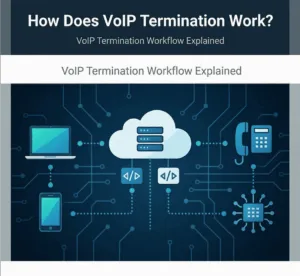
Example: How a Carrier Can Change the Route
Imagine a VoIP carrier has three suppliers for the same destination:
| Supplier | Cost | Recent ASR | Route Status |
|---|---|---|---|
| Carrier A | Low | Poor | Degraded |
| Carrier B | Medium | Good | Active |
| Carrier C | Higher | Very Good | Active |
A purely price-based routing system could select Carrier A.
A quality-aware routing system can identify that Carrier A is currently underperforming and route traffic through Carrier B instead.
This can help the carrier maintain better call completion without automatically selecting the most expensive route.
How ASR, ACD and PDD Affect Route Selection
Quality metrics are useful when they are connected directly to routing decisions.
ASR
Answer-Seizure Ratio measures the percentage of call attempts that receive an answer.
A declining ASR can be a signal that a route is not performing as expected.
However, ASR can also be influenced by destination behavior, busy numbers, network conditions, and other factors. It should therefore be analyzed in context.
ACD
Average Call Duration shows the average length of answered calls.
A sudden drop in ACD may indicate a routing or quality problem, especially when combined with other performance indicators.
ACD should not be treated as a quality score by itself.
PDD
Post Dial Delay measures the time between call initiation and the point at which the caller receives the expected call progress.
High PDD can create a poor calling experience even when the call eventually connects.
For carriers, PDD is particularly useful when troubleshooting slow call setup.
What Happens When the Preferred Route Fails?
Professional carrier routing usually needs a fallback strategy.
For example:
Primary Route → Failure → Secondary Route → Failure → Backup Route
The exact logic depends on the carrier’s routing platform and policies.
A routing engine can use failure conditions and route performance data to determine when traffic should move to another supplier.
This is where dynamic routing and automatic failover become valuable for high-volume traffic.
Common Problems in a VoIP Termination Call Flow
Even when the architecture is correct, several issues can affect call completion.
Wrong Destination Analysis
Incorrect number analysis can send traffic toward the wrong route or carrier.
Poor Route Quality
A route may be inexpensive but produce low answer rates, short calls, or inconsistent voice quality.
High PDD
Long call setup times can make the service feel slow to customers.
Packet Loss
Lost RTP packets can cause missing parts of the conversation.
Jitter
Irregular packet arrival can create choppy or distorted audio.
Carrier Outage
A supplier may temporarily become unavailable, making route redundancy important.
Routing Table Errors
Incorrect prefixes, rate decks, or carrier configuration can cause calls to fail or be sent through unsuitable routes.
VoIP Termination vs Origination vs Transit
These terms are often confused.
| Function | Main Role | Typical Position |
|---|---|---|
| VoIP Origination | Brings outbound traffic into a provider network | Start of call |
| VoIP Transit | Carries traffic between networks | Middle of call |
| VoIP Termination | Delivers traffic toward the destination network | End of call |
A single call can involve all three.
For example:
Origination → Transit → Termination
Understanding this distinction is particularly important when designing wholesale carrier relationships and routing policies.
How Carriers Optimize the VoIP Termination Call Flow
Carriers can improve their routing architecture by combining several practices.
Maintain Multiple Carrier Options
Using multiple suppliers can reduce dependency on one route.
Monitor Route Performance
ASR, ACD, PDD and other indicators can help identify route degradation.
Use Quality-Aware Routing
Routing decisions can consider both cost and performance.
Apply Automatic Failover
Traffic can move to another supplier when the preferred route becomes unavailable.
Keep Destination Data Updated
Accurate number and prefix information helps prevent incorrect routing.
Review Route Performance Regularly
A route that performed well last month may not be the best option today.
When Do You Need Wholesale VoIP Termination?
Wholesale termination is generally relevant when a business or telecom operator needs to send significant voice traffic to domestic or international destinations.
Typical users include:
- VoIP carriers
- MVNOs
- Telecom operators
- Call centers
- SIP providers
- Cloud PBX companies
- Communication service providers
The key requirement is not simply the number of calls.
It is the need for scalable carrier connectivity, routing control, destination coverage, and reliable call delivery.
What a Carrier Should Check Before Choosing a Termination Partner
Before sending production traffic, carriers should evaluate more than advertised rates.
Check:
- Destination coverage
- Route types
- Carrier interconnections
- SIP compatibility
- Route quality
- ASR and ACD reporting
- PDD performance
- Failover capabilities
- Fraud controls
- Technical support
- Billing accuracy
- Routing flexibility
A good termination partner should provide enough visibility for the carrier to understand how its traffic is performing.
VoiceBuy for Carrier VoIP Termination
VoiceBuy provides wholesale VoIP termination and global routing infrastructure for carriers, MVNOs, call centers, and enterprises.
The platform supports multiple route profiles and routing options so traffic can be managed according to destination, cost, and quality requirements.
For carriers looking to move from basic static routing toward a more controlled termination workflow, the relevant solution is VoIP termination with intelligent routing and carrier connectivity.
Final Takeaway
A VoIP termination call is not a single connection between two phones.
The call moves through a sequence of technical decisions:
Origination → Destination Analysis → Route Search → Carrier Selection → SIP Signaling → RTP Media → Terminating Carrier → Final Delivery → Quality Monitoring
For carriers, the most important part is not simply making the call connect.
The goal is to select a route that provides the right balance of delivery, quality, reliability, and cost.
Understanding this call flow makes it easier to troubleshoot failed calls, evaluate wholesale carriers, optimize routing policies, and build a more reliable international voice network.
Frequently Asked Questions
How does VoIP termination work?
VoIP termination delivers a voice call from an IP-based network to its final destination network. The process typically includes destination analysis, route selection, carrier interconnection, call delivery, and quality monitoring.
What is the difference between VoIP termination and origination?
VoIP origination brings outbound traffic into a provider or carrier network, while VoIP termination delivers the traffic toward its final destination network.
What is the role of a transit carrier?
A transit carrier transports voice traffic between interconnected networks. It does not necessarily own or operate the final destination network.
Does VoIP termination always use SIP?
SIP is widely used for signaling in VoIP networks, but the exact architecture can vary between networks and services. SIP is defined by the IETF in RFC 3261.
Why does route selection matter in VoIP termination?
Route selection affects the cost, call completion, setup time, and overall quality of voice traffic. Carriers therefore evaluate route performance instead of relying only on the lowest rate.
What are ASR, ACD and PDD used for?
ASR measures answered call attempts, ACD measures average answered call duration, and PDD measures call setup delay. Carriers can use these metrics together to evaluate route performance.
Can a VoIP call use more than one carrier?
Yes. Depending on the network architecture, a call can pass through an originating carrier, one or more transit or wholesale networks, and a terminating carrier before reaching the destination. For broader context, see the Wikipedia entry on VoIP.
Ready to Optimize Your VoIP Termination Routing?
If you are looking for global VoIP termination, carrier routes, or routing options for high-volume voice traffic, explore VoiceBuy’s termination infrastructure and discuss your destination requirements with the technical team.
Explore VoIP termination
Request routes and rates
Contact VoiceBuy
Technical References
- IETF RFC 3261 — SIP
- IETF RFC 3550 — RTP
- ITU-T E.164 — International public telecommunication numbering plan
Want to understand how wholesale VoIP termination works end to end? See our complete Wholesale VoIP Termination guide.
Last edit: October 6, 2026 - 17:20 by ENG. Hisham Mohamed
Eng. Hisham Mohamed is a telecommunications specialist with over 8 years of experience in VoIP, SIP termination, telecom infrastructure, voice services, and modern communication solutions. He is also a professional technical writer covering telecommunications, VoIP, cloud communication, and digital transformation.

Written by
ENG. Hisham Mohamed
Eng. Hisham Mohamed is a telecommunications specialist with over 8 years of experience in VoIP, SIP termination, telecom infrastructure, voice services, and modern communication solutions. He is also a professional technical writer covering telecommunications, VoIP, cloud communication, and digital transformation.