
VoiceBuy vs Twilio: Which Is Better for Wholesale VoIP?
VoiceBuy and Twilio serve different purposes in the VoIP industry. Twilio is primarily a cloud communications platform focused on APIs for developers, while VoiceBuy is built for carrier-grade wholesale VoIP, SIP termination, routing optimization, and telecom businesses. If your goal is wholesale voice services with competitive rates and high-quality routing, VoiceBuy is generally the better fit. If you need programmable communications inside applications, Twilio is often the stronger choice.
Last updated: September 2026
Compare VoiceBuy vs Twilio for wholesale VoIP, pricing, routing quality, SIP termination, scalability, and carrier-grade features. Discover which platform delivers better value for telecom providers, carriers, call centers, and businesses looking for reliable global voice services without unnecessary complexity.
Introduction
Choosing a wholesale VoIP provider isn’t just about comparing prices anymore. Network stability, routing intelligence, call quality, global coverage, and technical support all have a huge impact on your business.
A lot of companies compare VoiceBuy vs Twilio because both operate in the voice communications market. But here’s the thing, they’re actually built for different customers.
Twilio became popular because of its communication APIs that developers love. VoiceBuy, on the other hand, focuses on telecom infrastructure, wholesale voice, SIP routing, and helping carriers move millions of minutes efficiently.
So which one is actually better?
The answer depends on what you’re trying to build.
Understanding the Difference Before Comparing
This comparison makes more sense once you understand that these companies weren’t designed with exactly the same audience in mind.
Twilio is a Communications Platform as a Service (CPaaS). It allows developers to add voice, SMS, authentication, video, and messaging into applications through APIs.
VoiceBuy focuses on wholesale voice services, carrier routing, SIP termination, hosted telecom infrastructure, and enterprise-grade voice connectivity.
That difference changes almost everything.
VoiceBuy Overview
VoiceBuy is designed for telecom operators, wholesale carriers, call centers, VoIP providers, ISPs, MVNO projects, and enterprises that require reliable voice infrastructure.
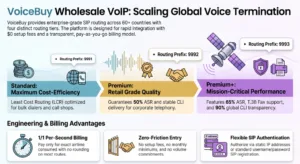
Instead of concentrating mainly on APIs, VoiceBuy focuses on delivering stable international voice traffic with optimized routing and competitive wholesale pricing.
Typical services include:
- Wholesale VoIP
- SIP Termination
- Hosted Softswitch
- Hosted PBX
- Cloud IMS
- Carrier Routing
- International Voice Termination
- Telecom Infrastructure
For businesses moving high call volumes every day, those services usually matter much more than application APIs.
Twilio Overview
Twilio is one of the biggest names in cloud communications.
Developers use Twilio because integrating voice calls into software is relatively straightforward.
Common use cases include:
- Customer support applications
- Click-to-call buttons
- Appointment reminders
- SMS notifications
- Two-factor authentication
- Voice bots
- IVR systems
It’s incredibly flexible.
But flexibility isn’t always the same thing as wholesale telecom optimization.
VoiceBuy vs Twilio Comparison
1. Wholesale VoIP Services
This is probably the biggest difference.
VoiceBuy was built around wholesale voice.
That means:
- Carrier relationships
- Competitive termination rates
- Intelligent routing
- High-volume traffic handling
- Global voice delivery
Twilio wasn’t designed primarily as a wholesale carrier.
If wholesale termination is your business, VoiceBuy naturally fits that model better.
2. SIP Termination
Reliable SIP termination determines both call quality and operating costs.
VoiceBuy emphasizes:
- Stable routes
- Multiple carrier options
- Quality monitoring
- Low latency routing
- Competitive pricing
Twilio also supports SIP connectivity, but many telecom providers find it more suitable for enterprise communications rather than wholesale traffic optimization.
3. Pricing
Pricing depends on destination, traffic volume, and commercial agreements.
Generally speaking:
VoiceBuy focuses on wholesale pricing models that become increasingly attractive as call volume grows.
Twilio follows a usage-based pricing model that works well for software companies and businesses integrating communication features into applications.
If you’re terminating millions of international minutes, the economics can look very different.
4. Call Quality
Good call quality isn’t only about codecs.
It’s affected by:
- Route selection
- Carrier partnerships
- Network congestion
- Packet loss
- Latency
- Jitter
VoiceBuy’s infrastructure is optimized around maintaining high-quality voice routes for wholesale traffic.
Twilio provides excellent quality for enterprise communication workloads, but wholesale optimization isn’t its primary focus.
5. Routing Intelligence
Wholesale carriers constantly optimize routes.
VoiceBuy supports routing strategies that help improve:
- ASR
- ACD
- Answer quality
- Network efficiency
- Profit margins
For telecom businesses, routing quality directly affects customer satisfaction.
6. API Capabilities
This is where Twilio shines.
Developers can build applications using APIs for:
- Voice
- SMS
- Video
- Authentication
- Conversations
VoiceBuy also supports integration options, but its core strength isn’t replacing an application development platform.
It’s delivering telecom infrastructure.
7. Scalability
Both platforms scale well.
The difference is how they scale.
Twilio scales cloud communications.
VoiceBuy scales wholesale voice operations.
If your company grows from one million minutes to fifty million minutes every month, infrastructure priorities become very different.
8. Support for Telecom Businesses
VoiceBuy focuses heavily on businesses like:
- Wholesale carriers
- Telecom operators
- Call centers
- International voice providers
- ISPs
- MVNO operators
Twilio serves a broader market including developers, SaaS companies, startups, healthcare, retail, financial services, and customer engagement platforms.
Neither approach is wrong.
They’re simply solving different problems.
Feature Comparison Table
| Feature | VoiceBuy | Twilio |
|---|---|---|
| Wholesale VoIP | Excellent | Limited focus |
| SIP Termination | Excellent | Good |
| Carrier Routing | Excellent | Basic |
| API Platform | Good | Excellent |
| SMS APIs | Limited | Excellent |
| Global Voice | Excellent | Excellent |
| High Volume Traffic | Excellent | Good |
| Developer Tools | Good | Excellent |
| Wholesale Pricing | Strong | Less competitive for wholesale |
| Telecom Infrastructure | Excellent | Moderate |
Which Platform Is Better for Different Businesses?
Choose VoiceBuy if you…
- Operate a telecom business.
- Need wholesale voice services.
- Buy and sell international voice traffic.
- Require SIP termination.
- Want carrier-grade routing.
- Focus on voice quality and routing optimization.
- Handle large monthly call volumes.
Choose Twilio if you…
- Build software products.
- Need communication APIs.
- Send SMS worldwide.
- Add voice calling into mobile apps.
- Build customer engagement platforms.
- Require programmable communications.
Performance Considerations
Many buyers compare providers based only on per-minute rates.
That can be expensive in the long run.
A cheaper route with poor ASR, high PDD, or frequent quality issues usually costs more through customer complaints and failed calls.
That’s why experienced wholesale providers evaluate:
- Route quality
- Network stability
- Carrier redundancy
- Technical support
- Monitoring
- Global coverage
Price matters, sure. But it shouldn’t be the only metric.
Is VoiceBuy More Cost-Effective?
For wholesale businesses, often yes.
Carrier-focused pricing, optimized routing, and infrastructure built for high-volume traffic can produce better long-term value than paying API-oriented communication rates.
For software companies that simply need programmable voice inside an application, Twilio may deliver better value despite higher voice pricing.
Again, the best platform depends on the business model.
Final Verdict
Comparing VoiceBuy and Twilio isn’t really about deciding which company is universally better.
It’s about choosing the right platform for the right job.
If you’re building customer communication features into an application, Twilio remains one of the strongest CPaaS platforms available.
If you’re operating in the wholesale VoIP market, managing international voice traffic, or looking for carrier-grade SIP termination with optimized routing and competitive wholesale pricing, VoiceBuy is the more specialized solution.
Understanding your traffic, your customers, and your long-term growth plans will help you make the right decision without paying for features you don’t actually need.
Frequently Asked Questions
Is VoiceBuy a replacement for Twilio?
Not necessarily. They target different markets. VoiceBuy focuses on wholesale VoIP and telecom infrastructure, while Twilio specializes in programmable communications and APIs.
Which platform is better for SIP termination?
Businesses handling wholesale voice traffic will generally find VoiceBuy better suited for carrier-grade SIP termination and routing optimization.
Is Twilio good for wholesale VoIP?
Twilio supports voice services, but it isn’t primarily designed as a wholesale VoIP platform. Companies focused on carrier operations often prefer providers built specifically for wholesale routing.
Which platform offers better scalability?
Both scale effectively. Twilio scales application communications, while VoiceBuy scales high-volume carrier voice operations.
Which platform is better for call centers?
It depends on the call center. Enterprise call centers needing programmable communications may benefit from Twilio. Wholesale and international voice operations usually align better with VoiceBuy’s infrastructure.
Last edit: October 6, 2026 - 17:19 by ENG. Hisham Mohamed
Eng. Hisham Mohamed is a telecommunications specialist with over 8 years of experience in VoIP, SIP termination, telecom infrastructure, voice services, and modern communication solutions. He is also a professional technical writer covering telecommunications, VoIP, cloud communication, and digital transformation.

Written by
ENG. Hisham Mohamed
Eng. Hisham Mohamed is a telecommunications specialist with over 8 years of experience in VoIP, SIP termination, telecom infrastructure, voice services, and modern communication solutions. He is also a professional technical writer covering telecommunications, VoIP, cloud communication, and digital transformation.