
Table of Contents
ToggleWhat is the difference between CS and IMS?
The main difference between CS (Circuit Switching) and IMS (IP Multimedia Subsystem) is that CS uses dedicated voice circuits for every call, while IMS delivers voice, video, messaging, and multimedia services over IP networks. CS is designed mainly for traditional voice communication, whereas IMS provides a flexible architecture that supports modern services like VoLTE, VoWiFi, video calling, and rich communication across LTE and 5G networks.
If you’ve worked with telecom networks for even a short time, you’ve probably seen the terms CS and IMS everywhere. They’re both responsible for delivering communication services, but that’s where the similarity almost ends.
For years, Circuit Switched networks powered nearly every phone call around the world. They were reliable, simple, and built for one thing, voice. Then mobile networks evolved. LTE arrived, data traffic exploded, and users expected HD voice, video calls, instant messaging, and seamless connectivity across different devices.
Traditional CS networks simply weren’t built for that.
That’s why the telecom industry introduced IMS, a completely different architecture designed for IP-based communication.
Understanding the difference between CS and IMS isn’t just useful for telecom engineers. It’s important for carriers, MVNOs, network architects, enterprise service providers, and anyone working with modern mobile infrastructure.
This guide explains everything in simple terms.
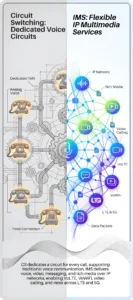
What Is Circuit Switching (CS)?
Circuit Switching, usually shortened to CS, is the traditional method of delivering voice calls.
Whenever someone makes a call, the network establishes a dedicated connection between the caller and the receiver. That connection remains reserved for the entire conversation, even during silent moments.
Think of it like reserving an entire highway lane for one car until the journey finishes.
The resources stay occupied until someone hangs up.
This model worked extremely well because voice traffic is continuous and predictable.
Traditional technologies that rely on CS include:
- GSM
- UMTS voice services
- PSTN
- ISDN
For decades, this architecture became the foundation of global telephony.
What Is IMS?
IMS stands for IP Multimedia Subsystem.
Instead of creating dedicated circuits, IMS delivers communication services using IP packets.
Voice becomes another IP service, just like streaming video or browsing a website.
But IMS isn’t only about voice.
It’s a complete service platform capable of supporting:
- VoLTE
- VoWiFi
- Video calling
- Rich Communication Services (RCS)
- SIP-based multimedia
- Presence services
- Messaging
- Future 5G communication services
IMS separates applications from network transport, making new services much easier to launch.
That’s one of the biggest reasons telecom operators continue investing in IMS infrastructure.
Why Did Telecom Move from CS to IMS?
The answer is simple.
Customer expectations changed.
Years ago, users only needed reliable phone calls.
Today they expect:
- HD voice
- Instant messaging
- Video conferencing
- Multi-device communication
- High-speed mobile internet
- Seamless switching between WiFi and LTE
- Integration with cloud applications
Circuit Switching cannot efficiently support these services.
IMS was designed specifically to handle them.
Difference Between CS and IMS
| Feature | CS | IMS |
|---|---|---|
| Network Type | Circuit Switched | Packet Switched |
| Transport | Dedicated circuits | IP network |
| Primary Service | Voice | Voice, video, messaging and multimedia |
| Resource Usage | Fixed during call | Dynamic packet transmission |
| Scalability | Limited | Highly scalable |
| LTE Support | Requires fallback | Native support |
| VoLTE | Not supported | Fully supported |
| VoWiFi | No | Yes |
| Video Calling | Limited | Native capability |
| Integration | Difficult | Easy with cloud platforms |
| Future Ready | No | Yes, designed for 5G |
How CS Handles Voice Calls
A CS network follows a straightforward process.
Step 1
The user initiates a voice call.
Step 2
The network reserves a dedicated circuit.
Step 3
Both users communicate using that exclusive path.
Step 4
Once the call ends, the circuit becomes available for someone else.
Simple, stable, but not very flexible.
How IMS Handles Communication
IMS works differently.
User Registration
The device registers with the IMS core using SIP.
Session Setup
Instead of reserving an entire circuit, SIP creates a communication session.
Media Transfer
Voice travels as RTP packets across the IP network.
Service Management
The IMS core controls authentication, routing, billing, security, and service delivery.
Everything remains software driven instead of hardware dependent.
CS Architecture Overview
The traditional CS core contains several important elements.
Mobile Switching Center (MSC)
Responsible for call switching.
Home Location Register (HLR)
Stores subscriber information.
Visitor Location Register (VLR)
Keeps temporary subscriber records.
Authentication Center (AuC)
Verifies subscriber identity.
Gateway MSC
Handles communication with external telephone networks.
The architecture works well, but expanding services usually requires additional hardware.
IMS Architecture Overview
IMS is more modular.
Its major components include:
P-CSCF
The first SIP contact point for user devices.
I-CSCF
Routes requests to the correct serving node.
S-CSCF
The heart of IMS session control.
HSS
Stores subscriber profiles and authentication data.
Application Servers
Deliver services such as voicemail, conferencing, messaging, and enterprise applications.
Because every function is separated, operators can introduce new services without redesigning the entire network.
Advantages of Circuit Switching
Although older, CS still offers benefits.
- Very stable voice quality
- Predictable performance
- Mature technology
- Wide global deployment
- Reliable emergency calling
Many legacy networks continue using CS because it remains dependable.
Advantages of IMS
IMS brings much greater flexibility.
Some major benefits include:
- HD Voice
- VoLTE support
- VoWiFi support
- Lower operational costs
- Better spectrum efficiency
- Faster service deployment
- Cloud integration
- SIP interoperability
- Multimedia communication
- 5G compatibility
- Easier scalability
This flexibility explains why nearly every modern operator is moving toward IMS.
Limitations of Circuit Switching
CS also has several drawbacks.
- Expensive hardware expansion
- Poor support for multimedia
- Low network efficiency
- Separate voice and data infrastructure
- Difficult service innovation
- Limited flexibility
As networks become more software-defined, these limitations become more noticeable.
Challenges of IMS
IMS isn’t perfect either.
Operators may face challenges such as:
- More complex deployment
- Higher initial implementation cost
- SIP expertise requirements
- Integration with legacy networks
- Security planning
- Migration from older infrastructure
However, once deployed, IMS often reduces long-term operational costs.
CS Fallback (CSFB)
During the early LTE rollout, many networks still relied on Circuit Switching for voice.
Because LTE originally carried only packet data, phones temporarily switched back to 3G or GSM whenever users made voice calls.
This process became known as Circuit Switched Fallback (CSFB).
While effective, CSFB increased call setup time.
VoLTE running on IMS eliminated this requirement.
IMS and VoLTE
VoLTE is one of IMS’s most successful applications.
Instead of leaving LTE for voice calls, subscribers stay connected to LTE while making HD-quality calls.
Benefits include:
- Faster call setup
- Better voice quality
- Lower latency
- Simultaneous voice and high-speed data
- Improved battery efficiency in many scenarios
Without IMS, VoLTE wouldn’t exist.
IMS and 5G
5G networks depend heavily on IMS.
Even though 5G introduces new core technologies, voice services continue relying on IMS through Voice over New Radio (VoNR).
IMS therefore remains one of the most valuable investments for operators planning long-term network evolution.
When Is CS Still Used?
Despite the shift toward IP, CS hasn’t disappeared.
You’ll still find it in:
- Legacy GSM networks
- Rural deployments
- Older feature phones
- Countries still modernizing infrastructure
- Backup voice services
Migration happens gradually rather than overnight.
When Should Operators Deploy IMS?
IMS becomes the preferred choice when operators need:
- VoLTE
- VoWiFi
- 5G services
- Multimedia communication
- Enterprise SIP services
- Rich messaging
- Faster service innovation
- Lower long-term operating costs
For greenfield mobile operators and MVNOs, IMS is usually the default architecture today.
CS vs IMS: Which One Is Better?
There’s no universal winner because each technology was designed for a different era.
If your goal is reliable traditional voice communication, Circuit Switching still performs well.
If your network must support HD voice, video calls, WiFi calling, cloud integration, and future 5G services, IMS is clearly the better choice.
Most telecom operators are no longer asking whether they should migrate to IMS. They’re planning how quickly they can complete the transition while continuing to support legacy CS users during the migration period.
Final Thoughts
The difference between CS and IMS reflects the evolution of telecommunications itself.
Circuit Switching transformed global voice communication and served the industry for decades with remarkable reliability. But modern users demand far more than voice alone.
IMS introduces a software-driven, IP-based architecture capable of delivering voice, video, messaging, and future multimedia services across LTE and 5G networks. It enables operators to innovate faster, reduce operational complexity over time, and provide the seamless communication experience customers now expect.
For carriers, MVNOs, and telecom providers planning long-term network growth, understanding the differences between CS and IMS is essential. While CS will continue to exist in legacy environments for years, IMS is the foundation on which modern and future mobile networks are being built.
Frequently Asked Questions
What is the main difference between CS and IMS?
CS uses dedicated circuits for voice communication, while IMS uses IP packet networks to deliver voice, video, messaging, and other multimedia services.
Is IMS replacing Circuit Switching?
Yes. Most telecom operators are gradually replacing Circuit Switched networks with IMS to support VoLTE, VoWiFi, and 5G services while reducing reliance on legacy infrastructure.
Why is IMS important for 5G?
IMS enables voice services such as VoNR and supports multimedia communication over all-IP networks, making it a core component of modern LTE and 5G deployments.
Can CS and IMS work together?
Yes. During migration, many operators run CS and IMS simultaneously. Technologies like Circuit Switched Fallback (CSFB) allow legacy voice services while IMS adoption continues.
Does IMS only support voice calls?
No. IMS supports voice, video calling, instant messaging, conferencing, presence services, VoLTE, VoWiFi, Rich Communication Services (RCS), and many other IP-based communication services.
Sources
- 3rd Generation Partnership Project (3GPP) — IMS architecture specifications (TS 23.228 and related standards).
- GSMA — Technical resources on VoLTE, VoWiFi, IMS, and mobile network evolution.
- Internet Engineering Task Force — SIP protocol specifications (RFC 3261), which form the signaling basis of IMS.
Last edit: July 28, 2026 - 07:09 by ENG. Hisham Mohamed
Eng. Hisham Ibrahim is a telecommunications specialist with over 8 years of experience in the telecom industry, focusing on VoIP technologies, communication solutions, and emerging trends in the telecommunications sector. Throughout his career, he has gained extensive knowledge of telecom infrastructure, voice services, and modern communication platforms. In addition to his technical expertise, Eng. Hisham is a professional technical writer who creates insightful and industry-focused articles covering telecommunications, VoIP, cloud communication, and digital transformation. His writing combines practical industry experience with deep technical understanding, helping businesses and professionals stay informed about the latest developments in communication technologies. With a passion for technology and knowledge sharing, Eng. Hisham continues to contribute valuable content that simplifies complex telecom concepts and provides meaningful insights for readers around the world.