
Table of Contents
ToggleHow Does VoIP Termination Work? A Step-by-Step Guide for Carriers
VoIP termination is the process of routing a voice call from one carrier’s network to its final destination using IP-based infrastructure. The process includes receiving the call, analyzing the destination, selecting the best route, forwarding the call through one or more wholesale carriers, completing the connection, and monitoring quality in real time. Modern VoIP providers use intelligent routing algorithms to balance call quality, latency, and cost.
Every phone call that travels across the internet follows a path. Most people never think about that path, they simply dial a number and expect the call to connect instantly.
For carriers, wholesalers, and telecom providers, that path is everything.
A single international call may pass through several networks before reaching the person on the other end. Each network makes routing decisions that affect voice quality, latency, reliability, and cost. This entire process is known as VoIP termination.
Understanding how VoIP termination works helps carriers improve customer experience, reduce expenses, and avoid routing problems that can hurt their business.
In this guide we’ll walk through the complete process, from the moment a call starts until it reaches its destination.
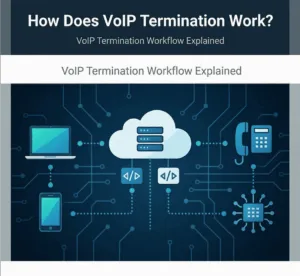
What Is VoIP Termination?
VoIP termination is the process of delivering a voice call from an IP network to the destination phone network.
The destination might be:
- A mobile network
- A landline carrier
- Another VoIP provider
- A PBX system
- An enterprise SIP trunk
Instead of relying on traditional PSTN switching alone, VoIP termination uses SIP signaling and IP networks to move voice traffic efficiently across carriers around the world.
The better the routing decisions, the better the call quality.
Why VoIP Termination Matters for Carriers
For telecom operators, routing a call isn’t just about getting it connected.
Every routing decision impacts:
- Voice quality
- Call completion rates
- Customer satisfaction
- Carrier costs
- Profit margins
- Network utilization
Even saving a fraction of a cent per minute across millions of minutes can translate into significant revenue.
That’s why modern carriers invest heavily in intelligent routing platforms.
Step 1 – The Caller Initiates the Call
Everything begins when someone places a call.
This could happen through:
- A softphone
- IP phone
- Mobile application
- Hosted PBX
- SIP trunk
- Enterprise phone system
The caller’s device sends a SIP INVITE message to the originating carrier.
That message includes important information such as:
- Calling number
- Destination number
- Codec capabilities
- Session information
- Authentication details
At this point no voice has started flowing yet.
The network is simply preparing the connection.
Step 2 – The Carrier Identifies the Destination
Next, the originating carrier analyzes the destination number.
Using the country code and national numbering plan, the routing platform determines:
- Destination country
- Mobile or fixed line
- Network operator
- Rate deck category
- Available wholesale routes
This lookup happens almost instantly.
A properly maintained routing database is critical because incorrect destination analysis can send traffic through the wrong carrier.
Step 3 – The Routing Engine Searches for Available Routes
Now comes one of the most important steps.
The routing engine checks every available supplier capable of completing the call.
A carrier may have:
- Premium routes
- Standard routes
- Direct carrier connections
- Wholesale partners
- Regional providers
Each route has different characteristics.
For example:
| Route Type | Cost | Quality | Typical Use |
|---|---|---|---|
| Premium | Higher | Excellent | Business traffic |
| Standard | Lower | Good | Cost-sensitive traffic |
| Direct Carrier | Medium | Very High | Enterprise customers |
| Mixed Route | Balanced | Balanced | General traffic |
Instead of choosing randomly, the routing platform evaluates every option.
Step 4 – Least Cost Routing (LCR) Calculates the Best Option
Most wholesale providers use Least Cost Routing (LCR).
LCR compares multiple variables including:
- Cost per minute
- ASR (Answer-Seizure Ratio)
- ACD (Average Call Duration)
- Historical quality
- Current availability
- Capacity
- Network congestion
The cheapest route isn’t always selected.
Modern systems often prioritize quality when a low-cost supplier has poor performance.
This balance is what separates professional VoIP carriers from low-quality providers.
Step 5 – The SIP Call Is Forwarded
Once the best route has been selected, the SIP session is forwarded to the chosen wholesale carrier.
The SIP INVITE continues through one or more interconnected networks until it reaches the terminating carrier.
Each carrier exchanges:
- SIP signaling
- Authentication
- Session negotiation
- Codec information
Only after the destination accepts the session does the voice stream begin.
Step 6 – Media Flows Through RTP
After SIP establishes the connection, voice travels using RTP (Real-time Transport Protocol).
Unlike SIP, RTP carries the actual audio.
The quality of RTP depends on several factors:
- Packet loss
- Latency
- Network jitter
- Bandwidth
- Codec selection
Poor network conditions immediately affect the conversation.
That’s why carriers constantly monitor media performance.
Step 7 – The Destination Network Delivers the Call
Eventually the call reaches the terminating carrier.
This carrier is responsible for delivering the call to:
- Mobile subscriber
- Landline
- Corporate PBX
- SIP endpoint
- Contact center
If everything works correctly, the phone rings.
The person answers.
The conversation begins.
For the caller it feels instant.
Behind the scenes dozens of routing decisions happened in less than a second.
Step 8 – Quality Monitoring Happens Throughout the Call
The work doesn’t stop once the call connects.
Professional carriers continuously monitor performance.
Important KPIs include:
ASR (Answer-Seizure Ratio)
Measures how many call attempts are successfully answered.
Higher ASR usually indicates healthier routes.
ACD (Average Call Duration)
Longer conversations often indicate better call quality.
Very short calls may signal poor routing.
PDD (Post Dial Delay)
Measures the time between dialing and hearing ringing.
Customers expect this delay to be minimal.
MOS (Mean Opinion Score)
MOS estimates voice quality on a scale from poor to excellent.
Premium carriers usually target consistently high MOS values.
Intelligent Routing Improves Every Step
Traditional routing relied almost entirely on pricing.
Today’s routing platforms consider much more.
Modern systems evaluate:
- Real-time route health
- Historical performance
- Active outages
- Fraud detection
- Capacity management
- Network latency
- Geographic optimization
Many providers now automate route switching in real time.
If one supplier begins failing calls, traffic moves elsewhere almost instantly.
Customers usually never notice.
Common Problems During VoIP Termination
Even advanced networks experience issues.
Some of the most common include:
High Latency
Long network paths create delays that make conversations awkward.
Packet Loss
Missing voice packets produce broken audio.
Jitter
Irregular packet arrival creates choppy conversations.
Incorrect Routing
Poor routing tables can send calls to unavailable networks.
Low-Quality Wholesale Providers
Choosing the absolute cheapest supplier sometimes results in poor ASR and unhappy customers.
Saving money upfront can cost more later.
How Carriers Optimize VoIP Termination
Leading carriers rarely depend on a single supplier.
Instead they combine:
- Multiple wholesale carriers
- Dynamic routing
- Real-time monitoring
- Automatic failover
- Premium routes
- Geographic optimization
- Intelligent quality scoring
This approach improves reliability while keeping operating costs under control.
Why Businesses Care About VoIP Termination
Businesses may never see the routing engine.
But they absolutely notice the results.
Better termination means:
- Clearer conversations
- Faster call setup
- Higher customer satisfaction
- Fewer dropped calls
- Better contact center performance
- Improved international communication
For organizations handling thousands of calls every day, even small improvements make a measurable difference.
Choosing the Right VoIP Termination Provider
If you’re selecting a provider, don’t focus only on price.
Ask questions like:
- How many carrier interconnections do they maintain?
- Do they offer premium and standard routes?
- Is dynamic routing available?
- What monitoring tools are used?
- Can they provide ASR and ACD reports?
- Do they support automatic failover?
- What SLA do they guarantee?
A provider with strong routing intelligence often delivers better long-term value than one offering the lowest rates.
Why VoiceBuy Is a Trusted Choice for Smart VoIP Termination
VoiceBuy provides carrier-grade Smart VoIP Routing Solutions designed for businesses, wholesale carriers, and telecom providers that require consistent voice quality and dependable global connectivity.
Rather than relying on static routing, VoiceBuy uses intelligent routing technologies that continuously evaluate available routes based on performance, stability, and cost efficiency. This helps reduce failed calls, improve answer rates, and maintain excellent voice quality across international destinations.
Whether your business needs Wholesale Standard Routes, Mix Routes, Wholesale Premium Routes, or Wholesale Premium Plus Routes, VoiceBuy offers flexible routing options that can match different traffic profiles and quality requirements. Combined with real-time monitoring and scalable infrastructure, these services enable carriers to optimize both operational costs and customer experience.
Final Thoughts
VoIP termination is much more than sending a call from one network to another.
Behind every successful conversation is a sophisticated routing process that analyzes destinations, compares wholesale carriers, evaluates network quality, and delivers the call using the most suitable path.
For carriers, mastering this process means better margins, stronger network performance, and happier customers. And as global voice traffic continues to grow, intelligent VoIP termination will remain one of the most important technologies in modern telecommunications.