Wholesale VoIP Routes 2026

Table of Contents

Wholesale VoIP Routes: The Complete Guide to High-Quality Voice Routing, Pricing, Optimization & Carrier Selection (2026)

Introduction

Global voice communications have evolved far beyond traditional telephone networks. Today, businesses, telecom carriers, Internet Telephony Service Providers (ITSPs), call centers, CPaaS platforms, and wholesale operators rely on Wholesale VoIP Routes to deliver millions of international calls every day with high quality, low latency, and competitive pricing.

However, purchasing wholesale routes isn’t simply about finding the lowest price. A route that appears inexpensive on paper can quickly become costly if it suffers from poor call quality, high post-dial delay (PDD), low answer-seizure ratio (ASR), or frequent routing failures. In wholesale voice, profitability depends on balancing cost, quality, reliability, and intelligent routing strategies.

As global voice traffic continues to increase and customer expectations rise, network operators must evaluate route quality using measurable performance metrics rather than price alone. They also need to understand how wholesale routing works behind the scenes, how carriers optimize traffic in real time, and how modern technologies such as AI-powered routing, dynamic least-cost routing (LCR), and automated failover are reshaping the industry.

Whether you’re launching a new VoIP business, expanding your carrier network, or optimizing an existing voice infrastructure, understanding wholesale routes is essential for delivering reliable international calling services while maximizing operational efficiency and profit margins.

This comprehensive guide explains everything you need to know, including:

  • What Wholesale VoIP Routes are and how they work?
  • The different types of wholesale voice routes.
  • How wholesale call termination is performed step by step?
  • The differences between CLI, Non-CLI, and CC routes.
  • Quality metrics every buyer should monitor.
  • How pricing, rate decks, and billing increments affect profitability?
  • Best practices for selecting high-quality carriers.
  • Common mistakes to avoid.
  • Future trends shaping wholesale voice routing in 2026 and beyond.

By the end of this guide, you’ll have a practical framework for evaluating providers, optimizing voice quality, reducing costs, and building a resilient wholesale VoIP infrastructure.

What Are Wholesale VoIP Routes?

Wholesale VoIP Routes are international voice paths that enable telecommunications providers to deliver calls between different networks using Internet Protocol (IP) instead of the traditional Public Switched Telephone Network (PSTN).

Rather than connecting directly to every destination worldwide, service providers purchase access to wholesale routes from specialized carriers that already maintain extensive interconnections with mobile operators, fixed-line providers, and global telecom networks.

Think of a wholesale route as a carefully engineered pathway that carries a voice call from its origin to its destination through multiple interconnected networks. The quality, reliability, and cost of that pathway determine the overall calling experience.

Unlike retail VoIP services designed for individual businesses or consumers, wholesale routes operate at carrier scale, handling thousands—or even millions—of concurrent international calls every day.

Why Wholesale VoIP Routes Matter

For telecom operators, every outbound call represents both a service opportunity and a financial decision.

Selecting the wrong route can lead to:

  • Poor voice quality
  • High latency
  • Frequent call failures
  • Increased customer complaints
  • Lost revenue
  • Carrier penalties
  • Reduced customer retention

Conversely, selecting high-quality routes helps providers:

  • Improve customer satisfaction
  • Increase answer rates
  • Reduce operational costs
  • Optimize network utilization
  • Expand global coverage
  • Maximize profit margins
  • Maintain service-level agreements (SLAs)

In competitive markets such as the United States and Europe, route quality has become a key differentiator. Businesses increasingly prioritize consistent call performance over marginal cost savings, making intelligent route management a strategic advantage.

Who Uses Wholesale VoIP Routes?

Wholesale VoIP routing supports a wide range of organizations across the telecommunications ecosystem.

Internet Telephony Service Providers (ITSPs)

ITSPs use wholesale routes to terminate international calls without building direct interconnections in every country. This allows them to offer competitive global calling services while maintaining flexible operating costs.

Telecom Carriers

National and international carriers purchase wholesale routes to extend network coverage, improve redundancy, and optimize traffic distribution across multiple partners.

Call Centers

Outbound and inbound contact centers rely on high-quality routes to ensure reliable customer interactions, especially for sales, customer support, collections, and appointment reminders where call clarity directly impacts business outcomes.

CPaaS Providers

Communications Platform as a Service providers integrate wholesale voice routes into APIs that enable developers to build voice-enabled applications, automated notifications, authentication calls, and omnichannel communication platforms.

Wholesale Voice Providers

Wholesale carriers buy and sell voice traffic between international operators, constantly optimizing routing decisions based on quality metrics, pricing, and network performance.

Enterprise Businesses

Large multinational enterprises with global offices often use wholesale-grade voice infrastructure through managed providers to reduce communication costs while maintaining enterprise-grade reliability.

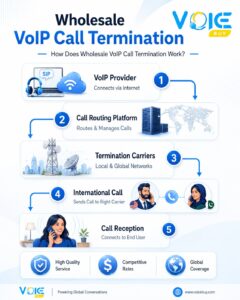
How Wholesale VoIP Call Termination Works, Step by Step

One of the biggest misconceptions about wholesale voice services is that a phone call travels directly from the caller to the recipient. In reality, every international VoIP call passes through multiple intelligent network components before reaching its destination.

Understanding this journey helps explain why route quality, carrier selection, and routing policies have such a significant impact on both call quality and operating costs.

The Wholesale Call Flow

Caller
   │
IP Phone / PBX
   │
Session Border Controller (SBC)
   │
Softswitch
   │
Routing Engine (LCR / Quality Routing)
   │
Wholesale Carrier
   │
Tier-1 or Direct Carrier
   │
Destination Network
   │
Recipient
Wholesale VoIP Routes 2026

Each component in this chain plays a specific role in ensuring that the call reaches its destination efficiently, securely, and with the highest possible voice quality.

Step 1: The Call Originates

The process begins when a user places a call from an IP phone, softphone, SIP trunk, PBX system, or cloud communications platform.

At this stage, the voice signal is converted into IP packets using audio codecs such as G.711, G.729, or Opus, depending on network conditions and service requirements.

Step 2: Session Border Controller (SBC)

The call is then processed by a Session Border Controller.

The SBC acts as the first line of defense for the network by:

  • Authenticating SIP sessions
  • Preventing unauthorized access
  • Protecting against SIP attacks
  • Managing NAT traversal
  • Encrypting voice traffic when required
  • Maintaining interoperability between different networks

Without an SBC, wholesale voice networks would be significantly more vulnerable to fraud, denial-of-service attacks, and interoperability issues.

Step 3: Softswitch Processing

Once authenticated, the call reaches the softswitch—the operational brain of a wholesale voice network.

The softswitch is responsible for:

  • User authentication
  • Call authorization
  • Codec negotiation
  • Billing integration
  • Call logging
  • Route selection
  • Policy enforcement
  • Carrier management

Modern cloud softswitches can process hundreds of thousands of simultaneous call sessions while continuously evaluating route performance in real time.

Step 4: Intelligent Route Selection

Instead of selecting a fixed path, the routing engine evaluates multiple available carriers based on predefined policies.

These policies may include:

  • Least Cost Routing (LCR)
  • Quality-Based Routing
  • Priority Routing
  • Geographic Routing
  • Time-Based Routing
  • Load Balancing
  • Dynamic Carrier Ranking
  • Automatic Failover

For example, if Carrier A offers the lowest rate but its ASR has dropped below an acceptable threshold, the routing engine may automatically choose Carrier B to preserve call quality.

This dynamic decision-making process is one of the key reasons modern wholesale VoIP networks outperform traditional static routing models.

Step 5: Wholesale Carrier Processing

After route selection, the chosen wholesale carrier accepts the call and forwards it through its own network infrastructure.

Large wholesale providers maintain direct interconnections with hundreds of operators worldwide, allowing them to deliver calls efficiently across multiple regions while minimizing latency.

Step 6: Destination Carrier

The destination carrier receives the call and routes it into the local telephone network, whether mobile, fixed-line, or enterprise.

Depending on the destination, this may involve:

  • Mobile Network Operators (MNOs)
  • Fixed-Line Operators
  • National Carriers
  • Regional Telecom Providers
  • Enterprise SIP Networks

Step 7: Call Completion

Finally, the recipient’s device rings, and the call is established.

Throughout the entire conversation, network components continuously monitor packet delivery, latency, jitter, and call stability to ensure a consistent voice experience.

Why Understanding the Call Flow Matters

Every stage in the wholesale routing process influences call quality, operating costs, and customer satisfaction.

A weak SBC configuration may expose the network to fraud.

A poorly configured routing engine may select low-quality carriers.

An unreliable upstream provider may increase latency or reduce answer rates.

Understanding these dependencies enables telecom operators to troubleshoot issues faster, optimize routing policies, and make informed decisions when evaluating wholesale providers.

Types of Wholesale VoIP Routes

Not all wholesale VoIP routes are created equal. While many providers advertise “premium quality” or “low-cost international termination,” the reality is that each route type is designed for different business objectives.

Some prioritize crystal-clear voice quality, while others focus on reducing costs for high-volume traffic. Choosing the wrong route can lead to poor customer experiences, reduced Answer-Seizure Ratios (ASR), increased support tickets, and lower profit margins.

Understanding the characteristics of each route type allows operators to align routing decisions with their business goals rather than relying solely on price.

Premium Routes

Premium Routes are considered the highest-quality wholesale VoIP routes available. They are typically delivered through direct carrier interconnections or trusted Tier-1 providers, ensuring minimal packet loss, low latency, and excellent call completion rates.

These routes are ideal for businesses where voice quality directly impacts customer satisfaction or revenue.

Key Characteristics

  • Direct or near-direct carrier connections
  • High ASR and ACD
  • Excellent voice clarity
  • Low PDD (Post-Dial Delay)
  • Minimal jitter and packet loss
  • Stable long-term performance
  • Strong SLA commitments

Best For

  • Financial institutions
  • Healthcare providers
  • Government communications
  • Enterprise businesses
  • Executive communications
  • Customer support centers
  • High-value international clients

Advantages

  • Outstanding voice quality
  • Reliable call completion
  • Lower customer complaints
  • Better customer retention
  • Consistent network performance

Considerations

Premium routes generally come at a higher cost than standard alternatives, but they often generate a stronger return on investment by reducing failed calls and improving customer experience.

Standard Routes

Standard Routes offer a balanced combination of quality and affordability.

Rather than using exclusively direct interconnections, these routes may pass through several trusted wholesale carriers while still maintaining acceptable performance levels.

They are among the most commonly used route types in the wholesale voice industry.

Best For

  • SMB VoIP providers
  • International business communications
  • General enterprise traffic
  • Moderate-volume voice services

Advantages

  • Competitive pricing
  • Good voice quality
  • Wide international coverage
  • Flexible scalability

Limitations

Quality may vary depending on the destination country and upstream carrier relationships.

Value Routes

Value Routes prioritize cost savings over premium call quality.

They are designed for operators managing large traffic volumes where keeping costs low is more important than achieving the highest possible voice performance.

Although these routes may experience occasional quality fluctuations, they remain suitable for many commercial applications.

Common Use Cases

  • High-volume outbound campaigns
  • Promotional calls
  • Non-critical voice traffic
  • Emerging markets
  • Price-sensitive customers

Direct Routes

Direct Routes terminate calls directly into the destination operator’s network without relying on multiple intermediary carriers.

Because there are fewer network hops, these routes generally provide superior reliability and lower latency.

Benefits

  • Faster call setup
  • Better audio quality
  • Lower latency
  • Higher call completion rates
  • Reduced routing complexity

Direct routes are especially valuable for destinations where voice quality is a top priority or where regulatory compliance requires direct carrier relationships.

Tier-1 Routes

Tier-1 Routes are provided by carriers that own extensive global telecommunications infrastructure and maintain direct peering agreements with numerous international operators.

These carriers typically operate large backbone networks capable of handling millions of voice sessions simultaneously.

Characteristics

  • Extensive international reach
  • High network redundancy
  • Carrier-grade infrastructure
  • Excellent uptime
  • Strong service-level agreements

Best For

  • International telecom operators
  • Wholesale carriers
  • Large cloud communication providers
  • Global enterprises

Tier-2 Routes

Tier-2 carriers purchase capacity from Tier-1 providers and redistribute voice traffic to regional markets.

Although they generally offer lower pricing, performance may vary depending on the quality of their upstream providers.

Advantages

  • Competitive rates
  • Flexible commercial agreements
  • Strong regional expertise

Considerations

Careful quality monitoring is essential when working with Tier-2 providers.

Static Routes

Static Routes follow predefined routing paths that remain unchanged until manually updated.

Advantages

  • Predictable routing behavior
  • Easier troubleshooting
  • Consistent traffic management

Disadvantages

  • Limited flexibility
  • Slower response to network failures
  • Manual optimization required

Static routing is commonly used in highly controlled enterprise environments.

Dynamic Routes

Dynamic Routes automatically adapt to changing network conditions.

Routing engines continuously evaluate carrier performance and select the most appropriate route based on predefined quality and pricing rules.

Modern cloud softswitches increasingly rely on dynamic routing to optimize network performance in real time.

Benefits

  • Automatic route optimization
  • Higher availability
  • Better call quality
  • Reduced operational workload
  • Intelligent traffic distribution

Hybrid Routes

Hybrid routing combines multiple routing strategies into a single intelligent framework.

For example:

  • Premium routes for VIP customers
  • Standard routes for business traffic
  • Value routes for marketing campaigns

This approach allows operators to maximize profitability while maintaining service quality where it matters most.

CLI, Non-CLI, and CC Routes: Choosing the Right Wholesale VoIP Route Type

One of the most important decisions wholesale voice buyers make is selecting the appropriate caller identification method.

Although pricing often attracts the most attention, the type of route you choose significantly affects answer rates, customer trust, regulatory compliance, and overall call success.

What Are CLI Routes?

CLI (Calling Line Identification) Routes transmit the caller’s authentic phone number to the recipient.

When the recipient answers the phone, they see the correct originating number rather than an anonymous or substituted caller ID.

Benefits

  • Higher answer rates
  • Greater customer trust
  • Improved brand reputation
  • Better regulatory compliance
  • Reduced spam detection
  • Essential for enterprise communications

Recommended For

  • Customer support
  • Financial services
  • Healthcare organizations
  • Authentication calls
  • Business communications
  • Government agencies

What Are Non-CLI Routes?

Non-CLI Routes either suppress or replace the caller ID before the call reaches the destination.

Because the recipient cannot verify the origin of the call, these routes typically experience lower answer rates.

Advantages

  • Lower pricing
  • Suitable for certain bulk traffic scenarios
  • Available in destinations where CLI support is limited

Risks

  • Reduced customer confidence
  • Higher likelihood of call rejection
  • Potential regulatory restrictions
  • Increased spam filtering

What Are CC Routes?

CC (Call Center) Routes are specifically optimized for high-volume outbound and inbound call center operations.

Unlike standard wholesale routes, CC routes are engineered to handle sustained traffic volumes while maintaining stable call quality and predictable performance.

Common Features

  • Optimized for continuous outbound dialing
  • Improved route stability
  • Better congestion management
  • High concurrent call capacity
  • Enhanced routing consistency

Best For

  • Contact centers
  • Customer service departments
  • Telemarketing operations
  • Debt collection agencies
  • Appointment reminder systems

Comparing CLI, Non-CLI, and CC Routes

Feature CLI Routes Non-CLI Routes CC Routes
Caller ID Visibility ✅ Yes ❌ No ✅ Usually
Voice Quality Excellent Variable High
Customer Trust Very High Low High
Average Cost Higher Lower Moderate
Answer Rates High Lower High
Compliance Strong Depends on destination Strong
Best Use Case Enterprise communications Cost-sensitive traffic High-volume call centers

Expert Recommendation

If your business depends on customer engagement, brand reputation, or regulatory compliance, CLI routes should be your default choice.

Non-CLI routes should only be used after carefully evaluating destination regulations and understanding the potential impact on call completion rates.

For organizations operating large contact centers, dedicated CC routes provide the best balance between scalability, reliability, and operational efficiency.

Choosing the Right Route for Your Business

Different business models require different routing strategies. There is no universal solution that fits every organization.

Business Type Recommended Route
Enterprise PBX Premium CLI
International Carrier Tier-1 + Dynamic Routing
Wholesale Provider Hybrid Routes
Outbound Call Center CC Routes
Authentication Platform (OTP) Direct CLI Routes
CPaaS Provider Premium + Dynamic LCR
Budget VoIP Provider Standard Routes
Marketing Campaigns Value Routes (where compliant)

Expert Tip: Instead of relying on a single route type, build a diversified routing strategy that combines Premium, Standard, and Dynamic Routes. This improves resilience, reduces dependency on a single carrier, and enables intelligent failover during outages or congestion.

How Wholesale Routes Are Selected

Many businesses assume that once a call enters a carrier’s network, it automatically follows the shortest or cheapest path. In reality, modern wholesale voice networks use sophisticated routing engines that evaluate multiple factors before selecting the optimal route for every individual call.

A single destination may have dozens—or even hundreds—of available routes offered by different carriers. The routing engine continuously analyzes pricing, quality metrics, network availability, historical performance, and routing policies before making a decision in milliseconds.

This intelligent routing process is what separates carrier-grade wholesale providers from low-cost resellers.

Least Cost Routing (LCR)

Least Cost Routing (LCR) is the most widely used routing strategy in the wholesale VoIP industry.

Its primary objective is simple: deliver calls through the lowest-cost route that still meets predefined quality requirements.

Instead of sending every call through the same carrier, the routing engine compares available rates from multiple providers and dynamically selects the most economical option.

How LCR Works

  1. A call request reaches the softswitch.
  2. The routing engine identifies all carriers capable of terminating the destination.
  3. It compares buy rates from each provider.
  4. Quality thresholds are checked.
  5. The lowest-priced qualifying route is selected.
  6. If the preferred carrier is unavailable, the system automatically moves to the next available route.

Advantages

  • Reduces operating costs
  • Improves profit margins
  • Supports automatic carrier selection
  • Simplifies international routing

Potential Drawbacks

Using price as the only decision factor can negatively affect:

  • Voice quality
  • Call completion rates
  • Customer satisfaction
  • Long-term profitability

For this reason, modern wholesale operators rarely rely on pure LCR alone.

Quality-Based Routing

Quality-Based Routing prioritizes call performance instead of price.

The routing engine continuously measures each carrier’s performance using live network statistics and historical data.

Rather than choosing the cheapest provider, it selects the route most likely to deliver a successful, high-quality call.

Typical Evaluation Factors

  • ASR (Answer-Seizure Ratio)
  • ACD (Average Call Duration)
  • PDD (Post-Dial Delay)
  • Packet loss
  • MOS score
  • Latency
  • Jitter
  • Historical route stability

This approach is commonly used for:

  • Enterprise communications
  • Financial services
  • Emergency services
  • Premium international traffic
  • Executive communications

Priority Routing

Priority Routing follows a predefined hierarchy established by network administrators.

For example:

Priority 1 → Direct Carrier

Priority 2 → Tier-1 Carrier

Priority 3 → Regional Carrier

Priority 4 → Backup Provider

The system always attempts to use the highest-priority route first. If that carrier becomes unavailable or fails to meet quality thresholds, traffic automatically shifts to the next available option.

This strategy is particularly effective when operators have trusted long-term carrier partnerships.

Load Balancing

Large wholesale providers rarely send all traffic through a single carrier.

Instead, they distribute traffic across multiple providers simultaneously to improve efficiency and reduce congestion.

Benefits

  • Better resource utilization
  • Reduced network overload
  • Improved redundancy
  • Higher availability
  • Greater resilience during traffic spikes

Load balancing also prevents excessive dependence on a single upstream provider.

Geographic Routing

Geographic Routing selects carriers based on the destination region rather than applying identical routing rules worldwide.

For example:

  • One carrier may consistently deliver excellent quality in Germany.
  • Another may perform better in Brazil.
  • A third may offer superior connectivity in Southeast Asia.

Rather than forcing one provider to handle every destination, geographic routing assigns traffic to the strongest regional performer.

This strategy improves:

  • Call quality
  • Route efficiency
  • Customer satisfaction
  • Cost optimization

Time-Based Routing

Network performance changes throughout the day.

During peak hours, some carriers experience congestion, while others maintain stable performance.

Time-Based Routing automatically adjusts carrier preferences according to predefined schedules or historical traffic patterns.

For example:

  • Premium carriers during business hours
  • Cost-optimized carriers overnight
  • Specialized routing for weekends
  • Seasonal routing adjustments

This approach maximizes both service quality and profitability.

Automatic Failover Routing

Carrier outages are inevitable.

Whether caused by fiber cuts, power failures, signaling issues, or network congestion, interruptions can happen without warning.

Automatic Failover ensures that calls continue flowing without manual intervention.

How It Works

If Carrier A fails:

The routing engine immediately detects the issue.

Carrier B becomes active.

If necessary, traffic shifts again to Carrier C.

Users experience minimal disruption.

This capability is essential for maintaining high service availability and meeting enterprise SLA commitments.

AI-Powered Routing

Artificial Intelligence is rapidly transforming wholesale voice routing.

Instead of relying solely on static rules, AI systems continuously analyze millions of historical call records to predict which carrier is most likely to provide the best outcome for each call.

Modern AI routing engines can evaluate:

  • Destination performance trends
  • Carrier reliability
  • Network congestion
  • Time-of-day behavior
  • Seasonal traffic patterns
  • Historical ASR fluctuations
  • Customer-specific routing preferences

Benefits of AI Routing

  • Improved call quality
  • Faster route optimization
  • Reduced manual intervention
  • Predictive carrier selection
  • Better profit margins
  • Continuous self-optimization

As AI adoption grows, predictive routing is becoming a competitive advantage for wholesale operators serving enterprise and carrier customers.

Static vs. Dynamic Route Selection

Feature Static Routing Dynamic Routing
Manual Configuration Yes No
Real-Time Optimization No Yes
Automatic Failover Limited Yes
Quality Monitoring Minimal Continuous
Scalability Moderate Excellent
Best For Small deployments Carrier-grade networks

For most modern wholesale environments, dynamic routing provides greater flexibility, resilience, and long-term operational efficiency.

Building a Multi-Carrier Routing Strategy

Relying on a single wholesale provider creates unnecessary operational risk.

A more resilient approach is to build a multi-carrier ecosystem with intelligent routing policies.

A typical strategy might include:

  • Primary Carrier: Premium direct routes for mission-critical traffic.
  • Secondary Carrier: Competitive standard routes for routine business communications.
  • Backup Carrier: Reliable failover provider for unexpected outages.
  • Regional Specialists: Carriers with exceptional performance in specific countries or regions.

This layered architecture improves redundancy, maintains service continuity, and enables continuous optimization based on both quality and cost.

Quality Metrics Every Wholesale VoIP Routes Buyer Should Track

Price alone does not determine the value of a wholesale VoIP route. A low-cost route that produces failed calls, poor audio quality, or customer complaints can quickly become more expensive than a premium alternative.

Professional carriers monitor a set of key performance indicators (KPIs) to evaluate route quality objectively. Understanding these metrics allows buyers to compare providers, detect performance issues early, and optimize routing decisions.

Ready to Get Started?

Contact our team today and get a fast response.

Contact Us

Answer-Seizure Ratio (ASR)

ASR measures the percentage of call attempts that are successfully answered.

Formula:

ASR = (Answered Calls ÷ Total Call Attempts) × 100

Why It Matters

A consistently high ASR indicates that calls are reaching their destinations successfully, while a low ASR may signal routing problems, network congestion, invalid numbers, or poor carrier performance.

General Benchmark:

  • Above 60% – Excellent
  • 45–60% – Good
  • Below 45% – Requires investigation

It’s important to interpret ASR in context, as expected values vary by destination, traffic type, and calling patterns.

Average Call Duration (ACD)

ACD measures the average length of successfully connected calls.

Longer call durations often indicate that users are having meaningful conversations rather than hanging up due to poor quality or connection issues.

Typical Guidelines

  • Over 3 minutes – Strong engagement
  • 2–3 minutes – Acceptable
  • Under 2 minutes – May indicate quality concerns or call setup issues

ACD should always be analyzed alongside ASR for a complete picture of route performance.

Post-Dial Delay (PDD)

PDD is the time between dialing a number and hearing the ringing tone.

Customers expect calls to connect quickly, and excessive delays can create the impression that the network is unreliable.

Recommended Targets

  • Under 2 seconds – Excellent
  • 2–4 seconds – Acceptable
  • Over 4 seconds – Poor user experience

High PDD often points to inefficient routing, overloaded signaling infrastructure, or excessive carrier hops.

Mean Opinion Score (MOS)

MOS is an industry-standard measure of perceived voice quality, typically rated on a scale from 1 (poor) to 5 (excellent).

It reflects the user’s listening experience by considering factors such as clarity, distortion, delay, and packet loss.

MOS Ratings

MOS Score Quality
4.3–5.0 Excellent
4.0–4.3 Very Good
3.6–4.0 Acceptable
Below 3.6 Needs Improvement

Latency

Latency is the time it takes for voice packets to travel from the caller to the recipient.

High latency causes noticeable delays in conversations, making interactions feel unnatural.

Recommended Levels

  • Below 150 ms – Excellent
  • 150–200 ms – Acceptable
  • Above 250 ms – Likely to impact conversation quality

Jitter

Jitter measures the variation in packet arrival times.

Excessive jitter can cause robotic voices, choppy audio, or gaps in conversations.

Most modern networks use jitter buffers to smooth packet delivery, but consistently high jitter still degrades call quality.

Packet Loss

Voice communication depends on the continuous delivery of IP packets. When some of these packets fail to reach their destination, portions of the conversation are lost.

Unlike video streaming—which can often recover from missing packets—real-time voice traffic has very little tolerance for packet loss.

Common Causes

  • Network congestion
  • Poor internet connectivity
  • Faulty routing
  • Overloaded carrier infrastructure
  • Hardware failures
  • Bandwidth limitations

Impact on Call Quality

Even a small amount of packet loss can significantly degrade the user experience.

Typical symptoms include:

  • Missing words
  • Choppy conversations
  • Robotic voices
  • Audio clipping
  • Broken sentences

Recommended Thresholds

Packet Loss Voice Quality
Below 1% Excellent
1–2% Good
2–5% Acceptable
Above 5% Poor

Jitter

Although latency measures delay, jitter measures the consistency of packet delivery.

Imagine receiving the words of a sentence in random order instead of a steady flow—that’s essentially what excessive jitter creates.

Acceptable Values

Jitter Quality
<20 ms Excellent
20–30 ms Good
30–50 ms Acceptable
>50 ms Poor

Networks with high jitter often require larger jitter buffers, which can increase overall latency.

False Answer Supervision (FAS)

False Answer Supervision is one of the most important—and often overlooked—quality indicators in wholesale voice.

FAS occurs when a carrier incorrectly reports that a call has been answered before the recipient actually picks up.

As a result:

  • Billing begins immediately.
  • Customers pay for unanswered calls.
  • Voice prompts or advertisements may play before connection.
  • Profitability decreases.
  • Customer trust is damaged.

Warning Signs

  • Unusually high ASR with very low ACD
  • Customer complaints about silent calls
  • Unexpected billing increases
  • Recorded messages before connection

Professional wholesale buyers actively monitor FAS because it directly affects both customer satisfaction and financial performance.

CLI Accuracy

For businesses using CLI routes, displaying the correct caller ID is essential.

Incorrect CLI information can lead to:

  • Lower answer rates
  • Spam classification
  • Regulatory issues
  • Reduced customer trust

Regular testing across multiple destinations helps ensure CLI consistency.

Route Stability

Quality should not fluctuate dramatically throughout the day.

A reliable wholesale route maintains consistent performance during:

  • Peak business hours
  • High traffic events
  • Seasonal demand spikes
  • International traffic surges

Frequent quality variations often indicate overloaded upstream carriers or poor traffic engineering.

Carrier Availability

Carrier availability measures the percentage of time a provider remains operational.

Enterprise customers generally expect:

  • 99.9% uptime
  • 99.95% uptime
  • 99.99% uptime

Anything significantly lower can affect SLA commitments and business continuity.

Building a Route Quality Scorecard

Rather than evaluating providers based on a single metric, successful wholesale buyers create a balanced scorecard that combines several KPIs.

Metric Target
ASR >60%
ACD >3 minutes
PDD <2 seconds
MOS >4.0
Latency <150 ms
Jitter <20 ms
Packet Loss <1%
CLI Accuracy 99%+
Uptime 99.99%

This scorecard provides a more complete picture of route quality and helps identify providers that consistently deliver reliable performance.

Expert Tip: Don’t evaluate carriers based on a single day’s performance. Analyze trends over several weeks or months to account for traffic fluctuations, maintenance windows, and regional variations.

Understanding Rate Decks

Every wholesale VoIP provider publishes a Rate Deck, which serves as the pricing foundation for international call termination.

A rate deck is much more than a simple price list. It defines the commercial terms under which voice traffic is exchanged between carriers.

Understanding how to read and evaluate rate decks is essential for protecting profit margins and avoiding unexpected costs.

What Is a Rate Deck?

A Rate Deck is a structured document that lists:

  • Destination countries
  • Destination prefixes
  • Buy rates
  • Billing increments
  • Effective dates
  • Currency
  • Route type
  • Special pricing conditions

Each destination is priced individually because termination costs vary depending on local operators and regulatory environments.

Typical Rate Deck Example

Destination Prefix Buy Rate Billing
United States 1 $0.0025 1/1
United Kingdom 44 $0.0031 1/1
Germany 49 $0.0042 30/6
France 33 $0.0038 1/1

Although two providers may advertise similar pricing, differences in billing increments and route quality can significantly affect the actual cost per call.

Why Rate Decks Change Frequently

Wholesale voice pricing is dynamic.

Providers regularly update rate decks due to:

  • Changes in carrier agreements
  • Regulatory adjustments
  • Currency fluctuations
  • Seasonal demand
  • Traffic optimization
  • Market competition

Many wholesale carriers publish updated rate decks weekly—or even daily.

How to Compare Two Rate Decks

Price should never be evaluated in isolation.

Instead, compare:

  • Buy rate
  • Route quality
  • Billing increment
  • CLI availability
  • Average ASR
  • Average ACD
  • Direct vs indirect routing
  • SLA commitments

A route priced at $0.0045 may ultimately deliver better profitability than one priced at $0.0038 if it significantly improves answer rates and customer satisfaction.

Wholesale VoIP Pricing Explained

Understanding wholesale pricing requires more than comparing rate cards.

Successful operators analyze the complete financial impact of each routing decision.

Buy Rate

The buy rate is the amount you pay your upstream carrier to terminate a call.

For example:

Buy Rate = $0.008 per minute

Sell Rate

The sell rate is what you charge your customer.

Example:

Sell Rate = $0.012 per minute

Gross Margin

Your gross margin is the difference between the sell rate and the buy rate.

Example:

Buy Rate: $0.008

Sell Rate: $0.012

Gross Profit: $0.004 per minute

Margin:

0.012−0.0080.012×100=33.3%\frac{0.012-0.008}{0.012}\times100 = 33.3\%

However, this theoretical margin only exists if route quality remains high enough to avoid failed calls and customer churn.

Billing Increments

One of the most misunderstood aspects of wholesale pricing is billing increments.

Carriers rarely bill by the exact second.

Instead, they use predefined billing intervals.

1/1 Billing

Calls are billed per second from the first second.

Example:

A 45-second call = 45 seconds billed.

This model is considered the fairest and most transparent.

6/6 Billing

Calls are rounded up to the nearest six-second interval.

Example:

A 31-second call becomes 36 billable seconds.

30/6 Billing

The first 30 seconds are billed in full.

After that, billing occurs in six-second increments.

Example:

A 12-second call = billed for 30 seconds.

A 44-second call = billed for 48 seconds.

60/60 Billing

Every started minute is billed as a full minute.

A 5-second call becomes a 60-second charge.

While this model may appear inexpensive based on the published buy rate, it often increases the effective cost of short-duration calls.

The Hidden Cost of Cheap Routes

A route with the lowest advertised price isn’t always the most profitable.

For example:

Route Buy Rate ASR ACD Customer Experience
Route A $0.004 38% 1.6 min Poor
Route B $0.006 67% 4.2 min Excellent

Although Route A appears cheaper, Route B may generate higher revenue through better call completion, longer conversations, and improved customer retention.

The most successful wholesale providers optimize for total business value—not simply the lowest price.

Wholesale VoIP Route Best Practices: Maximizing Quality and Margins

Selecting high-quality routes is only the first step. Long-term success in wholesale voice depends on continuously monitoring, optimizing, and refining your routing strategy.

The following best practices are used by leading carriers and enterprise VoIP providers to maximize service quality while protecting profit margins.

1. Never Choose a Route Based on Price Alone

Low rates can be attractive, but they often come with hidden costs such as poor ASR, high PDD, or unreliable call completion. Evaluate the total value of a route, including quality metrics, SLA commitments, and customer experience.

2. Diversify Your Carrier Portfolio

Avoid relying on a single upstream provider. Maintaining multiple carriers allows you to balance traffic, improve redundancy, and quickly fail over during outages or performance degradation.

3. Monitor KPIs Continuously

Track ASR, ACD, PDD, MOS, latency, jitter, packet loss, and uptime in real time. Establish alert thresholds so your operations team can respond before customers are affected.

4. Test Routes Regularly

Conduct scheduled test calls to key destinations, especially after receiving updated rate decks or making routing changes. Verify audio quality, CLI presentation, and call setup times across different regions.

5. Use Dynamic Routing Policies

Implement intelligent routing that adapts to live network conditions rather than relying solely on static configurations. Combining Least Cost Routing with quality-based rules helps maintain a balance between profitability and customer satisfaction.

Fraud Prevention in Wholesale VoIP

As wholesale voice networks expand globally, they also become increasingly attractive targets for fraud.

Without proactive monitoring and security controls, fraudulent activity can generate substantial financial losses within minutes.

Understanding the most common fraud schemes—and how to prevent them—is essential for protecting your business.

International Revenue Share Fraud (IRSF)

IRSF is one of the most damaging forms of telecom fraud.

Attackers generate large volumes of calls to premium-rate international numbers, sharing the resulting revenue with the owners of those destinations.

Prevention Strategies

  • Real-time traffic monitoring
  • Destination blocking
  • Spending limits
  • Call velocity alerts
  • AI-based anomaly detection

False Answer Supervision (FAS)

As discussed earlier, FAS occurs when calls are falsely reported as answered before reaching the recipient.

Protect against FAS by:

  • Monitoring ACD trends
  • Comparing ASR with billing data
  • Performing regular test calls
  • Working only with trusted carriers

CLI Spoofing

Fraudsters manipulate caller ID information to impersonate legitimate organizations.

Consequences include:

  • Brand damage
  • Customer distrust
  • Regulatory violations
  • Increased spam classification

Implementing CLI validation and STIR/SHAKEN helps reduce this risk in supported regions.

SIP Registration Attacks

Weak SIP credentials can allow attackers to register unauthorized devices and place fraudulent calls.

Mitigation includes:

  • Strong authentication
  • Multi-factor authentication (where applicable)
  • IP restrictions
  • Session Border Controllers
  • Continuous monitoring

Traffic Pumping

Traffic pumping artificially inflates call volumes to specific destinations for financial gain.

Detection methods include:

  • Call pattern analysis
  • Unusual destination monitoring
  • AI-driven behavioral analytics
  • Real-time reporting

Regulatory Compliance in the United States and Europe

Compliance is no longer optional. Telecom providers must meet evolving regulatory requirements to maintain customer trust and avoid penalties.

United States

Key regulatory considerations include:

  • STIR/SHAKEN for caller ID authentication
  • FCC regulations governing voice services
  • Emergency calling support (where applicable)
  • Robocall mitigation requirements
  • Consumer privacy protections

Providers serving the U.S. market should ensure their routing partners support compliant caller identification and anti-spoofing mechanisms.

European Union

For operators serving Europe, compliance extends beyond network quality.

Important frameworks include:

  • GDPR for personal data protection
  • ePrivacy Directive
  • National telecommunications regulations
  • Number portability requirements
  • Lawful interception obligations

Understanding local regulations for each destination country helps avoid compliance issues and service disruptions.

Common Mistakes Wholesale VoIP Buyers Make

Even experienced operators can make costly routing decisions. Avoid these common pitfalls:

Buying Based Only on Price

Low-cost routes often compromise quality, leading to customer dissatisfaction and lower long-term profitability.

Ignoring Performance Metrics

Without monitoring ASR, ACD, PDD, and MOS, it’s impossible to identify underperforming routes before they impact users.

Relying on a Single Carrier

A lack of redundancy increases operational risk and leaves your business vulnerable to outages.

Failing to Test Routes

Regular testing verifies that routes continue to meet quality expectations as network conditions evolve.

Overlooking Fraud Prevention

Reactive security measures are rarely sufficient. Proactive monitoring is essential for minimizing financial losses.

The Future of Wholesale VoIP Routes

The wholesale voice industry continues to evolve rapidly, driven by advances in cloud computing, automation, and artificial intelligence.

Several trends are shaping the future of carrier-grade voice routing.

AI-Powered Route Optimization

Machine learning models are increasingly used to predict route quality, automate carrier selection, and optimize traffic in real time.

Cloud-Native Softswitches

Cloud infrastructure enables greater scalability, simplified management, and faster deployment of new services.

Predictive Network Analytics

Instead of responding to issues after they occur, predictive analytics identify potential problems before they affect customers.

5G and VoNR

As 5G adoption grows, Voice over New Radio (VoNR) will further improve voice quality and reduce latency, creating new opportunities for wholesale providers.

Greater Automation

Automation will continue to streamline:

  • Route management
  • Billing
  • Fraud detection
  • Performance monitoring
  • Network provisioning

Providers that embrace these technologies will be better positioned to deliver high-quality services while maintaining competitive operating costs.

Frequently Asked Questions (FAQs)

What are Wholesale VoIP Routes?

Wholesale VoIP Routes are carrier-grade voice paths used by telecom providers to terminate international calls over IP networks. They enable businesses to connect with global destinations without maintaining direct connections to every operator.

What is the difference between CLI and Non-CLI routes?

CLI routes display the caller’s authentic phone number, improving answer rates and trust. Non-CLI routes suppress or alter caller identification and are generally used for cost-sensitive applications.

How do I evaluate route quality?

Monitor KPIs such as ASR, ACD, PDD, MOS, latency, jitter, packet loss, and uptime. A balanced scorecard provides a more accurate view than pricing alone.

Why is Least Cost Routing important?

LCR helps reduce operating costs by selecting the lowest-priced route that meets predefined quality thresholds. Modern implementations often combine cost optimization with quality-based routing.

Should I work with multiple wholesale providers?

Yes. A multi-carrier strategy improves redundancy, enables automatic failover, and allows continuous optimization based on quality and pricing.

Conclusion

Wholesale VoIP Routes form the backbone of global voice communications, connecting businesses, carriers, and service providers across international networks. However, successful wholesale routing is about far more than finding the lowest termination rates.

Organizations that consistently deliver high-quality voice services focus on measurable performance metrics, intelligent routing strategies, diversified carrier relationships, and proactive network management. By combining dynamic routing, continuous quality monitoring, strong fraud prevention, and careful provider evaluation, businesses can reduce operational costs while improving customer satisfaction and long-term profitability.

As technologies such as AI-driven routing, cloud-native softswitches, and predictive analytics continue to transform the telecommunications industry, selecting the right wholesale routes will become an even more strategic competitive advantage.

Whether you’re an ITSP, telecom carrier, CPaaS provider, or enterprise expanding your global voice capabilities, adopting the best practices outlined in this guide will help you build a resilient, scalable, and future-ready wholesale VoIP infrastructure that delivers consistent quality and sustainable growth.

Last edit: July 2, 2026 - 10:45 By hisham

Ready to Get Started?

Contact our team today and get a fast response.

Contact Us

Leave a Comment

Your email address will not be published. Required fields are marked *