
Best Carrier SIP Softswitches in 2026: Top Providers Guide
Choosing a softswitch for your carrier? See our softswitch page for live rates and details.
Last updated: September 2026
Choosing a carrier-grade SIP softswitch in 2026 is no longer just an infrastructure purchase—it is a core business decision that directly dictates call completion rates, operational margins, regulatory compliance, and network resiliency.
As global voice traffic becomes increasingly complex and margins in wholesale voice continue to tighten, telecom operators—from Tier-1 carriers and MVNOs to regional ITSPs—require switching platforms that deliver microsecond latency, intelligent routing algorithms, and automated fraud defense. Furthermore, operating in highly regulated jurisdictions like North America requires strict adherence to regulatory standards such as STIR/SHAKEN and E911 mandates.
This comprehensive evaluation analyzes the architectural requirements of modern Class 4 and Class 5 softswitches, highlights critical evaluation metrics, and reviews top industry providers powering modern voice networks in 2026.
Class 4 vs. Class 5 SIP Softswitches: Understanding the Core Difference
Before evaluating software platforms, telecom engineering teams must align platform capabilities with their core architecture requirements:
| Parameter | Class 4 Softswitch | Class 5 Softswitch |
| Primary Focus | High-volume wholesale voice traffic & transit routing. | End-user service delivery & business communications. |
| Key Capability | Intelligent LCR, SIP-to-SIP bridging, multi-carrier interconnects. | UCaaS, Hosted PBX, IVR, Auto-attendants, Call Center tools. |
| Throughput Requirement | High Concurrent Calls (CC) & Calls Per Second (CPS). | Moderate CPS, high feature density per endpoint. |
| Target Audience | Carriers, Wholesale Voice Aggregators, MVNOs. | ITSPs, CLECs, Enterprise Service Providers. |
Must-Have Features for Carrier Softswitches in 2026
1. Advanced Routing & Margin Protection
-
Least Cost Routing (LCR): Automated real-time dynamic routing based on rate deck analysis, target margins, and quality metrics.
-
Quality-Based Routing (QBR): Real-time monitoring of Answer Seizure Ratio (ASR) and Average Call Duration (ACD) to automatically bypass degraded routes.
-
Margin-Driven Routing: Ensures call attempts are automatically blocked or re-routed if the cost exceeds the wholesale selling price.
2. Regulatory Compliance (Essential for North America)
-
STIR/SHAKEN Framework: Native support for SIP identity header verification, certificate management, and token signing (A, B, and C-level attestations) to comply with FCC mandates.
-
E911 & Emergency Services Routing: Dynamic location routing (Kari’s Law & RAY BAUM’S Act compliance) to ensure location-precise dispatch.
-
LRN (Location Routing Number) Lookup: Local Number Portability (LNP) database queries to eliminate unnecessary transit fees.
3. Automated Fraud Mitigation
-
International Revenue Share Fraud (IRSF) detection algorithms.
-
SIM Box Detection & Traffic Pattern Analysis.
-
Rate Limits & CPS Throttling: Automatic blocking of unauthorized call spikes or IP registration hijacking attempts.
Top SIP Softswitch Providers for Carriers in 2026
1. VoiceBuy
Best for: Hosted Cloud Softswitch Infrastructure, Fast Deployment, and Scalable Wholesale VoIP.
VoiceBuy offers specialized cloud-hosted switching and termination infrastructure designed for operators seeking enterprise-grade performance without the heavy CapEx of maintaining physical hardware.
-
Key Strengths: Fully managed cloud infrastructure, flexible hosted Class 4/5 options, rapid deployment, integrated routing, and scalable wholesale capabilities.
-
Best Suited For: Wholesale VoIP providers, telecom startups, MVNO operators, and international carriers seeking rapid deployment and flexible infrastructure.
2. Sippy Softswitch
Best for: Pure Wholesale Voice, High-Volume Class 4 Traffic, and International Interconnects.
Sippy remains an industry benchmark for wholesale voice operators requiring robust Class 4 performance, high CPS capacity, and dependable billing engines.
-
Key Strengths: Highly efficient LCR engines, excellent rate deck management, and robust REST APIs.
-
Best Suited For: Wholesale aggregators, international voice transit carriers, and established VoIP operators.
3. PortaOne (PortaSwitch)
Best for: Hybrid Wholesale/Retail Operators and All-in-One Telecom BSS/OSS Platforms.
PortaOne offers an integrated billing and switching architecture (PortaBilling + PortaSIP), making it a comprehensive platform for service providers offering a mix of wholesale, retail, and MVNO services.
-
Key Strengths: Single platform for billing, provisioning, and routing; source-code access options for custom development.
-
Best Suited For: Mid-to-large ITSPs, converged operators, and MVNOs looking for unified platform management.
4. Sansay (VSXi)
Best for: High Security, Carrier-Grade Class 4 Switching, & US Market Compliance.
Sansay is a staple in North American carrier networks, recognized for high-concurrency throughput, rock-solid stability, and deep regulatory compliance integrations.
-
Key Strengths: Superior STIR/SHAKEN handling, ultra-low latency bridging, and enterprise-grade hardware/cloud reliability.
-
Best Suited For: Tier-2/3 carriers, CLECs, and large wholesale operations operating in strict regulatory environments.
5. NetSapiens (SNAP-Solution)
Best for: UCaaS Providers, Class 5 Hosted PBX, and Managed Service Providers.
While NetSapiens focuses heavily on Class 5 UCaaS delivery, its session routing capabilities make it a market leader for service providers delivering end-user business communication solutions.
-
Key Strengths: Feature-rich UCaaS platform, multi-tenant portal management, flexible seat-based or session-based licensing.
-
Best Suited For: MSPs, regional ITSPs, and enterprise PBX service providers.
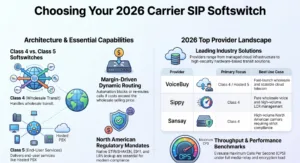
Feature Comparison Matrix
| Provider | Primary Class Focus | STIR/SHAKEN Support | Deployment Model | Ideal Use Case |
| VoiceBuy | Class 4 / Hosted Class 5 | Integrated Support | Managed Cloud | Fast-Launch Wholesale & Scalable Cloud Telecom |
| Sippy | Class 4 | Supported via Integration | Cloud & On-Premise | Wholesale Voice & LCR Management |
| PortaOne | Class 4 / Class 5 | Native Integration | Cloud & On-Premise | Converged Carrier Services & Billing |
| Sansay | Class 4 | Advanced Native | Cloud, Virtualized & Bare-Metal | High-Volume North American Carrier Traffic |
| NetSapiens | Class 5 / UCaaS | Native Integration | Hosted Cloud | Hosted PBX & Business Communications |
Key Buyer Questions Before Selecting a Softswitch Vendor
When submitting Requests for Proposals (RFPs) to softswitch vendors, technical evaluation teams should insist on clear answers to the following operational questions:
-
Throughput Benchmarks: What is the maximum tested Calls Per Second (CPS) and Concurrent Calls (CC) under full media-relay and encryption (TLS/SRTP) load?
-
STIR/SHAKEN & Regulatory Tooling: Does the platform feature native STI-AS / STI-VS authentication engines, or does it rely entirely on third-party API integrations?
-
Database Architecture & Replication: How does the platform handle real-time CDR writing and database failover during a node failure in an active-active setup?
-
Automated Fraud Containment: Can the platform automatically kill active sessions dynamically if suspicious call duration patterns or velocity spikes are detected?
-
API Coverage: Is 100% of the platform’s administrative and billing functionality accessible via documented RESTful APIs?
Conclusion & Strategic Recommendations
Selecting the right SIP softswitch in 2026 requires balancing raw performance against long-term operational adaptability:
-
For fast-scaling or cloud-first operations: Managed cloud architectures like VoiceBuy eliminate infrastructure overhead while enabling quick entry into wholesale and MVNO services.
-
For pure high-volume wholesale voice: Focus on high-CPS platforms like Sippy or Sansay with proven dynamic routing engines.
-
For North American operations: Prioritize solutions with native STIR/SHAKEN, LRN, and E911 capabilities to avoid compliance penalties and high carrier surcharge fees.
Last edit: September 10, 2026 - 12:21 by ENG. Hisham Mohamed
Eng. Hisham Mohamed is a telecommunications specialist with over 8 years of experience in VoIP, SIP termination, telecom infrastructure, voice services, and modern communication solutions. He is also a professional technical writer covering telecommunications, VoIP, cloud communication, and digital transformation.

Written by
ENG. Hisham Mohamed
Eng. Hisham Mohamed is a telecommunications specialist with over 8 years of experience in VoIP, SIP termination, telecom infrastructure, voice services, and modern communication solutions. He is also a professional technical writer covering telecommunications, VoIP, cloud communication, and digital transformation.