
Wholesale VoIP Routes 2026: A-Z & Premium Routes
Exploring wholesale VoIP routes? See our wholesale VoIP routes page for live rates and details.
Last updated: September 2026
Every failed call is a direct hit to your bottom line and customer trust. In today’s hyper-connected landscape, telecom operators, Internet Telephony Service Providers (ITSPs), call centers, CPaaS platforms, and wholesale carriers rely on wholesale VoIP routes to terminate millions of international minutes daily.
Sourcing wholesale routes is not just about finding the lowest rate card. A route that seems incredibly cheap on paper quickly becomes expensive when plagued by poor voice quality, high post-dial delay (PDD), low answer-seizure ratios (ASR), or billing fraud. In wholesale voice, true profitability depends on a calculated balance of cost, quality, and routing intelligence.
This guide breaks down how wholesale VoIP routes work, the critical technical differences between route types (CLI, Non-CLI, CC), the metrics you must track to protect your margins, and how to build a resilient, fraud-resistant voice infrastructure.
TL;DR
-
The Core Concept: Wholesale VoIP routes are high-capacity digital pathways carrying bulk voice traffic between global carrier networks.
-
The Classifications: Routes are divided into CLI (passes caller ID), Non-CLI (hides caller ID), and CC (designed for prepaid calling cards).
-
Quality Matters: True route value is measured by technical KPIs like ASR, ACD, and MOS—not just price per minute.
-
Margin Protection: Guarding against False Answer Supervision (FAS), auditing billing increments (like 1/1 billing), and active fraud prevention are essential to keeping your operations profitable.
1. What Are Wholesale VoIP Routes?
Wholesale VoIP routes are digital trunk pathways that allow telecommunication providers to terminate voice calls internationally using Internet Protocol (IP) instead of traditional Public Switched Telephone Networks (PSTN).
Rather than building direct physical interconnections with thousands of local operators globally, businesses buy access to wholesale routes from specialized carriers. These carriers maintain the global infrastructure and interconnects required to hand off calls to mobile operators, landline networks, and international gateways.
Quick Comparison: Wholesale VoIP vs. Retail VoIP
-
Retail VoIP: Designed for end-users or standard businesses running a limited number of concurrent calls.
-
Wholesale VoIP: Engineered at carrier scale to handle massive, concurrent traffic volumes. Wholesale rates typically run between $0.003 and $0.01 per minute—3 to 10 times cheaper than retail—provided the buyer can deliver high-volume, consistent traffic.
2. Route Classifications: CLI, Non-CLI, and CC
The route type you select determines your call completion rates, regulatory compliance, and cost structure.
CLI Routes (Calling Line Identification)
-
What they are: These routes preserve and transmit the caller’s actual phone number to the receiving party.
-
Best for: Outbound contact centers, sales teams, and customer support desks where trust and callback rates are critical.
-
The Verdict: While CLI routes carry a higher price per minute, their superior call-answer rates make them the most cost-effective option for legitimate business operations.
Non-CLI Routes
-
What they are: These routes do not transmit the caller’s identity. The recipient’s screen displays “Unknown,” “Private Number,” or an unassigned local number.
-
Best for: Automated, one-way notifications, high-volume blast alerts, and applications where immediate interactive dialogue is not required.
-
The Verdict: Non-CLI routes offer rock-bottom pricing but carry a high risk of being blocked by local carriers, resulting in lower overall connection rates.
CC Routes (Calling Card Routes)
-
What they are: Specifically engineered to handle the complex, multi-leg signaling of prepaid calling cards.
-
Best for: Providers targeting markets with high calling card usage across parts of Africa, South Asia, and Latin America.
-
The Verdict: These routes are optimized to manage PIN inputs, long connection delays, and automated IVR interactions without dropping the line prematurely.
3. Five Technical Quality Metrics Every Buyer Must Track
Route quality is invisible on a standard rate sheet. To know if a wholesale VoIP route is worth the investment, you must continuously monitor five core performance indicators:
-
Answer Seizure Ratio (ASR): The percentage of call attempts that successfully connect. For premium CLI routes, target an ASR between 60% and 80%. A dropping ASR indicates network congestion or failing route infrastructure.
-
Average Call Duration (ACD): Tracks how long connected calls actually last. A healthy, stable ACD (typically above 90 seconds) indicates clear audio and genuine connections. A sudden drop in ACD suggests callers are hanging up due to poor audio or dropped lines.
-
Post-Dial Delay (PDD): The silent gap in seconds between hitting “Call” and hearing the first ring. High-quality routes keep PDD below 4 to 5 seconds. PDD exceeding 6–8 seconds frustrates callers, causing them to hang up before the call ever completes.
-
Mean Opinion Score (MOS): A standard rating from 1 (unusable) to 5 (excellent) measuring overall audio clarity. Professional voice networks prioritize routes with a MOS of 4.0 or higher, keeping packet loss, latency, and jitter within strict parameters.
-
False Answer Supervision (FAS): A billing fraud practice where a route starts charging for a call before the recipient actually answers (such as billing during the ringing phase). Insisting on FAS-free routes is non-negotiable for margin protection.
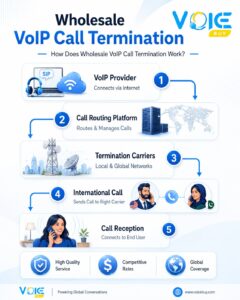
4. How Wholesale VoIP Call Termination Works
Understanding how voice packets travel allows you to diagnose technical bottlenecks quickly and hold your carrier accountable:
Call Origination ──> Security (SBC / Softswitch) ──> Intelligent Routing ──> Local Termination
-
Origination: A call is placed from an IP phone or PBX system, converting voice into IP packets using standard codecs (like G.711, G.729, or Opus).
-
SBC & Softswitch Processing: The call passes through a Session Border Controller (SBC) for security, NAT traversal, and firewall protection, before reaching the Softswitch—the brain of the carrier network—for authorization and routing instructions.
-
Intelligent Route Selection: The routing engine evaluates available carriers in real time using rules like Least Cost Routing (LCR) or quality-based criteria to select the optimal pathway.
-
Local Termination: The selected wholesale carrier hands the call off to the destination carrier (landline or mobile operator) in the target country to complete the connection.
5. Wholesale VoIP Best Practices: Protecting Margins and Quality
Optimizing your voice operations requires combining quality route sourcing with smart routing configurations inside your network.
-
Implement Dynamic Least Cost Routing (LCR): An LCR engine automatically directs outbound calls to the lowest-cost carrier that still meets your predefined quality thresholds. This dynamic balancing can cut your termination costs by 20% to 35% without degrading call quality.
-
Diversify Your Carrier Portfolio: Relying on a single carrier creates a single point of failure. Maintain primary, secondary, and tertiary routes for every high-volume destination. If a primary route’s ASR drops, your system should automatically failover to an alternative link.
-
Audit Your Billing Increments: Pay close attention to how your carriers bill. 1/1 billing (per-second billing) is highly cost-effective, particularly for short calls. Standard billing increments like 6/6, 30/6, or 60/60 can add substantial hidden costs to your monthly invoice.
-
Active Fraud Monitoring: Secure your network with strict rate limits, IP authentication, and automated alarms. Unsecured SIP networks are highly vulnerable to International Revenue Share Fraud (IRSF), toll fraud, and unauthorized trunk registration attacks.
6. How to Choose a Wholesale VoIP Carrier
Many entities selling wholesale VoIP routes are resellers marking up capacities they do not own. When quality drops on a resold route, the reseller cannot fix it directly; they must open a ticket with their upstream provider while your business suffers.
-
Verify Network Ownership: Ask directly if they operate their own network infrastructure, have direct Tier-1 interconnects, and run a 24/7 Network Operations Center (NOC).
-
Demand Written FAS-Free Guarantees: Ensure your Service Level Agreement (SLA) explicitly states you will only be billed for successfully connected, human-answered calls.
-
Ensure Regulatory Compliance: If you terminate traffic in highly regulated regions like North America or Europe, verify that your carrier is compliant with STIR/SHAKEN standards to prevent your legitimate business calls from being flagged as spam.
Compare VoiceBuy Wholesale VoIP Routes
| Feature | Wholesale Standard Route | Mix Route | Wholesale Premium Route | Wholesale Premium Plus Route |
|---|---|---|---|---|
| Best For | Businesses looking for balanced quality and cost | Providers needing flexibility between price and quality | Companies requiring higher call quality and reliability | Enterprises and carriers requiring maximum performance |
| Route Quality | Good quality with competitive performance | Balanced quality using multiple routing options | High-quality routes optimized for better call completion | Highest quality routing with premium carrier selection |
| Pricing Level | Cost-effective | Medium pricing with optimized value | Higher than standard due to improved quality | Premium pricing for mission-critical communication |
| Call Quality | Reliable voice quality for everyday traffic | Better flexibility based on destination requirements | Excellent voice clarity and stability | Maximum voice quality and consistency |
| Routing Strategy | Standard wholesale routing | Intelligent combination of multiple route types | Premium optimized routing | Advanced premium routing with priority quality selection |
| ASR Performance | Good | Improved depending on destination | High | Very High |
| ACD Performance | Suitable for normal business traffic | Better optimization for different traffic types | Strong performance for professional communication | Designed for high-value traffic |
| Latency | Low to moderate | Optimized based on selected routes | Lower latency connections | Lowest possible latency through premium routing |
| CLI Support | Available depending on destination | Available with route selection flexibility | Strong CLI capabilities | Advanced CLI quality and reliability |
| Best Use Cases | Small & medium VoIP providers, resellers, general business traffic | Wholesale providers managing different customer needs | Enterprises, contact centers, professional VoIP providers | Carriers, large enterprises, high-volume communication platforms |
| International Coverage | Wide destination coverage | Wide coverage with route flexibility | Premium global destinations | Premium global destinations requiring highest stability |
| Scalability | Suitable for growing businesses | Highly flexible for different traffic volumes | Designed for scaling professional VoIP operations | Built for carrier-level traffic requirements |
| Recommended Customers | Startups, SMB VoIP companies | MSPs, resellers, growing telecom providers | Established VoIP providers and enterprises | Telecom operators and large-scale communication platforms |
| Main Advantage | Best balance between cost and performance | Maximum flexibility and optimization | Better quality and customer experience | Highest reliability and premium voice performance |
Which VoiceBuy Route Should You Choose?
| Business Requirement | Recommended Route |
|---|---|
| Starting a VoIP business with controlled costs | Wholesale Standard Route |
| Need a balance between price and quality | Mix Route |
| Serving enterprise customers and contact centers | Wholesale Premium Route |
| Operating as a carrier or high-volume provider | Wholesale Premium Plus Route |
Quick Summary
Wholesale Standard Route
Best option for companies that need reliable wholesale VoIP connectivity while maintaining competitive operating costs. It is suitable for general voice traffic, resellers, and businesses entering the VoIP market.
Mix Route
A flexible solution for providers that need to balance different traffic requirements. It allows businesses to optimize costs while maintaining acceptable call quality across multiple destinations.
Wholesale Premium Route
Designed for companies where voice quality directly affects customer satisfaction. Ideal for enterprises, contact centers, and professional VoIP providers requiring stronger performance.
Wholesale Premium Plus Route
The highest-level option for organizations that cannot compromise on voice quality. Designed for carriers, large VoIP operators, and businesses handling critical communication traffic.
How VoiceBuy Delivers
At VoiceBuy, we eliminate the guesswork from wholesale telecom. As a trusted wholesale VoIP and SIP trunking provider, we give you direct, real-time access to high-capacity routes with full rate deck transparency. Our developer-friendly API and robust customer portal allow you to download rate decks, monitor live Call Detail Records (CDRs), and choose precise billing increments (including 1/1 billing) that align with your volume. Backed by proactive anti-fraud controls and automated failover routing, VoiceBuy ensures your voice traffic stays clear, secure, and highly profitable.
Compare VoiceBuy route tiers
Choose the quality tier that fits your traffic mix: Standard VoIP routes for lowest-cost termination, Premium VoIP routes for balanced ASR and quality, Premium+ VoIP routes for maximum ASR with full CLI transparency, or Mix routes to blend all three tiers in one SIP trunk.
7. Frequently Asked Questions (FAQs)
Compare VoiceBuy route tiers
Choose the quality tier that fits your traffic mix: Standard VoIP routes for lowest-cost termination, Premium VoIP routes for balanced ASR and quality, Premium+ VoIP routes for maximum ASR with full CLI transparency, or Mix routes to blend all three tiers in one SIP trunk.
Q: What is the main difference between CLI and Non-CLI routes?
-
A: CLI routes transmit the caller’s actual phone number to the recipient, ensuring high call-answer rates. Non-CLI routes hide or randomize the caller ID; they are cheaper but yield much lower connection rates and are subject to local carrier filtering.
Q: How does 1/1 billing save money compared to 60/60 billing?
-
A: With 1/1 billing, you are billed for the exact seconds of the call (e.g., a 4-second call costs exactly 4 seconds). With 60/60 billing, any call lasting even 1 second is rounded up and billed as a full minute, which drastically inflates costs for outbound call centers.
Q: What is FAS and how do I prevent it?
-
A: False Answer Supervision (FAS) is a type of billing fraud where a provider charges you for call duration while the phone is still ringing or before a real connection is made. You can prevent this by working with reputable, Tier-1 aligned carriers like VoiceBuy who guarantee FAS-free termination in writing.
Last edit: September 10, 2026 - 13:26 by ENG. Hisham Mohamed
Eng. Hisham Mohamed is a telecommunications specialist with over 8 years of experience in VoIP, SIP termination, telecom infrastructure, voice services, and modern communication solutions. He is also a professional technical writer covering telecommunications, VoIP, cloud communication, and digital transformation.

Written by
ENG. Hisham Mohamed
Eng. Hisham Mohamed is a telecommunications specialist with over 8 years of experience in VoIP, SIP termination, telecom infrastructure, voice services, and modern communication solutions. He is also a professional technical writer covering telecommunications, VoIP, cloud communication, and digital transformation.